Every hand-carved sofa, armchair and dining chair that leaves our workshop begins as a stack of seasoned hardwood, and the first decision on a classic commission is not the fabric or the finish but which wood that stack should be. Two species do almost all of the work: teak, which the workshop knows as sagwan, and sheesham, the Indian rosewood. They look alike once gilded or lacquered. They do not behave alike.
Why the frame decides more than the finish
On a fully upholstered modern sofa the frame is invisible, and a well-built engineered carcass (we use HDMR board or hardwood plywood there) is the sensible choice. Classic furniture is different: the frame is the furniture. The crest rail, the scrolled arms, the apron and the cabriole legs are all show-wood, carved by hand and then finished, and the upholstery sits inside them. That puts three demands on the timber that a hidden carcass never faces. It has to carry fine carving without crumbling at the edges. It has to stay dimensionally stable for decades, so that neither the joints nor the finish open up. And it has to be dense enough to feel substantial when you lift the arm.
It is worth saying plainly: once a piece is gilded or lacquered in ivory, nobody can see which wood is underneath. The choice is about structure, carving and climate, not colour. Only a natural polished finish shows the grain, and there the two woods look very different.
Teak (sagwan): the stable one
Tectona grandis. Golden to medium brown, mostly straight-grained, with a faintly oily feel to a freshly planed surface. That oiliness is the point. Teak carries a high natural oil and silica content that makes it exceptionally resistant to moisture, insects and decay, and it is among the most dimensionally stable hardwoods in common use: it moves very little as humidity changes, which is why it has been the wood of ship decks and garden benches for two centuries.
At roughly 650 kg per cubic metre, with a Janka hardness of around 1,070 lbf, teak is a medium-density hardwood: solid, but not heavy. It carves cleanly, although the silica blunts chisels quickly and the very finest detail tends to come out with slightly softer edges than the same pattern cut in rosewood.
Where we specify it: large structural frames, anything for a coastal villa or a room that opens onto a terrace, pieces in homes that stand empty with the air conditioning off for the summer, and any piece the client wants polished natural, where teak's honey tone suits a lighter, more relaxed classic scheme.
Sheesham (Indian rosewood): the carver's wood
Dalbergia sissoo. Deeper in colour than teak, from golden brown to a rich reddish brown with darker streaks, with an interlocked grain that takes a high polish. It is denser and harder, at around 770 kg per cubic metre and a Janka hardness near 1,660 lbf, which is why a sheesham sofa is noticeably heavier than the same design in teak.
That density is what carvers like. Acanthus leaves, C-scrolls, shell crestings and the beading along an apron come out crisp and hold their edges, and the surface can be brought to a deep lustre under a polished finish. Sheesham is naturally resistant to termites, but it carries less oil than teak and is less forgiving of poor seasoning: a frame cut from timber that was not properly kiln-dried will move, and on a carved piece movement shows first as hairline cracks in the gesso beneath a gilt finish.
Where we specify it: the most intricately carved pieces, dining chairs and sofas that will see daily use, and anything to be polished dark, where the figure of rosewood is the whole point.
Side by side
- Stability in changing humidity: teak, clearly. Sheesham is stable when properly seasoned and sealed.
- Weight and density: sheesham is roughly 15–20% denser. Heavier to move; more solid in the hand.
- Carving detail: sheesham holds finer edges. Teak carves cleanly but wears tools and softens the very finest lines.
- Moisture and insect resistance: teak, by a wide margin, thanks to its natural oils. Both resist termites.
- Natural-finish appearance: teak is honey-gold and calm; rosewood is darker, richer and more figured.
- Under gilt or lacquer: indistinguishable to the eye. The choice is structural.
- Cost: teak is generally the more expensive timber in this region, but on a carved sofa the wood is a minority of the price. Carving hours dominate.
What Dubai does to a wooden frame
Dubai is harder on solid wood than its reputation suggests. Inside an air-conditioned villa the relative humidity sits around 40–60%; step outside in August and it can exceed 80%. The trouble is not either condition but the swing between them: a delivery van, a garage, a house left with the AC off for six weeks in summer, a majlis whose doors stand open to the garden every evening. Wood takes on and gives up moisture with its surroundings and moves across the grain as it does so. In a carved frame that movement shows up as a loose joint, a crazed finish or a creak.
The defence is the same regardless of species. Timber must be kiln-dried to a moisture content that matches an air-conditioned interior, roughly 8–10%, then allowed to acclimatise in the workshop before it is cut. Every joint is mortise-and-tenon or dowelled and glued, with corner blocks behind the seat rails, so that the frame is rigid without relying on fasteners. And every surface, including the hidden ones inside the upholstery, is sealed so that moisture cannot get in from the back. Teak tolerates lapses in that process; sheesham punishes them. This is also the most common failure in cheap imported "classic" furniture: green timber, stapled joints and an unsealed frame, hidden under a convincing gilt finish that starts to craze within a year.
How we use each
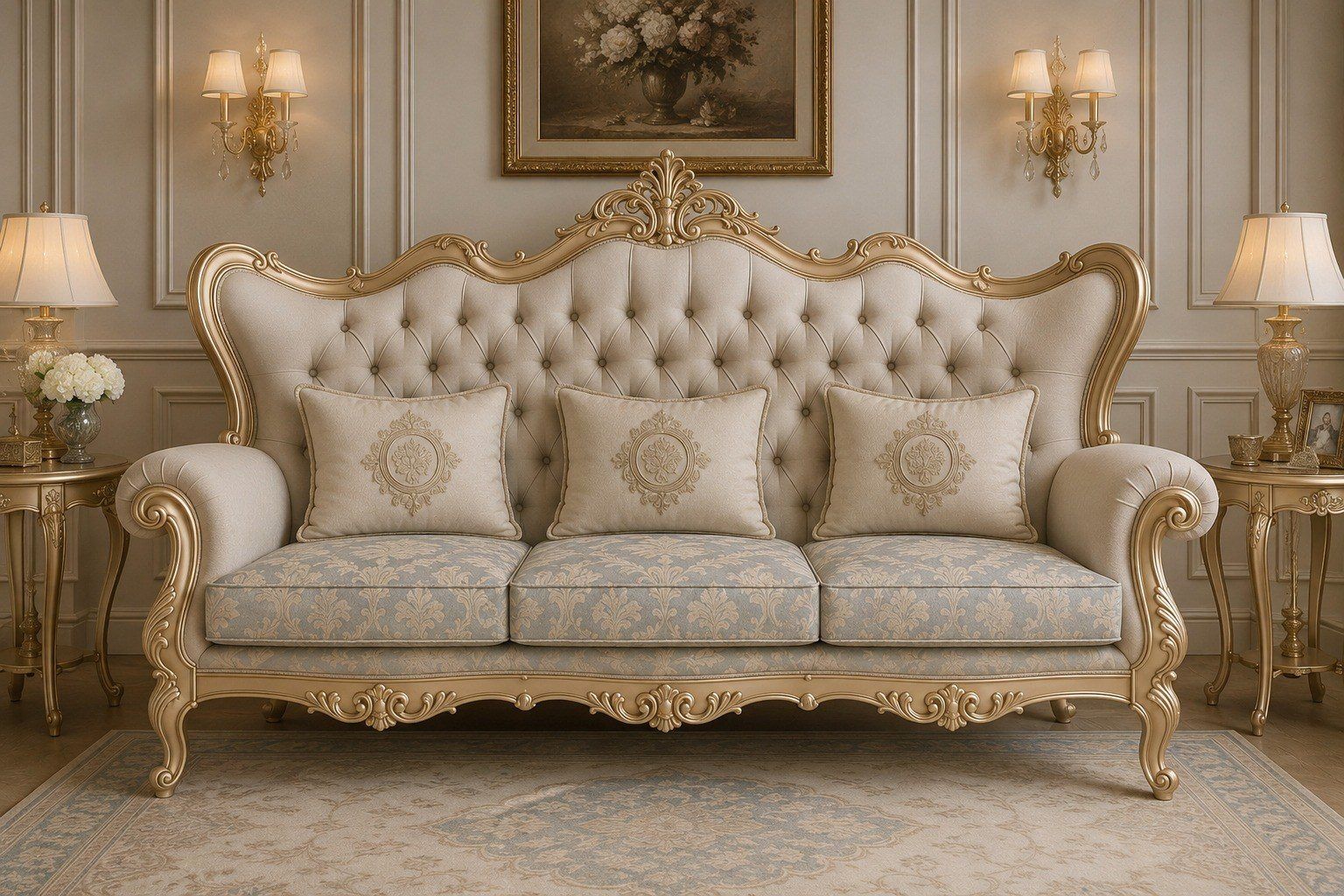
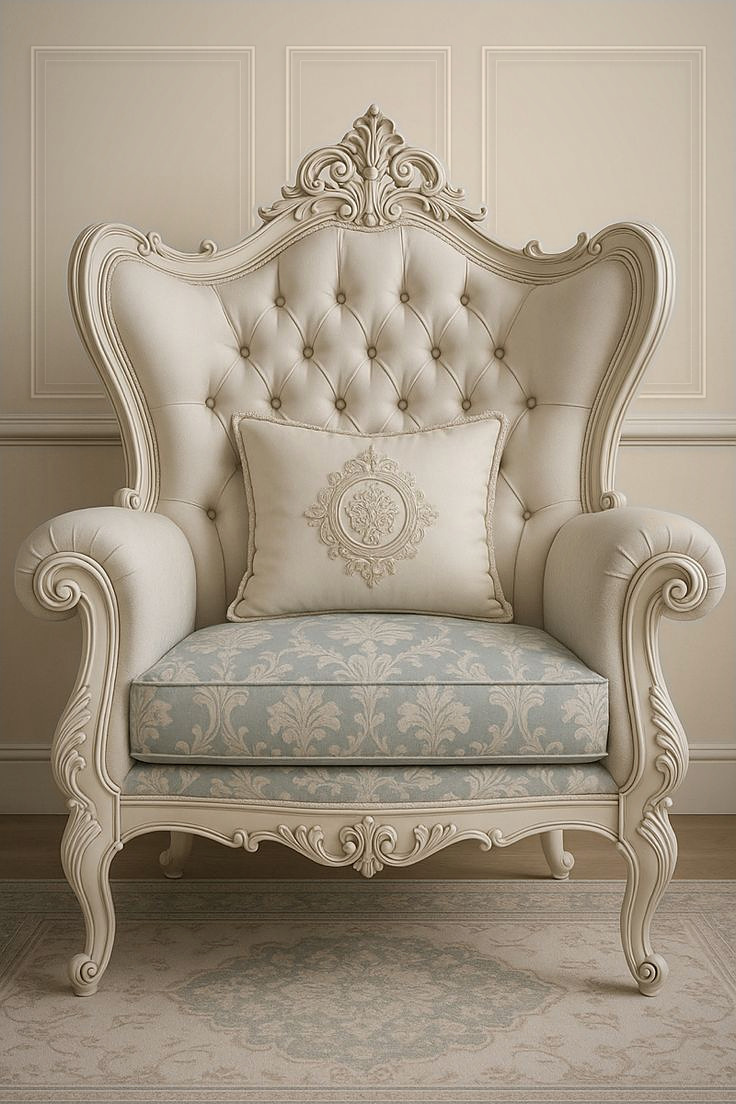
The two pieces photographed here were finished in the same week. The sofa is sheesham: a three-seater with a carved and pierced cresting, scrolled arms and a shaped apron, gilded in champagne and upholstered with a deep-buttoned back. The armchair is teak: a wing-back fauteuil with a tufted back and rolled arms, lacquered in ivory. Both carry the same carving hand and the same family of damask on the seats, and nobody looking at them side by side could tell which wood is which. The choice was made on the drawing board, for the reasons above, before a chisel was picked up.
The rule of thumb we apply: teak where stability and moisture resistance matter most; sheesham where carving depth and weight matter most; engineered board only where it is fully hidden inside a modern upholstered piece, and never for show-wood. Frame, foam grade and fabric are all written on the drawings you sign, so the decision is on paper before it is in the wood. If the piece is to be polished rather than painted, the wood also becomes a colour decision: teak for warm and light, rosewood for deep and formal.
Finishes, and which wood suits which
- Gilt (gold, champagne or silver leaf over gesso): either wood. Sheesham's crisper carving rewards it on very ornate pieces.
- Ivory, white or coloured lacquer: either wood. A calmer classic, common in bedrooms and lighter living rooms.
- Natural polish, open or closed grain: this is where the choice shows. Teak polishes to honey and amber; sheesham to a deep chestnut with dark figure.
- Antiqued or rubbed finishes: either, and both age gracefully, which matters for a piece meant to last thirty years.
Whatever the finish, it is applied in several coats over a sealed and sanded frame, and the fabric goes on last, so that the upholstery never meets a solvent. For the fabrics themselves, our three upholstery collections, Éclat, Nuance and Héritage, were assembled with exactly this kind of piece in mind; this guide covers how to choose between them.
Cost, lead time and how to decide
Per cubic foot, teak usually costs more than sheesham in this market. On a finished carved sofa the difference is small, because most of the price is the carver's and the upholsterer's time rather than the timber. Both woods run on the same schedule: roughly eight to ten weeks from signed drawings to delivery, longer for a full suite with matching dining chairs.
If you want the short version: choose teak for a coastal or terrace-facing room, a home that is closed up in summer, or a light natural polish. Choose sheesham for the most elaborate carving, a dark polished finish, or dining chairs that will be pulled in and out every day. If the piece will be gilded or lacquered and lives in an ordinary air-conditioned living room, either is right, and the decision can follow the carving. Whichever it is, ask any maker two questions before you order: what is the timber's moisture content, and how are the joints made. The answers tell you more than the finish ever will.
See the pieces we build in both woods on the sofas and custom furniture pages, or bring a photograph of a style you like and we will draw it to your dimensions.
Commissioning a classic sofa or armchair?
Send us a photograph or a sketch. We will advise on wood, carving and fabric, and return dimensioned drawings and a fixed quotation before anything is cut.
Book a Consultation