Clients often ask what they are paying for when a carved sofa costs several times what a showroom import does. The honest answer is time: a skilled pair of hands at every stage, and a check at the end of each one. This is what those stages look like inside our workshop in Al Qusais, following one commission from the first drawing to the day it is carried through the client's door.
1. The brief becomes a drawing
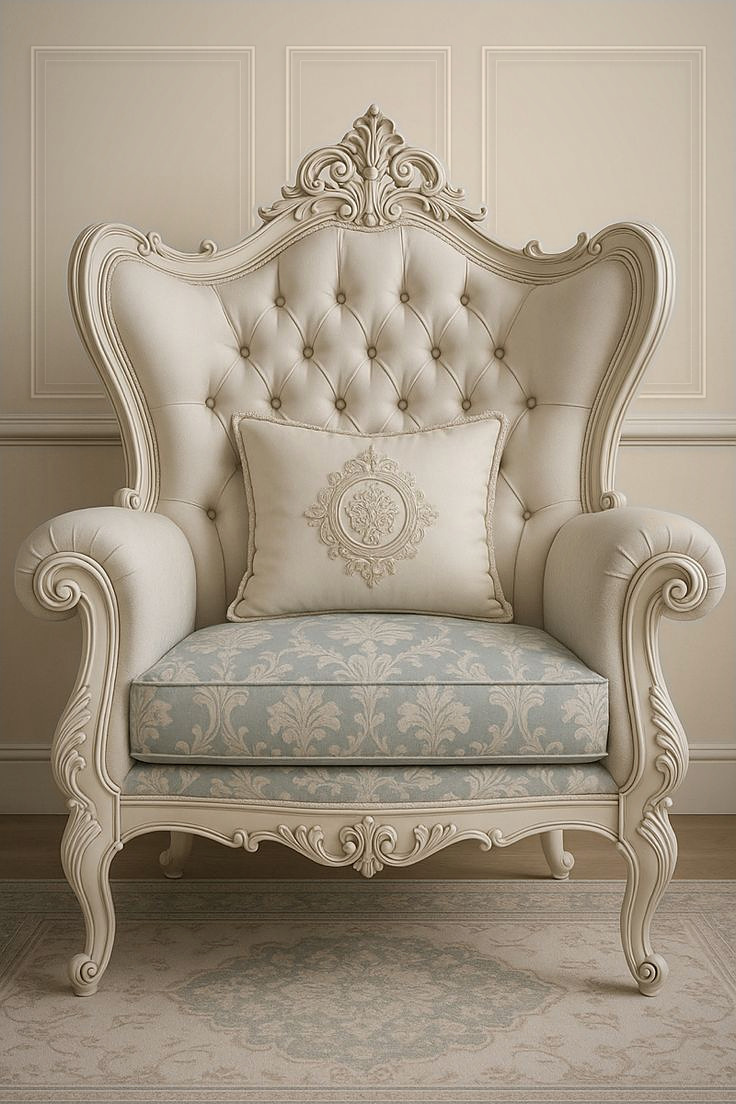
Nothing is cut until it is drawn and signed. A classic commission usually starts with a photograph the client likes, a room plan and a conversation about how the piece will be used: how many people, how formal, how deep a seat, whether it faces a television, a fireplace or a view. From that our designers produce a dimensioned drawing, front and side elevations with overall width, depth and height and the seat and arm heights, plus a 3D view for the proportions. A three-seat sofa for a Dubai villa is typically 2.1–2.3 m wide; a generous two-seater about 1.7 m; a fauteuil around 0.75 m. Every figure is agreed in writing, because a carved frame cannot be trimmed later the way a modern one can. Wood, foam grade and fabric are also fixed on the drawing, so the quotation is for the piece you will actually receive.
2. Timber is selected and seasoned
Show-wood frames are made in solid hardwood only: teak (sagwan) or sheesham, the Indian rosewood, chosen for the reasons set out in our guide to the two woods. Boards are kiln-dried to around 8–10% moisture content, the level that matches an air-conditioned interior, then racked in the workshop to acclimatise before machining. Sections are selected by eye: straight grain for the legs and rails that carry load, figured stock reserved for the crestings and aprons that will be seen. Engineered boards have a place in fully upholstered modern furniture, where we use HDMR or hardwood plywood carcasses. They have none in a carved frame.
3. The frame is joined, not stapled
The frame is cut, then joined with mortise-and-tenon and dowelled joints, glued, and reinforced with corner blocks behind the seat rails. It is assembled dry first, checked square and against the drawing, then glued and clamped. The reason we insist on this is simple: a sofa frame is pushed, sat on, leaned against and dragged across marble for decades. Staples and brackets alone work loose; a properly made joint gets tighter as the glue cures. At this stage the frame is also loaded and rocked, which is where any weakness shows itself, long before the upholstery hides it.
4. Carving, by hand
This is the stage that sets the piece apart and consumes the most hours. The carver transfers the pattern onto the blank, roughs out the relief with gouges, then works back to the detail: the acanthus scrolls on the arms, the shell or cartouche at the centre of the cresting, the beading along the apron, the knee and toe of a cabriole leg. On a suite, the same carver cuts every piece so that the motif reads identically across the sofa, the armchairs and the dining chairs. Machine-carved frames can be spotted by their uniformity and shallow relief; the hand-cut version has depth, undercutting and a slight variation that catches light differently on each leaf. Once carved, the frame is sanded through the grits and every surface sealed, including those that will disappear inside the upholstery.
5. Suspension and foam
How a sofa sits is decided here, and it is the part most often done badly. Seats are sprung on a webbed platform or a zig-zag spring unit, and the cushioning is specified by grade rather than by name. We work from a short menu: a standard-density foam for occasional pieces; a high-resilience polyurethane grade for everyday seating, which recovers its shape after years of use; natural and pincore latex, more breathable and resilient still, for clients who want a cooler, more buoyant seat; and a soft top layer over a firmer core when a piece needs a sink-in feel without losing support. Memory foam is available but we rarely recommend it for a sofa: it responds to body heat, so in a Dubai living room it can feel slow and warm. Seat height, depth and the pitch of the back are then tuned on the frame with the client in mind, not to a catalogue figure.
6. Upholstery and deep buttoning
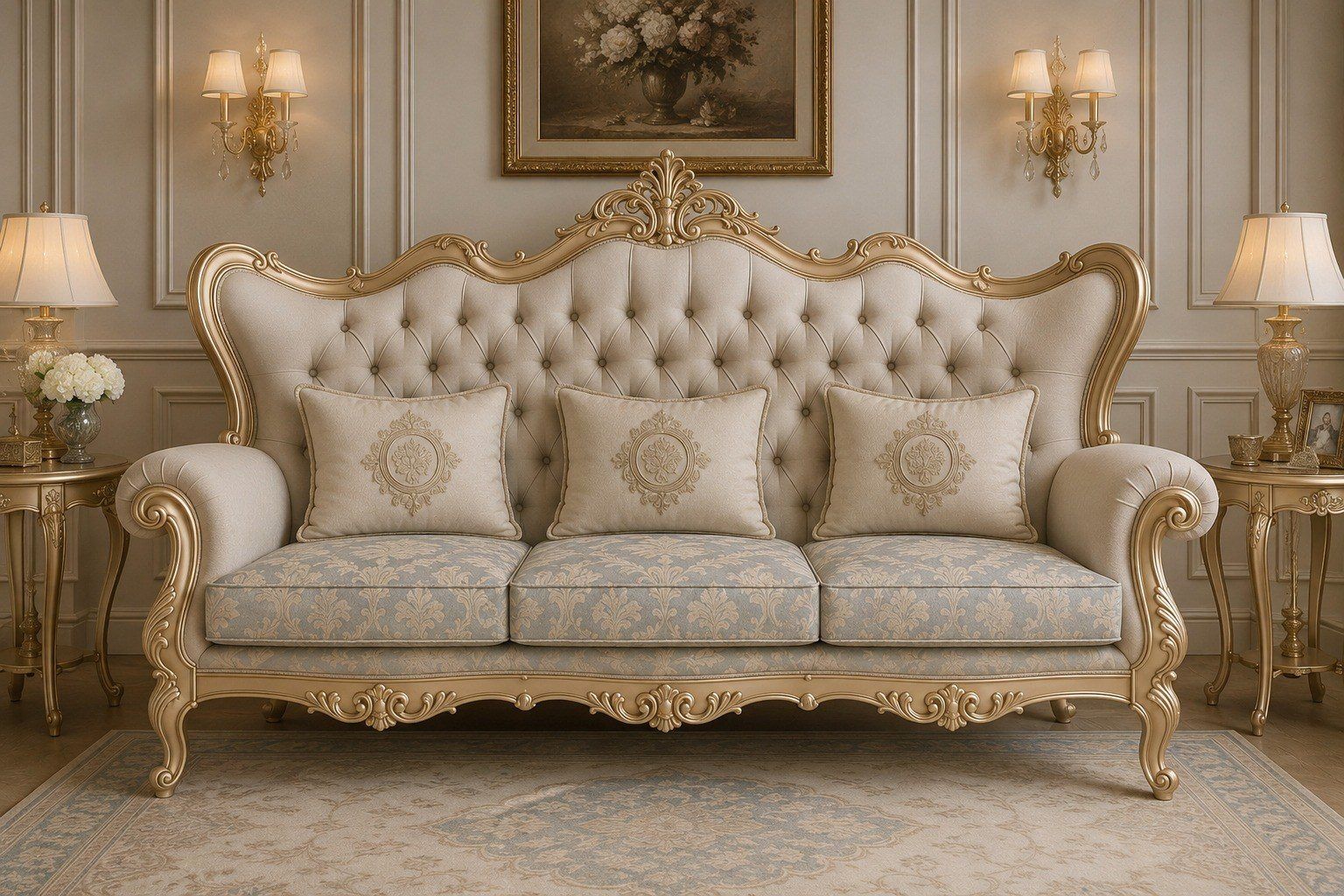
Upholstery starts with the fabric decision, which on a classic piece is usually two fabrics: a plain or textured cloth on the back and arms, and a damask, jacquard or velvet on the seat, as on both pieces photographed here. Patterns are centred and matched across cushions, and a deep-buttoned back is laid out on the frame so that the diamonds are symmetrical about the centre line and every button pulls to the same depth. Piping, gimp and studding follow the carving lines. We upholster in our own collections, Éclat, Nuance and Héritage, or in a client's own material; either way we look for a rub count and light-fastness rating suited to a sunlit Dubai room, which this article explains how to read.
7. The finish
Show-wood is finished before the fabric goes on, so the upholstery never meets a solvent. A gilt finish is built up over coats of gesso, sanded smooth, then leafed or gilded and toned back so that it reads as warm metal rather than paint. Ivory and coloured lacquers are sprayed in several coats over a sealed and filled surface and rubbed down between coats. A natural polish, where the client wants the grain of teak or rosewood to show, is oil or lacquer over a stained and sealed surface. Each is cured fully before the piece moves on. The finish is what the client sees first and what wood movement tests last, so it gets more inspection time than any other stage.
8. Final inspection, delivery and after
Before a piece leaves, it is measured against the signed drawing, sat in, rocked, and inspected under a raking light for finish defects. It travels blanket-wrapped, is carried in and placed by our own team, and is unwrapped in the room. That last point matters more than it sounds: a carved arm damaged by a courier is not repaired in a day. And because the workshop is in Dubai, a loose button, a scuffed foot or a cushion that needs re-filling five years on is a short visit, not a shipping claim.
What "made in Dubai" changes
Most classic furniture sold here is imported finished, which means the buyer never sees the frame, cannot change a dimension, and has no one to call when the gilt crazes. Building in our own workshop, with manufacturing capacity in Dubai and India, changes each of those. The frame is specified and inspected. The drawing is yours to alter before anything is cut. A suite can be matched piece for piece over months as rooms are completed. And aftercare is local. It also removes the importer's and the showroom's margins, which is why a made-to-measure carved piece from us is often close in price to a stock import of similar appearance and rather different construction.
How long, and what decides the price
A carved sofa or armchair takes about eight to ten weeks from signed drawing to delivery; a full living-room suite with matching dining chairs, twelve to fourteen. Price is driven, in order, by carving hours, fabric, foam grade and timber, so a plainer carving in a fine fabric and a highly carved piece in a modest cloth can cost about the same. If you would like a figure for a specific design, send a photograph and your room dimensions; we will return a drawing and a fixed quotation, and the piece will be built exactly to it.
Explore finished work on the sofas page, or read which design style suits your home before you commit to a classic scheme.
Want to see how your piece would be built?
Send a photograph or sketch with your room dimensions. We will return a dimensioned drawing, a wood and fabric recommendation, and a fixed quotation before anything is cut.
Book a Consultation