A sofa bed has two jobs, and most do one of them badly. Either it sits well and sleeps on a steel bar, or it sleeps tolerably and sits like a park bench. In Dubai, where apartments double as guest accommodation during the winter visiting season and holiday homes are expected to sleep every guest the listing promises, getting both right matters more than usual. It comes down to three things: the mechanism, the mattress and the space it needs when open.
The mechanisms, and what each is good for
- Fold-out with a separate mattress. The seat cushions come off and a folded metal frame opens forward, carrying its own mattress on a sprung or slatted deck. The better versions, often called Italian or three-fold mechanisms, are the only type we would suggest for regular sleeping. The cheaper ones use a thin mattress over a canvas sling with a bar across the middle, which is where sofa beds got their reputation.
- Pull-out or trundle. A second mattress rolls out from under the seat, as on a daybed. Simple, robust and comfortable, and it sleeps at a low height, which suits children better than adults.
- Click-clack or futon. The back folds down flat and you sleep on the seat upholstery. Cheap and quick, but you are sleeping on the joins between cushions. Fine for the occasional night.
- Corner or chaise sofa beds. A sectional with a pull-out section and often a storage box under the chaise. Useful in a family room that occasionally becomes a guest room.
The mechanism dictates the sofa, not the other way round: it sets a minimum inside width and seat depth, and the seat has to be built around it. That is why sofa beds usually sit a little firmer and shallower than the equivalent sofa, and why simply adding a mechanism to any sofa you like the look of is not possible.
The mattress is the bed
On a fold-out, the mattress thickness tells you most of what you need to know. Around 6–8 cm is an emergency bed. At 12–14 cm and above, in high-resilience foam, memory foam or a thin pocket-sprung unit, it is a real bed for a week-long visit. Ask for a removable, washable cover and a mattress protector, and open the bed to air it every few weeks: a mattress folded inside a sofa in a sealed, air-conditioned apartment can trap moisture, especially in the humid months.
Sleeping sizes, and what they mean for the sofa
- Single, around 80–90 cm wide: a child or one adult; the sofa will be a compact two-seater or an armchair bed.
- Small double, around 120–140 cm: one adult comfortably, two at a squeeze.
- Queen, 160 cm: a couple, and the size most guests expect.
The sofa will be roughly 30–50 cm wider than the mattress once the arms are added, so a 160 cm sleeper usually means a sofa of about 200–210 cm. If the wall is tight, slimmer arms give you sleeping width without a longer sofa, which is one of the advantages of having the piece drawn rather than bought.
The open length: the measurement everyone forgets
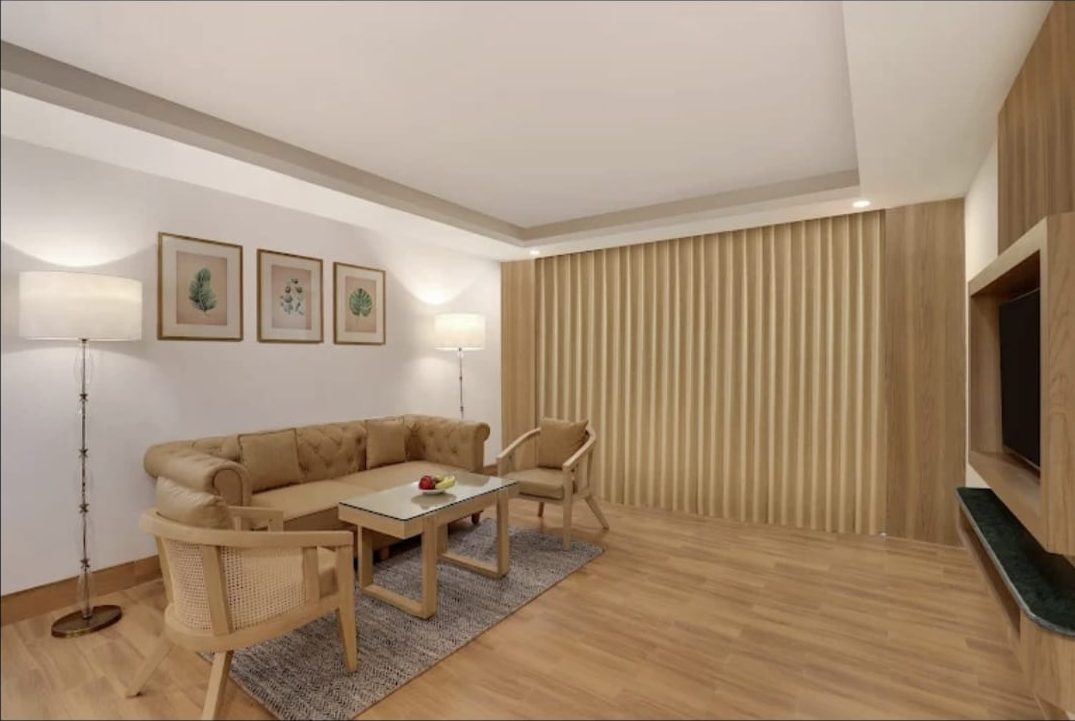
Most fold-out sofa beds need about 210–230 cm from the wall to the foot of the open mattress. Add a walkway of around 60 cm and somewhere for the coffee table to go, and a sofa bed that looks modest when closed can need a room at least 3 m deep to open properly. Before committing, mark the open outline on the floor with masking tape and walk round it. If the coffee table is heavy stone, choose one on castors or a pair of smaller tables that can be lifted aside.
Fabric and frame for rooms that work hard
A sofa bed in a holiday home is opened and closed by strangers every few days; one in a family apartment, a few times a year. Specify accordingly. For holiday lets and guest rooms that see frequent use, choose a mechanism rated for regular cycles, a reinforced frame, and a performance fabric with a high rub count that can be cleaned with water. Our holiday home furnishing guide explains the contract-grade specification guests quietly expect, and if you let a property under a holiday-home permit, check how your permit treats sofa beds before counting one towards the number of guests you advertise.
The alternatives worth considering
- Wall bed with a sofa in front. A proper mattress on a hinged frame folds up into a joinery cabinet, and a slim sofa or bench sits in front of it by day. It is the best answer when a room is slept in most nights, such as a study that is also a nanny's or a relative's room, and it is joinery we build to the wall.
- Daybed. A single bed dressed as a sofa with bolsters and cushions, sometimes with a trundle beneath. Excellent in a study, a children's room or a guest suite or annex.
- A real guest bed. If the room will be used as a bedroom more than a sitting room, give it a proper bed and a pair of armchairs instead. A sofa bed is a compromise, and the compromise should suit the room.
How we approach a sofa bed
We start from the mechanism and the mattress, then draw a sofa around them that looks like a normal sofa: arms slim enough to give sleeping width, a seat built as comfortably as the mechanism allows, and cushions that store easily when the bed is open. The drawing shows the piece closed and open in the room, with the walkway marked, before anything is made. For the sofa dimensions themselves, see how to size a sofa for a Dubai living room, and for the pieces we make, the sofas page.
Need a room to work twice?
Tell us the room size, who will sleep in it and how often. We will suggest a sofa bed, a daybed or a wall bed, draw it in both positions and send a fixed price.
Book a Consultation