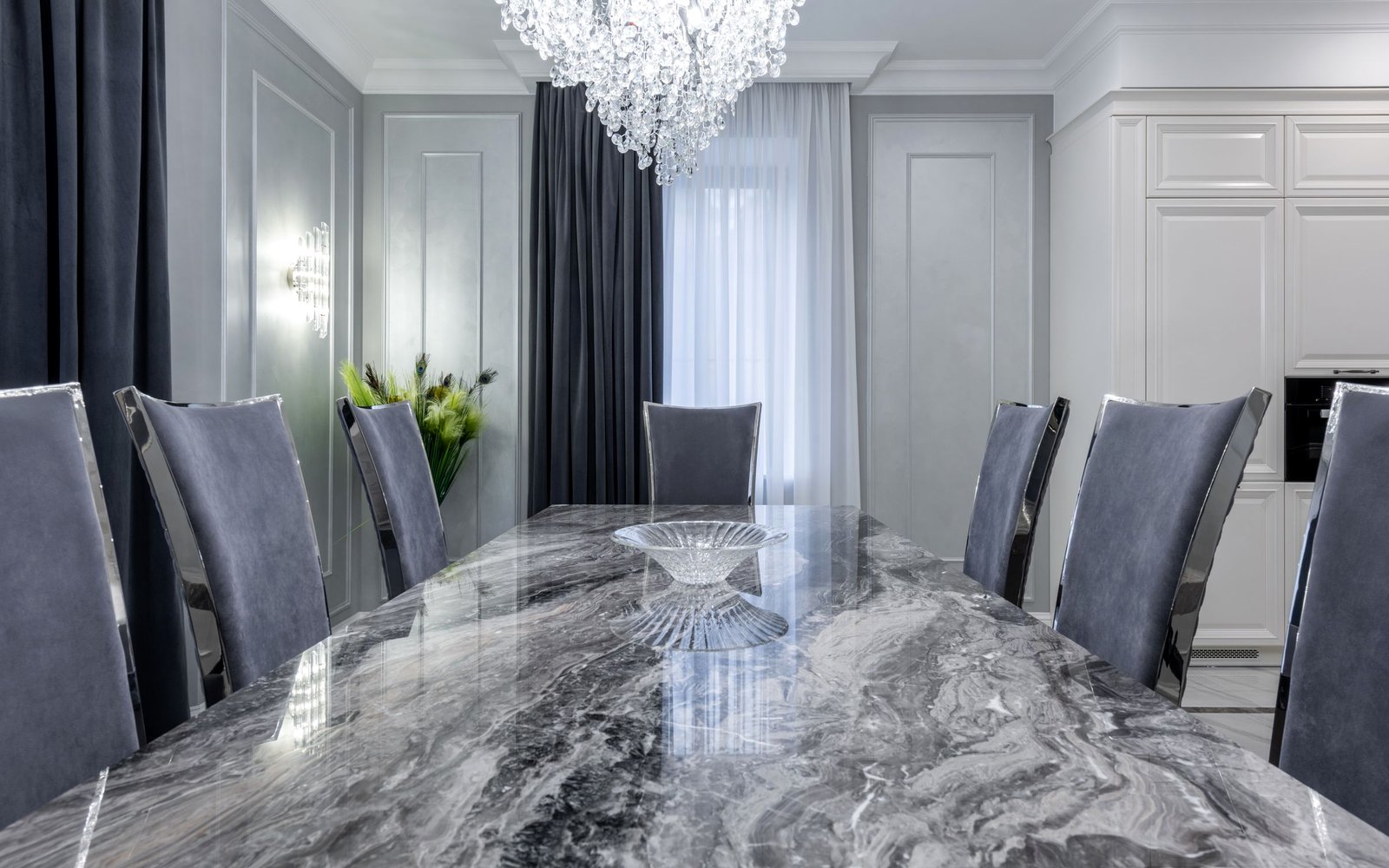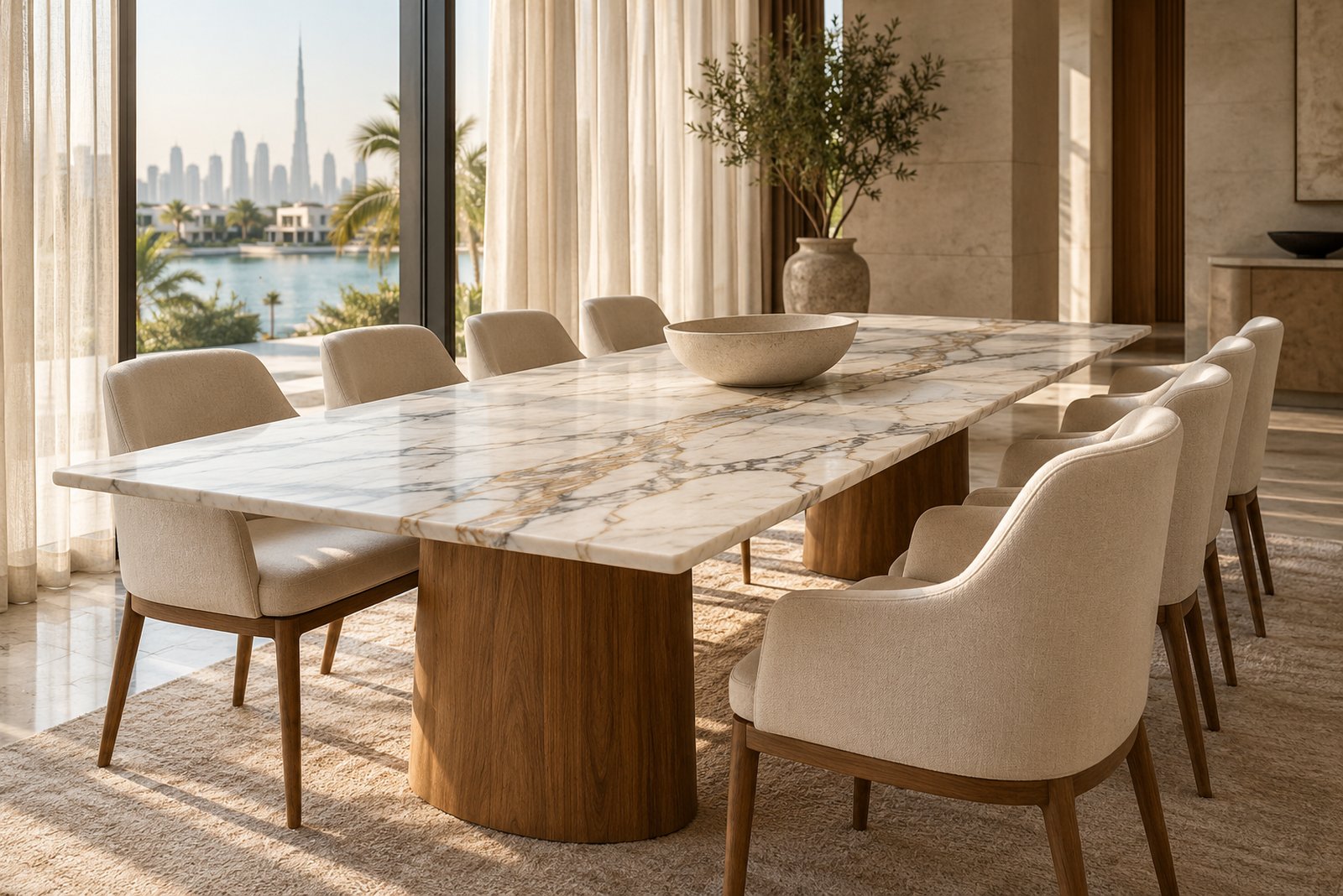
Our guide to marble versus sintered stone helps you decide whether marble is right for your table. This one is for when the answer is yes. Marble is a natural stone and no two slabs are alike, so the choices you make about the stone, its finish and how it is cut change both how the table looks and how it lives with you.
The short answer
For a family table, choose a honed finish in a lighter or busily veined marble that forgives marks, 20 mm thick with a mitred edge for presence without the weight, with the veins running along the length, on a solid teak or sheesham base. Save polished dark marble for tables that see more entertaining than daily meals.
The stones our clients ask about
Carrara. Soft grey veining on a white-grey ground. The most widely available of the Italian whites and the most affordable, and forgiving at the table because its busy veining hides small marks.
Statuario and Calacatta. Brighter white grounds with bolder veins: Statuario in crisp grey, Calacatta often thicker and warmer, with grey and gold. Rarer and priced at the top, they make showpiece tables, and because every slab is different you should choose from photographs of the actual slab, not a sample tile.
Arabescato. Dramatic, swirling grey veins on white. A strong statement for a large room, best with simple chairs.
Crema Marfil and Omani Beige. Warm cream and beige grounds with little veining. Calm, and lovely with teak. Omani Beige, quarried next door in Oman, is technically a dense limestone and is used widely across the Gulf. Pale tones hide dust and crumbs but will show oil or coffee if the stone is not sealed.
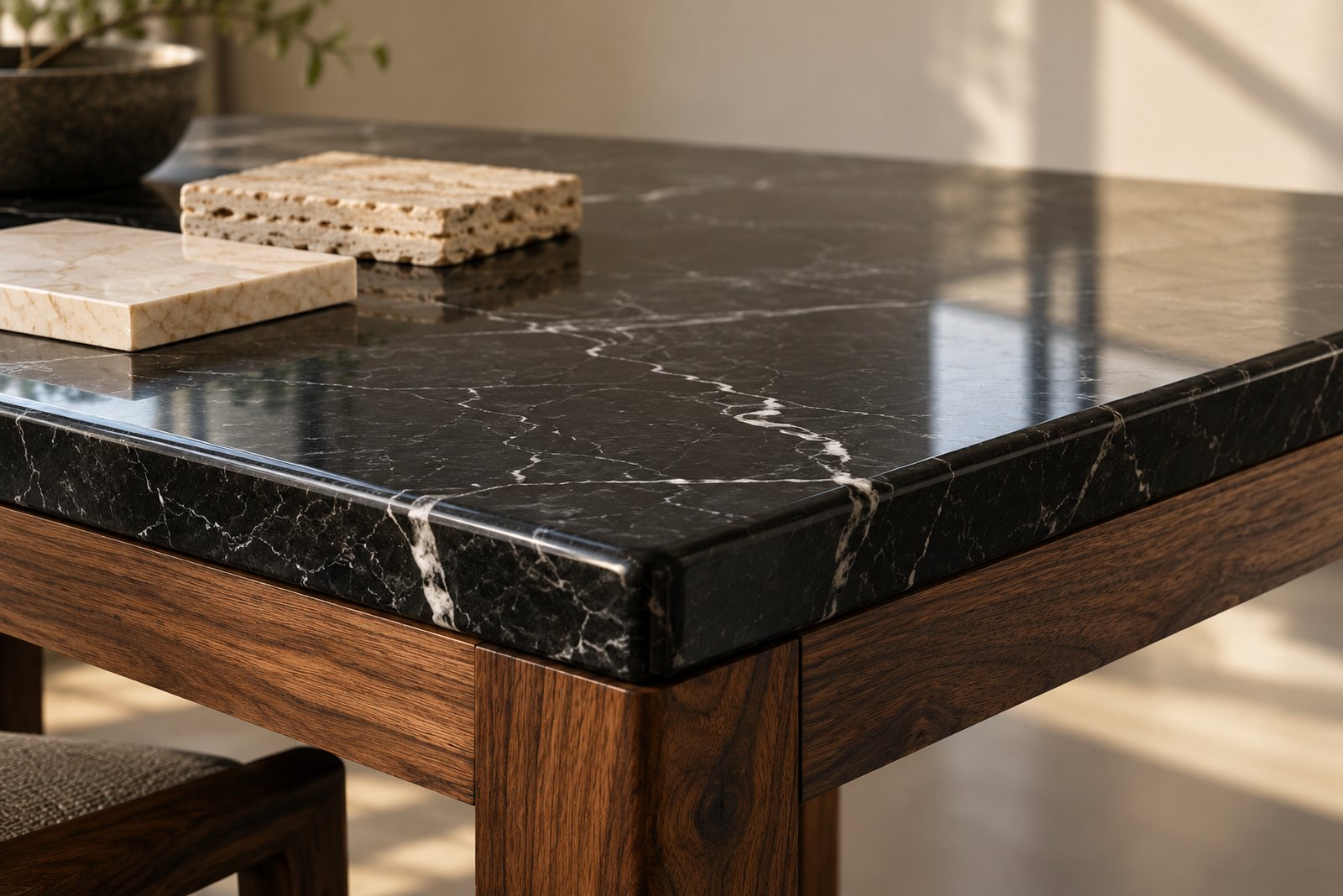
Nero Marquina and Emperador Dark. Black with crisp white veins, and deep chocolate brown with lighter veining, both from Spain. Dramatic and elegant, but on a dark polished stone every etch mark shows as a dull grey spot.
Travertine. Warm and earthy, with natural holes that are usually filled with resin. Honed travertine is fashionable for its soft matt look, but it is more porous than most marbles and needs good sealing.
Green marbles. Stones such as Verde Alpi and Verde Guatemala, deep green with white veining, look superb with brass, though matching several pieces from the same stone takes care.
Polished, honed or leathered
All marble is soft compared with granite or sintered stone, and acids such as lemon, vinegar and wine etch it whatever the finish. The finish decides how much that shows.
- Polished: a mirror gloss with the deepest colour and the most stain-resistant surface, but etch marks show clearly as dull patches, especially on dark stone.
- Honed: a smooth matt or satin surface. Etching blends in, which is why most families prefer it. It is slightly more open, so seal it well.
- Leathered or brushed: a gently textured, low-sheen surface that hides marks and fingerprints best. Crumbs need a brush rather than a cloth. Particularly good on dark stones.
Thickness and edges
Marble weighs about 2,700 kg per cubic metre, so thickness is a decision about weight as much as looks. A 20 mm slab weighs around 54 kg per square metre and is plenty strong when it is well supported. A 30 mm slab weighs around 81 kg per square metre: a 2.4 by 1.0 m top comes to about 130 kg in 20 mm and about 195 kg in 30 mm.
The most popular choice for modern tables is a 20 mm top with a mitred edge: a strip of the same slab is joined at 45 degrees beneath the edge, so the top looks 40 to 80 mm deep with the veins wrapping round the corner, without the weight of a solid block. For the profile itself, an eased or pencil-round edge suits modern rooms, a full bullnose is kindest to knees and least likely to chip, and an ogee belongs on classic tables.
Vein direction and book-matching
Ask for the veins to run along the length of the table: it makes a long table look longer and calmer. Most marble slabs come out of the quarry at around 2.8 to 3.2 metres long, so a longer table needs a joint. The elegant answer is a book-matched pair: two consecutive slabs opened like the pages of a book, so the veins mirror each other across the seam and the joint becomes a feature rather than a flaw.
Because no two slabs are alike, choose from photographs or video of the actual slab, and ask your maker to show you exactly where your top will be cut from it.
The base: wood under stone
A marble top needs a rigid base that spreads its weight without flexing. Solid wood does this beautifully and warms up a cool stone: we build marble tables on solid teak and sheesham pedestals and trestles, with brass details where the design calls for them. Ask how far the top overhangs the base, because long unsupported overhangs are where marble cracks. Our guide to dining table bases explains the options.
Living with marble in Dubai
- Seal the top on delivery and every 6 to 12 months. If a few drops of water darken the stone within minutes, it is time to reseal.
- Wipe up lemon, vinegar, wine and coffee straight away, and use coasters and placemats.
- Clean with a pH-neutral stone cleaner or mild soap and water, never bleach or vinegar.
- Use trivets under hot dishes, and keep the table out of strong direct sun if you can.
A quick checklist
- Stone chosen from photographs of the actual slab
- Honed or leathered for daily use; polished for show
- 20 mm with a mitred edge, or 30 mm if you want a heavier look
- Veins running along the length; book-matched if the table is longer than one slab
- A rigid solid teak or sheesham base, with sensible overhangs
- Sealed on delivery, and a care routine you will actually keep
The bottom line
The right marble is the one that suits how you use the table. For family meals, a honed Carrara, Calacatta or Crema Marfil on a solid wood base will look better every year; for a dining room that is mostly for entertaining, polished Statuario or Nero Marquina brings the drama. Either way, choose the actual slab, run the veins the length of the table and keep it sealed.
Planning a marble dining table?
Tell us the size of the room and how you use the table. We will suggest the stone, finish and base, and send you photographs of the actual slab before it is cut.
Book a Consultation