A dining table is a top and a base, and most of the attention goes to the top. The base does most of the work. It decides who gets legroom, how many chairs fit, whether the table rocks when someone leans on the end, and how a 170 kg marble slab stays where it should. It is also a large part of the price. Here is how to choose one.
The four families of dining table base
Almost every base is a variation on one of four ideas.
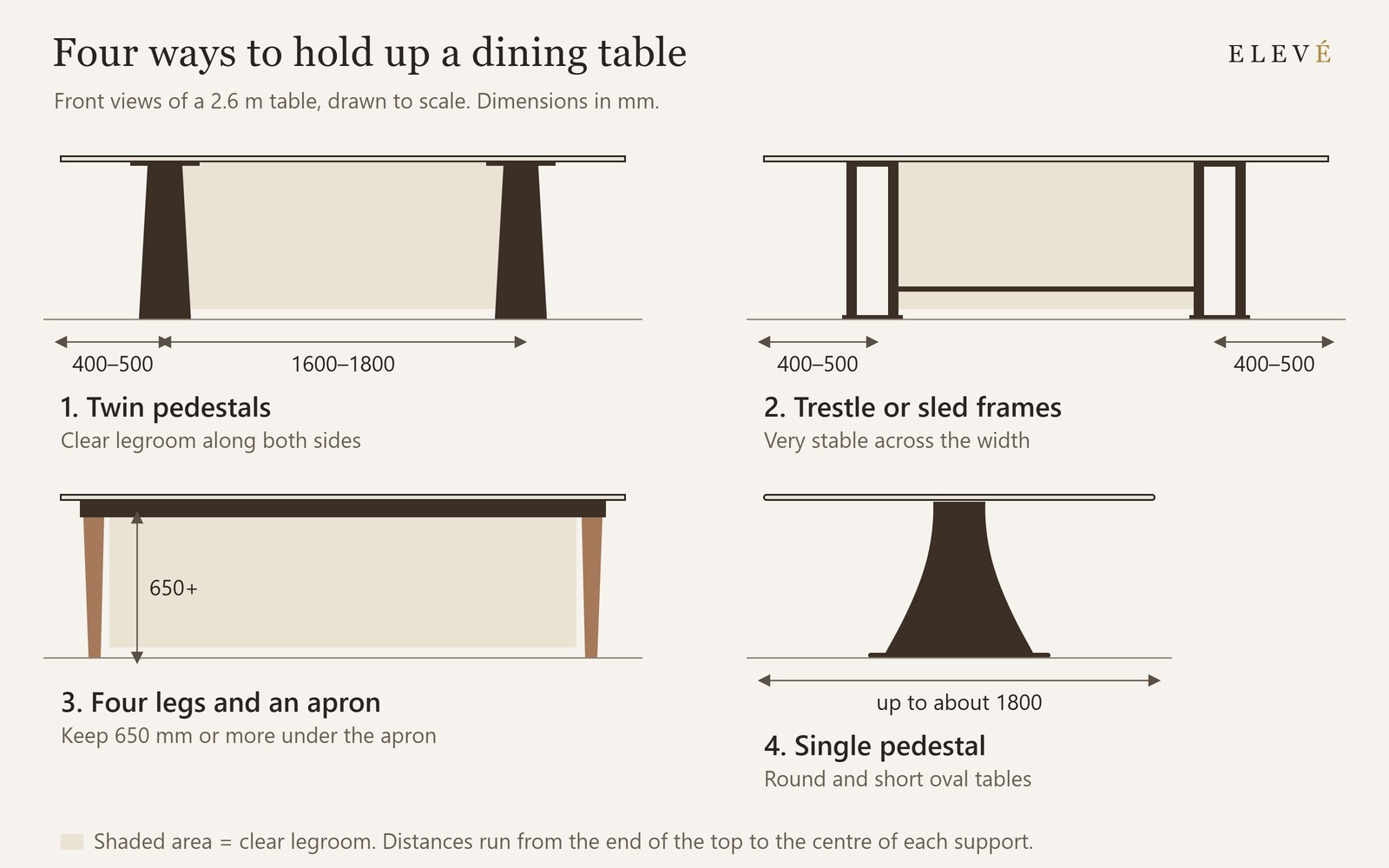
Twin pedestals
Two central supports, such as columns, blades, cones or pill-shaped plinths, set in from each end. Legroom is clear along both long sides and a chair fits at each end. This is the most popular base for stone tops, and the one where stability needs the most care.
Trestle and sled frames
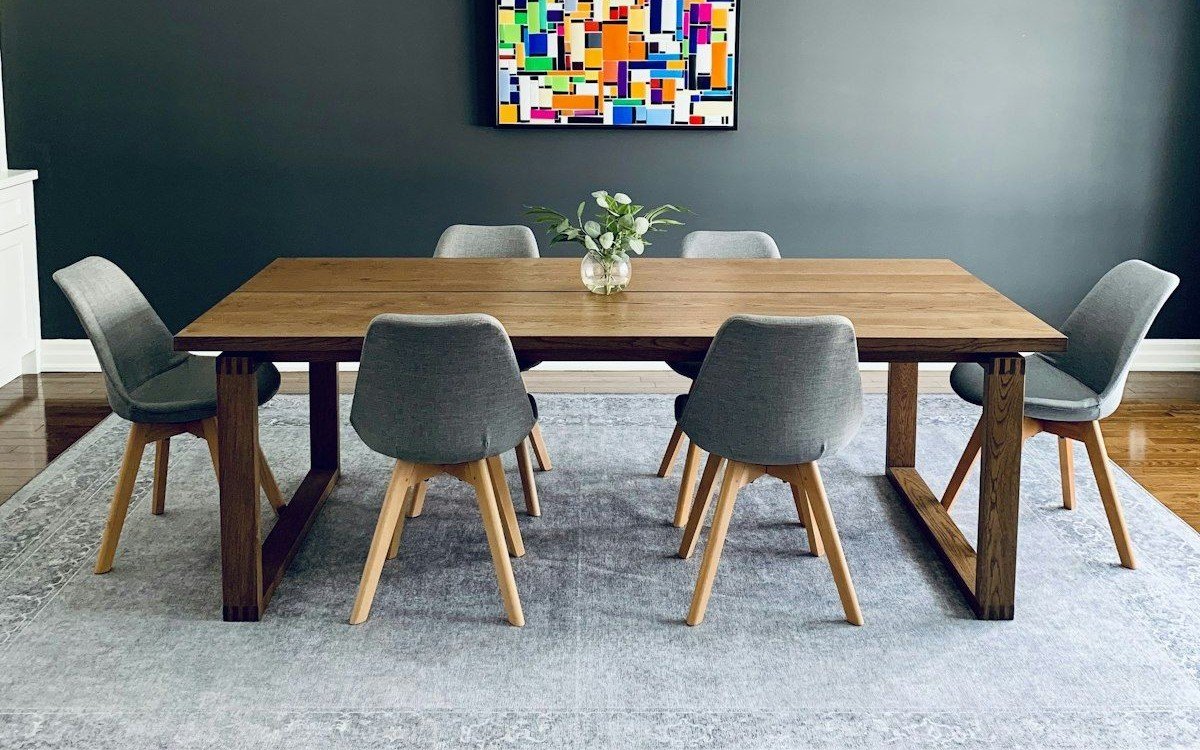
An open frame near each end, often a rectangle of timber or steel, sometimes joined by a stretcher. Very stable across the width and ideal for long wooden tables. Keep any stretcher low, or set it back, so that it does not catch shins.
Four legs and an apron
The classic: a leg at or near each corner, joined by a frame under the top. Simple, strong and timeless on wooden tables up to about 2.4 m. Keep at least 650 mm of clear height under the apron for knees, and set the legs in from the corners if you want a chair at each end.
Single pedestal
One central support, for round, square and short oval tables. Everyone gets legroom, and the table seats more people for its size. Beyond about 1.8 m, move to twin pedestals: a single foot wide enough to keep a bigger top stable starts to get in the way of feet.
Where the supports go
- From the ends: 400–500 mm from the end of the top to the centre of each pedestal or frame lets a chair sit at the end without hitting the support, and keeps the overhang stable.
- Per seat: allow at least 600 mm of table edge per person, and 650–700 mm for comfort or for armchairs. A 2.6 m table seats eight comfortably along the sides, or ten with a chair at each end.
- Knees: keep at least 650 mm from the floor to the underside of any apron or frame, and check that chair arms slide underneath.
- Height: 740–760 mm to the top surface, for chairs with a 450–480 mm seat.
- Long tables: above about 3.5 m, plan a third support in the middle. A 4–4.5 m table for 12–16 usually stands on three pedestals or two long frames.
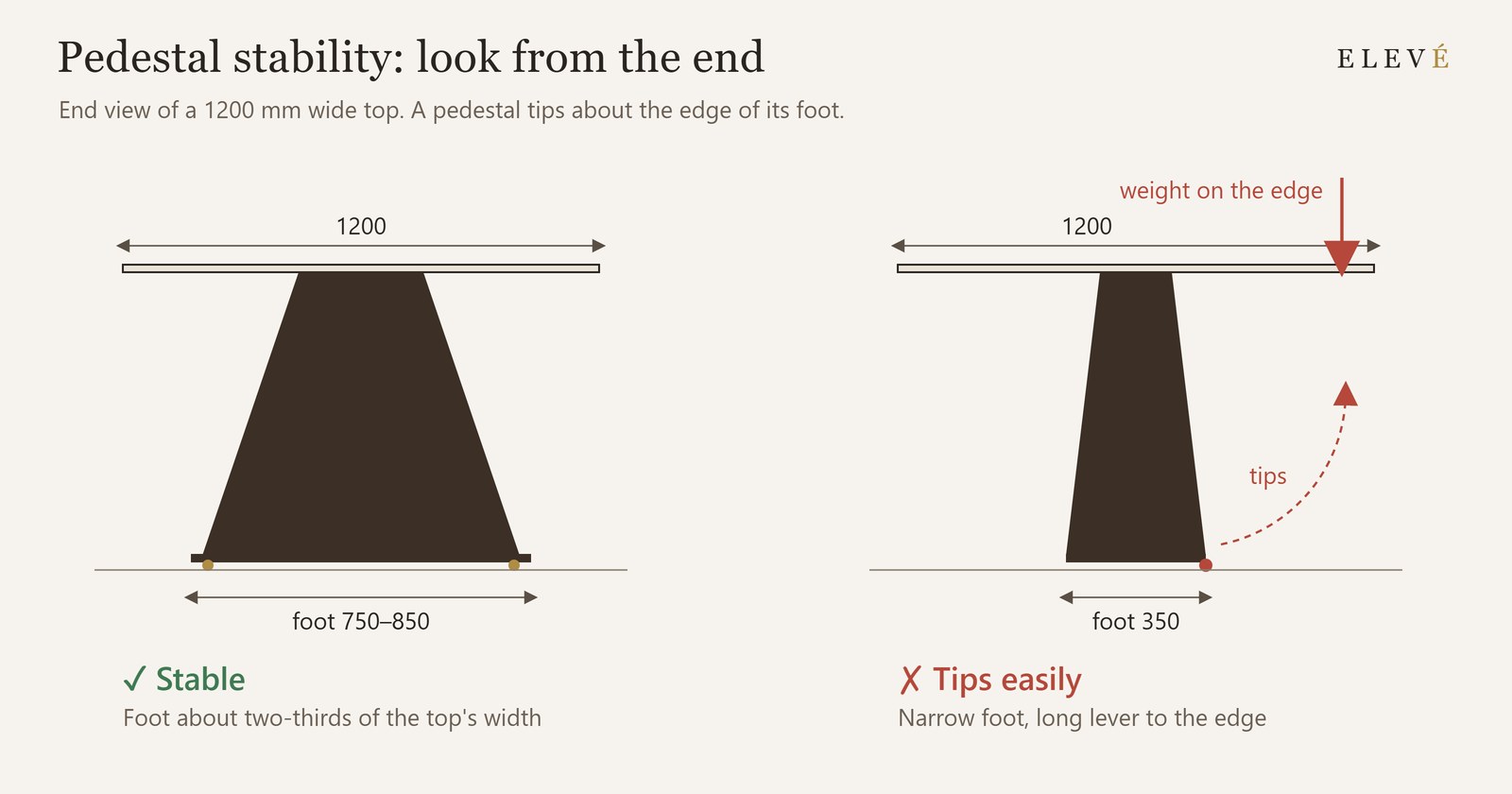
Stability: look at the table from the end
A pedestal table tips about the edge of its foot, so what matters is how far the foot reaches across the table, not how heavy the pedestal looks. A useful rule is that the foot should span about two-thirds of the top's width, around 750–850 mm on a 1200 mm top, with levelling feet near its ends. A slim 350 mm foot leaves a long lever between the foot and the edge of the top, and someone sitting on the edge can tip it. A heavy stone top helps, but it does not fix the geometry.
Carrying a stone top
A stone top is heavy, stiff and brittle, and the base has to respect all three. The usual arrangement is:
- A steel sub-frame under the slab, with cross members about every 400–450 mm, so the stone is supported across its width and not just at the legs.
- Set back from the edge by 75–150 mm, so the frame cannot be seen from a chair, especially under a bevelled edge.
- Neoprene pads and structural adhesive between frame and stone. The pads take up small irregularities and let steel and stone move slightly differently as the temperature changes; the adhesive holds the slab in place.
- No screws into the stone. Drilling the underside for screw inserts leaves thin stone above each hole and creates weak points where cracks can start, often along a vein. If a mechanical safety fixing is wanted, it should be undercut anchors designed for stone, in slotted holes and only snug.
- Legs fixed to the frame, not to the slab, so the top can come off for delivery.
The steel needs protecting too: a bare frame can rust in a humid villa and stain white marble from beneath. Powder coating or stainless steel avoids it. Our comparison of marble and sintered stone covers the weights involved and the edge details for each.
Wooden tops move: fix them so they can
Solid wood expands and contracts across the grain as the humidity changes, and in Dubai the swing between a sealed, air-conditioned summer and an open-windowed winter is significant. A solid top should be fixed to its base with wooden buttons, slotted brackets or figure-of-eight fasteners that let it move, never glued or screwed down rigidly, or it can crack or cup. A veneered top on a stable core moves far less. There is more on this in our guide to furniture materials for the Dubai climate.
Base materials, and what they cost
- Solid hardwood (oak, walnut, ash): warm and repairable, and ideal for trestles and four-leg designs. It needs proper joinery to carry a stone top.
- Powder-coated steel: the most economical way to carry a heavy top, and slim sections are possible because steel is so strong.
- Stainless steel: brushed, polished or PVD-coated in bronze, champagne or black tones; it shrugs off humidity and is easy to keep.
- Bronze and brass: cast or fabricated and often patinated. The most expensive metal option, and the one that ages best.
- Stone and travertine pedestals: monolithic and striking, very heavy, and usually built hollow from mitred slabs to keep the weight down.
- Leather-clad: legs or pedestals wrapped in leather, a detail borrowed from couture furniture.
As with the top, the base moves the price. A painted steel frame costs a fraction of a cast bronze or solid stone pedestal, and a base engineered to carry 170 kg of marble costs more than legs under a wooden top. Our bespoke tables start from AED 15,000, and the top and the base together decide where yours lands.
What is new in dining table design
Design moves slowly at the dining table, but some clear shifts have taken hold:
- Sculptural, architectural bases. The base is now the statement: chunky monolithic pedestals, cylinders and blades in stone, solid wood or metal. Long tables stand on two or three of them.
- Softer shapes. Racetrack and rounded-rectangle tops, soft corners and faceted ovals instead of sharp rectangles. They are easier to walk around and fit an extra guest.
- Characterful, honed stone. Beyond white Calacatta: green Verde Alpi, red Rosso Levanto, filled and honed travertine and other strongly coloured or veined stones, often in a matte finish.
- Darker woods. Smoked oak, dark walnut and ebonised timber, often as the base under a stone top.
- Mixed materials. Stone on wood, wood on bronze, leather-wrapped legs and metal inlays in the top.
- Bronze over gold. Patinated and brushed bronze, and PVD in softer tones, are replacing high-shine gold.
- Slim edges. Knife edges and thin bevels that make a heavy slab look light.
- Big rounds with a lazy Susan. Round tables of 2.2–2.5 m with a turntable in the centre, made for sharing dishes, are increasingly popular for family dining.
- Gulf-scale tables. In villas, 2.8–3.5 m is a common starting point, and 4–4.5 m tables for 12–16 on twin or triple bases are increasingly requested.
What is fading: glass tops on gold X-bases, thin hairpin legs, and the mass-produced fluted drum pedestal now seen everywhere. Fluting itself is not finished, but it looks far better made properly, at a generous scale, in solid timber or stone.
Delivery and assembly
A bespoke table should arrive in parts and be assembled in the room: base, frame and top separately. Check the route before ordering: the lift's internal size and door, the turn at the top of the stairs and the door into the dining room. A 2.6 m stone top travels on its edge on an A-frame and needs four to six people to carry and set. Most slabs are no longer than about 3.2 m, so longer stone tops need a joint, which should be placed and matched with care. Levelling feet on the base take care of uneven floors.
Before you commission
Have answers to five questions and any good workshop can design the right base:
- How many seats do you need, and should there be a chair at each end?
- What is the top, and how thick and heavy will it be?
- What size is the room, and what is the route in?
- Will the chairs have arms?
- Which look do you prefer, pedestal, trestle or legs, and in which material?
For sizing the whole set, see our guide to dining tables and chairs made to measure, or browse the dining tables we make.
Designing a dining table?
Send us the room size, the number of seats you need and the top you have in mind. We will propose a base, with the leg positions and legroom shown on a drawing, before anything is made.
Book a Consultation