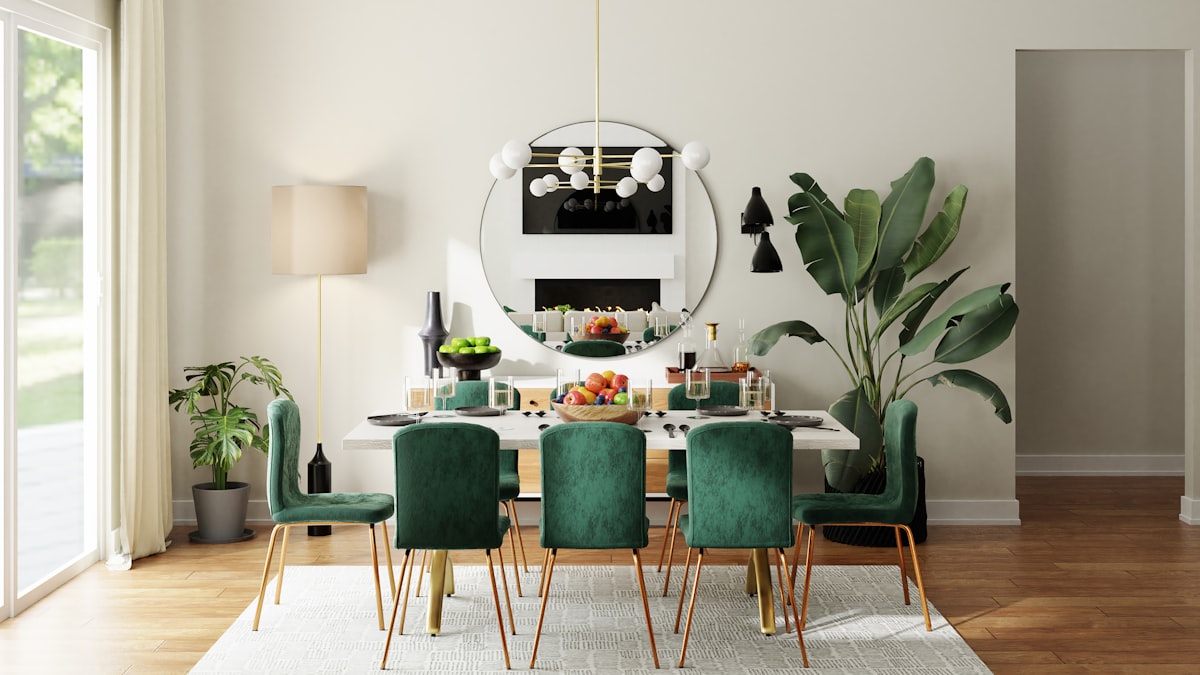
Nothing in a house works as hard as the dining set. Chairs are pulled out and pushed in several times a day, glasses are put down without coasters, children do homework on the table and, at Eid and on Fridays, fourteen people sit where eight were planned. The showroom question — which brand? — is the least important one. Size, top, chair construction and finish decide whether a dining set is still in daily use in fifteen years, and all four are easier to get right when the set is made to measure.
Size the table for the room and the guest list, in that order
Two numbers govern everything. Each diner needs 60–65 cm of table edge; and there must be 90 cm clear between the table edge and the nearest wall, sideboard or column, so that a chair can be drawn out and someone can pass behind it. Measure the room, subtract 180 cm from its length and width, and the remainder is the largest table the space will take. A rectangular table for eight is about 240–260 cm by 100 cm; for ten, 300–320 cm; for twelve, 360 cm, at which point two tables that can be pushed together are often the better answer. Round tables suit conversation and square rooms: 140–150 cm seats six, 180 cm seats eight, and above that the centre becomes unreachable.
This is precisely where stock sizes fail. Showroom tables come in 200, 240 and 300 cm; villas come with dining rooms of every other dimension, and the family that needs to seat eleven on Friday but four on Tuesday needs a table with leaves, or a pair, drawn to that brief. A made-to-measure table costs no more for being 268 cm than 260.
The top: solid, veneered or stone
Solid timber — oak, walnut, teak, sheesham — is the classic choice and the most forgiving over time: it can be sanded and refinished for decades. It must be kiln-dried to 8–10% moisture content and, critically, fixed to the frame with slotted buttons or expansion plates so that it can move across its width with the seasons. A solid top glued to its frame will crack in its first Dubai summer. Veneered tops on a plywood or high-density core are dimensionally stable and allow book-matched figure across a wide surface; done well, with a veneer thick enough to sand and solid lipping on the edges, they are entirely legitimate and the better choice for very wide tables. Stone — marble or quartzite on a steel or timber sub-frame — is beautiful and heavy, needs sealing against oil and lemon, and needs a frame engineered for the weight.
What to avoid is the combination that makes ready-made sets inexpensive: a paper-thin veneer or laminate over particleboard. It looks identical on the shop floor and it swells at the edges and lifts at the corners within a few humidity cycles.
Chairs: where the money should go
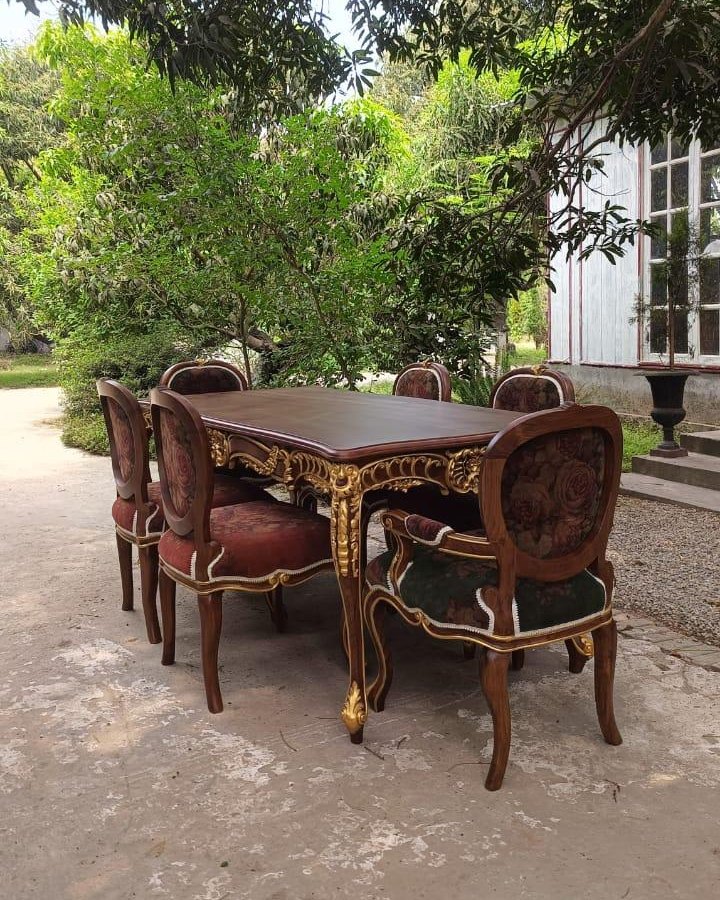
Chairs fail before tables, so they deserve the specification. A dining chair takes a person's full weight on four slender legs, often tipped back on two, and it does so thousands of times a year. The construction that survives that is a hardwood frame — beech, oak, teak or sheesham — with mortise-and-tenon joints between legs and rails, corner blocks glued and screwed under the seat, and stretchers where the design allows. Dowelled joints are acceptable; stapled joints, standard at the value end, work loose within a couple of years. Seat foam should be 40 kg/m³ or above, because dining foam is compressed in a small area rather than across a cushion, and the upholstery should be rated 30,000 Martindale rubs or more with a cleaning code you can actually use after a dinner party. A useful test in any showroom: lift the chair. A properly built one is heavier than it looks.
Upholstered chairs also need the seat at the right height for the table: 45–47 cm to the top of the compressed seat for a 75 cm table, and arms, if any, low enough to slide under the apron. Made to measure, that relationship is drawn; bought separately, it is luck.
Finish: what it has to survive
A dining top meets hot dishes, water rings, lemon, coffee and the occasional hand cream. A modern polyurethane or acid-catalysed lacquer, applied in several coats over a sealed surface, resists all of them and is the sensible finish for a family table. Hardwax oil gives a more natural surface that is easy to touch up but needs re-oiling every year or two and forgives less. French polish belongs on formal classic pieces that will be used with cloths and mats. Whichever it is, the underside must be sealed as well as the top, otherwise the two faces take up moisture at different rates and the top cups.
Showroom, ready-made or made to measure
- Designer showroom: superb tops and finishes, stock sizes, 12–20 weeks for made-to-order imports including freight, AED 40,000 upward for a table and chairs.
- Ready-made sets: immediate, from around AED 2,500, usually laminate or thin veneer on board with stapled chairs; excellent for a rental or a first apartment, replaced in a few years.
- Made to measure in Dubai: any size, any timber and finish, jointed hardwood chairs specified on the drawing, six to eight weeks (eight to ten for carved chairs), a solid six-seater from around AED 15,000 with chairs priced individually.
A brief for a made-to-measure set
- Room dimensions, door positions and where the sideboard will stand.
- Seats needed on an ordinary day, and on the largest occasion.
- Rectangular, round or extending; any leaves or a second table.
- Top material and finish; chair style, arm or armless, fabric or leather.
- Table height (75 cm standard) and any need for wheelchair or high-chair access.
From that brief we return a plan with the table drawn in the room and its clearances marked, chair elevations, and a fixed price and delivery week. The dining sets on our dining page show the range; the opening article in this series explains why local manufacture has become the route of choice for pieces like these.
Planning a dining room?
Send us the room dimensions and the number of seats you need. We will return a plan showing table size and clearances, chair options and a fixed price, before you commit to anything.
Book a Consultation