Walk into any fabric library and the choice can look endless, but most sofa fabrics fall into four families: velvet, bouclé, linen and the tight synthetic weaves sold as “performance” fabric. Each one looks and behaves differently in a Dubai living room, where the sun is strong, the air-conditioning runs most of the year, fine sand finds its way in and many homes have a dog or a cat. Our guide to choosing upholstery fabric covers how to read a spec sheet; this one compares the four families side by side, then shows you how to test a swatch at home before you commit.
The short answer
- Performance weave for the family sofa used every day, especially with children or pets.
- Polyester velvet for colour, softness and surprising durability, away from direct sun.
- Linen or a linen blend for a relaxed, matt look in a formal room that is used gently.
- Bouclé for an accent chair or a quiet room, not for a busy family sofa.
What a Dubai living room does to fabric
Sun. Large windows and strong light most of the year mean fading is the most common complaint we hear about sofas here. West-facing rooms take the worst of it in the afternoon. Natural fibres and surface-dyed fabrics lose colour first; fibres dyed right through hold it longest.
Air-conditioning dust. Air-conditioning runs for much of the year, and the fine grey dust it circulates settles on every horizontal surface, including the seat and arms of the sofa. On a smooth fabric it vacuums off; in a textured or looped fabric it works down into the weave and dulls the colour.
Fine sand. After a dusty day or a shamal, fine sand comes in on shoes, clothes and pets. Sand is abrasive: ground into a sofa by people sitting on it, it wears fibres faster than ordinary use. Fabrics that let grit fall out or vacuum away last longer.
Pets. Claws catch on loops and slubs, and drool and dusty paws need water-based cleaning. Our guide to pet-friendly upholstery fabric covers this in depth.
Five numbers and codes worth knowing first
Rub count (Martindale). The number of rubs a fabric survives in an abrasion test before it wears. As a rough guide: 15,000–25,000 for general domestic use, 25,000–30,000 for heavy domestic use, and above 30,000 for contract use. For a sofa in daily family use we suggest 30,000 or more; with dogs, 50,000 or more.
Lightfastness. Usually given on the Blue Wool scale from 1 to 8. Ask for 5 or more for a living room, and 6 or more for a sofa beside a large, unshaded window.
Pilling. Graded 1 to 5; ask for 4 or better.
Cleaning code. W water-based cleaning, S solvent only, W/S either, X vacuum only.
Fibre content. It decides how a fabric fades, stains, creases and cleans far more than the name on the swatch.
Velvet
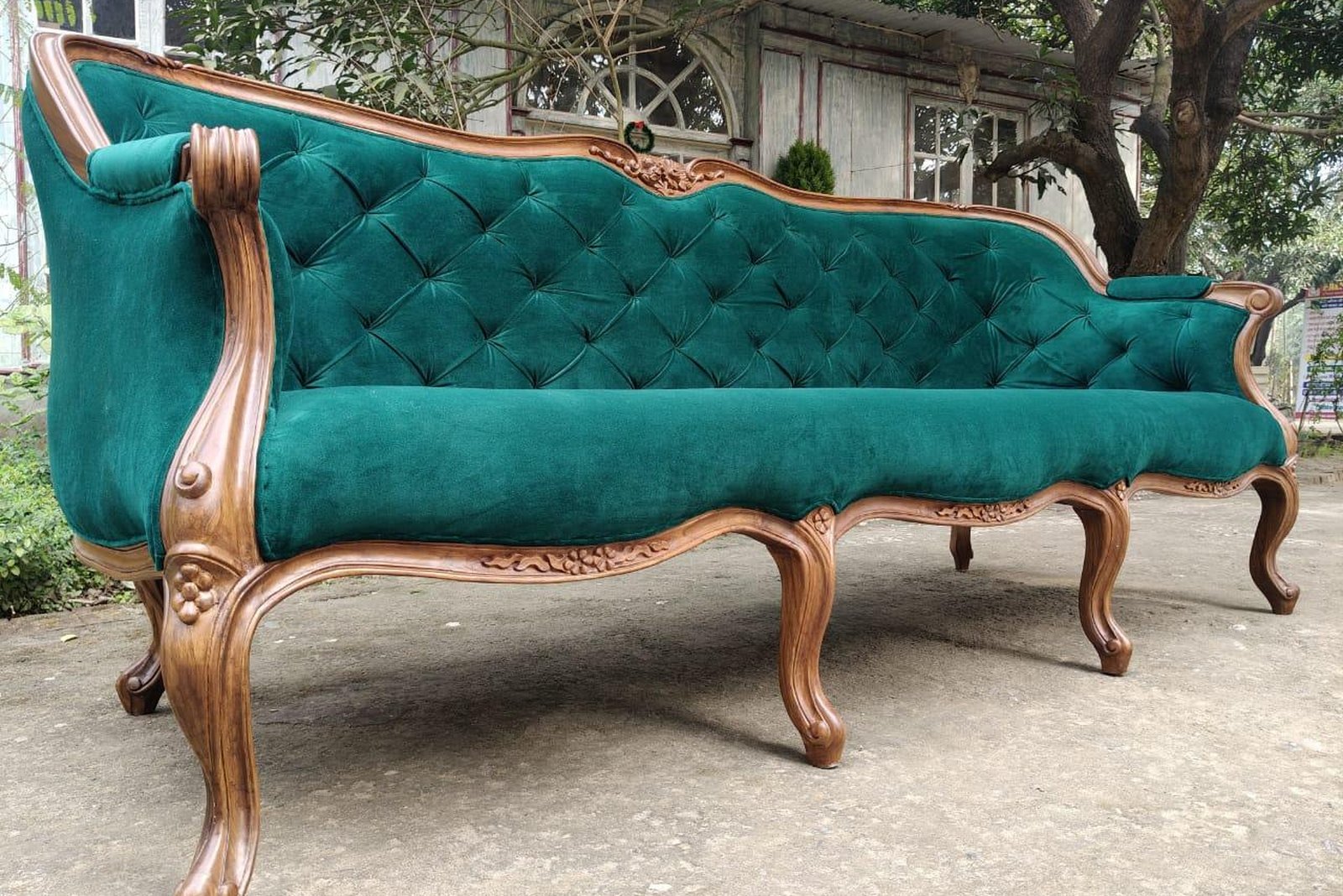
Velvet has a short, dense pile that catches the light, which is why it reads so richly in jewel colours such as emerald, teal and ink blue. The fibre matters more than the look.
Polyester velvet is one of the toughest sofa fabrics available: many qualities are rated at 50,000 to 100,000 rubs or more, it resists fading better than cotton, and it has no loops for a claw to pull. Cat hair wipes off it easily with a damp rubber glove. Cotton velvet is softer and more matt, but it fades faster in sun, marks with water and crushes where people sit.
Every velvet shows pile shading: the pile lies in different directions and looks lighter or darker from different angles. That is a feature of the cloth, not a fault, but it surprises people. Keep velvet out of direct afternoon sun on a west-facing window, and vacuum with a soft brush along the pile, not against it. Deep colours show pale dust and pet hair; mid-tones hide both.
In Dubai: good for dust, because a smooth pile vacuums clean. Fine with cats in a polyester quality. Poor in strong direct sun unless the lightfastness is 5 or more.
Bouclé
Bouclé is woven from looped yarn, which gives it a soft, nubbly, sheepskin-like surface. It has been everywhere in recent years, on curved sofas and rounded chairs.
The loops are both its charm and its weakness. They snag on claws, rings, watch straps and the Velcro on children’s shoes. They also hold fine sand and the grey dust that settles from air-conditioning, which works down between the loops and is hard to vacuum out. Rub counts vary widely, and a high number does not help when the problem is a single loop being pulled.
If you love the look, choose a tight, flat bouclé with small loops in a polyester or acrylic blend, in a mid-tone rather than bright white, and put it on an occasional chair or in a room that is used gently. Our Clarelle collection includes flat bouclés of this kind with a stain-resistant finish.
In Dubai: poor with pets, sand and AC dust. Good in a quiet room or on a single accent piece.
Linen
Linen is woven from flax. It has a cool, dry hand, a slightly irregular slub and a relaxed, matt look that suits warm climates. It is also the most demanding of the four.
- Creasing: pure linen creases where you sit, and the creases are part of the look.
- Sun: linen fades and the fibre gradually weakens in strong UV, so keep it away from unshaded glass.
- Wear: many pure linens are rated in the domestic range rather than the contract range, often well under 30,000 rubs, and loose slubs can snag.
- Washing: linen can shrink by several per cent, so removable covers should be pre-shrunk or dry-cleaned only.
A linen blend, linen with cotton, viscose or polyester, keeps most of the look while creasing less and wearing better. For a sofa that is used daily, a blend is usually the right call. Several performance weaves now imitate the linen look closely in polyester, which is worth considering if you want the appearance without the care.
In Dubai: lovely in a formal sitting room or majlis that is used for guests; less suited to a family sofa or a seat beside a sunny window.
Performance weave
“Performance” is a marketing word, not a standard, but it usually means a tight, flat weave in polyester, olefin or solution-dyed acrylic, with a finish that makes spills bead on the surface so they can be blotted away. Many are rated at 50,000 rubs or more and carry a W or W/S cleaning code.
Their weakness is that some feel slightly synthetic. The better ones are now hard to tell from a natural weave: chenilles, herringbones and tweed-like plains with a soft hand. Solution-dyed acrylic and polyester, where the colour goes right through the fibre, also hold their colour well in strong light.
Because “performance” has no fixed meaning, ask for the numbers: the rub count, the cleaning code, the lightfastness and what the finish actually does. A fabric that is merely “stain-resistant” needs spills blotted quickly; an easy-clean finish should let most household spills lift with water.
Our three easy-clean collections, Valora, Castelle and Clarelle, sit in this family. Valora and Castelle run in many qualities from 40,000 to 100,000 rubs and can be machine-washed at 30 °C as removable covers; Clarelle is a stain-resistant, spot-clean collection.
In Dubai: the most forgiving choice for sun, sand, pets, children and coffee.
Side by side
Rub counts below are typical ranges we see across mills; individual qualities sit above and below them, so always check the label of the exact fabric you choose.
| Fabric | Sun fade | Pets | Cleaning | Typical rub count | Best room |
|---|---|---|---|---|---|
| Polyester velvet | Good; keep out of direct afternoon sun | Good with cats and dogs; no loops | Vacuum along the pile; usually W or W/S | 50,000–100,000+ | Living room, family room, bedroom |
| Cotton velvet | Weak; fades and marks in strong light | Fair; hair lifts, but pile crushes | Often S or dry-clean only | 20,000–40,000 | Formal sitting room, away from windows |
| Bouclé | Varies with fibre; synthetics better | Poor; loops snag on claws | Hard to vacuum grit out of loops | 15,000–40,000 | Accent chair, quiet room |
| Pure linen | Weak; fades and weakens in UV | Poor; slubs snag, absorbs drool | Absorbent; often dry-clean only | 10,000–25,000 | Formal room or majlis used for guests |
| Linen blend | Fair to good, depending on blend | Fair in a tight weave | Varies; check the code | 20,000–35,000 | Living room used gently |
| Performance weave | Best, especially solution-dyed | Best; tight, flat, cleanable | W or W/S; many machine-washable covers | 40,000–100,000+ | Family room, homes with pets and children |
A swatch-test checklist
Ask for a swatch at least 30 × 30 cm, larger if it is a velvet or a pattern, and live with it for a few days before you decide. These tests take ten minutes between them.
- Light test. Look at the swatch on the sofa’s spot in your room, in the morning, the afternoon and under your evening lighting. Colours can shift a full shade between daylight and warm lamps.
- Sun test. Cover half the swatch with card and leave it on a sunny sill for a week. Any visible line between the halves is a warning for a sofa near the window.
- Water test. Put a few drops of water on the face. On an easy-clean fabric they bead and sit before soaking in; on an untreated one they vanish at once. Check that the fabric does not ring or mark as it dries.
- Claw test. Drag a key or the tines of a fork firmly across it a few times. If loops lift or threads pull, claws, rings and zips will do the same.
- Rub test. Rub it hard against a pair of jeans for a minute. Fuzzing or small balls of fibre mean pilling later.
- Dust and sand test. Sprinkle a pinch of fine sand, rub it in with your palm, then vacuum or brush it off. Whatever stays in the weave will stay in the sofa.
- Hair test. If you have a pet, press some of its hair into the swatch and wipe with a damp rubber glove. It should lift straight off.
- Crush test. For velvet, press your palm hard on the pile for a minute and brush it back. Note how quickly the mark recovers.
- Crease test. For linen and blends, squeeze a corner tightly in your fist for 30 seconds. Decide whether you can live with the creases you see.
- Label check. Before ordering, note the rub count, lightfastness, pilling grade, cleaning code and fibre content in writing, along with the dye lot.
Details that help any fabric last
- Removable, zipped covers on seat and back cushions, so they can be cleaned or turned.
- Reversible seat cushions, so wear and sun can be spread across both faces.
- A spare set of seat covers from the same dye lot if the sofa takes heavy use, because shades vary between lots.
- A sheer at the window. Even a light sheer cuts the direct sun on the sofa considerably.
- A weekly vacuum with a soft upholstery brush, before dust and sand work down into the weave.
- Blot, never rub, a spill, working from the outside in, and test any cleaner on a hidden area first.
And remember that the fabric is the part of a sofa you will replace. The frame should outlast two or three covers: ours are built in solid, kiln-dried teak and sheesham. When the time comes, our guide to re-upholstery explains what is worth restoring.
The bottom line
Choose the fabric for the way the room is used, not just the way the swatch looks. A busy family room wants a performance weave or a polyester velvet; a formal room can take linen or bouclé. Check the rub count, the lightfastness and the cleaning code, then test the swatch in your own room, in your own light. You can see all of our collections at our Al Qusais workshop and on our upholstery fabrics page, and every bespoke sofa we make can be covered in any of them.
Not sure which fabric suits your room?
Tell us how the sofa will be used, who sits on it and how much sun the room gets. We will shortlist fabrics from our collections and let you take swatches home before you decide.
Book a Consultation