An L-shaped sofa is the hardest-working piece in most Dubai living rooms. It seats the family, takes the guests and, with a chaise, gives one person somewhere to stretch out at the end of the day. It is also the piece most often ordered wrong: the chaise on the wrong side, a depth that eats the walkway, or a single long piece that cannot turn the corner into the lift. This guide covers the decisions to make before you choose a fabric, and shows three original designs from our workshop to start from.
First decision: chaise or corner?
“L-shaped” covers two quite different sofas. On a corner sofa the back runs round both sides of the L, so people sit facing each other, as they would in a majlis. On a sofa with a chaise, one end extends forward as a lounger, with no back along its outer edge. The difference sounds small on a floor plan and is large in daily life.
| Sofa with chaise | Corner sofa | |
|---|---|---|
| Seats | Three, with one person lounging | Four to six, sitting upright |
| Best for | Apartments, TV rooms, couples and small families | Family rooms, entertaining, majlis-style seating |
| Feel in the room | Open: the chaise has no back on its outer edge | Enclosed: backs on both sides frame the space |
| Lounging | One long seat to stretch out on | Only in the corner seat, which is often the least comfortable |
| Typical footprint | 2.2–3.0 m by 1.5–1.7 m | 2.4–3.2 m along both walls |
| Watch out for | The chaise side is fixed once it is made | A corner seat that is too deep to sit in properly |
If the sofa is mainly for watching films and lying down, choose a chaise. If it is mainly for guests and conversation, a corner sofa seats more people well. Many families settle on a chaise for the living room and keep a corner arrangement for the majlis.
Left or right: getting the chaise on the correct side
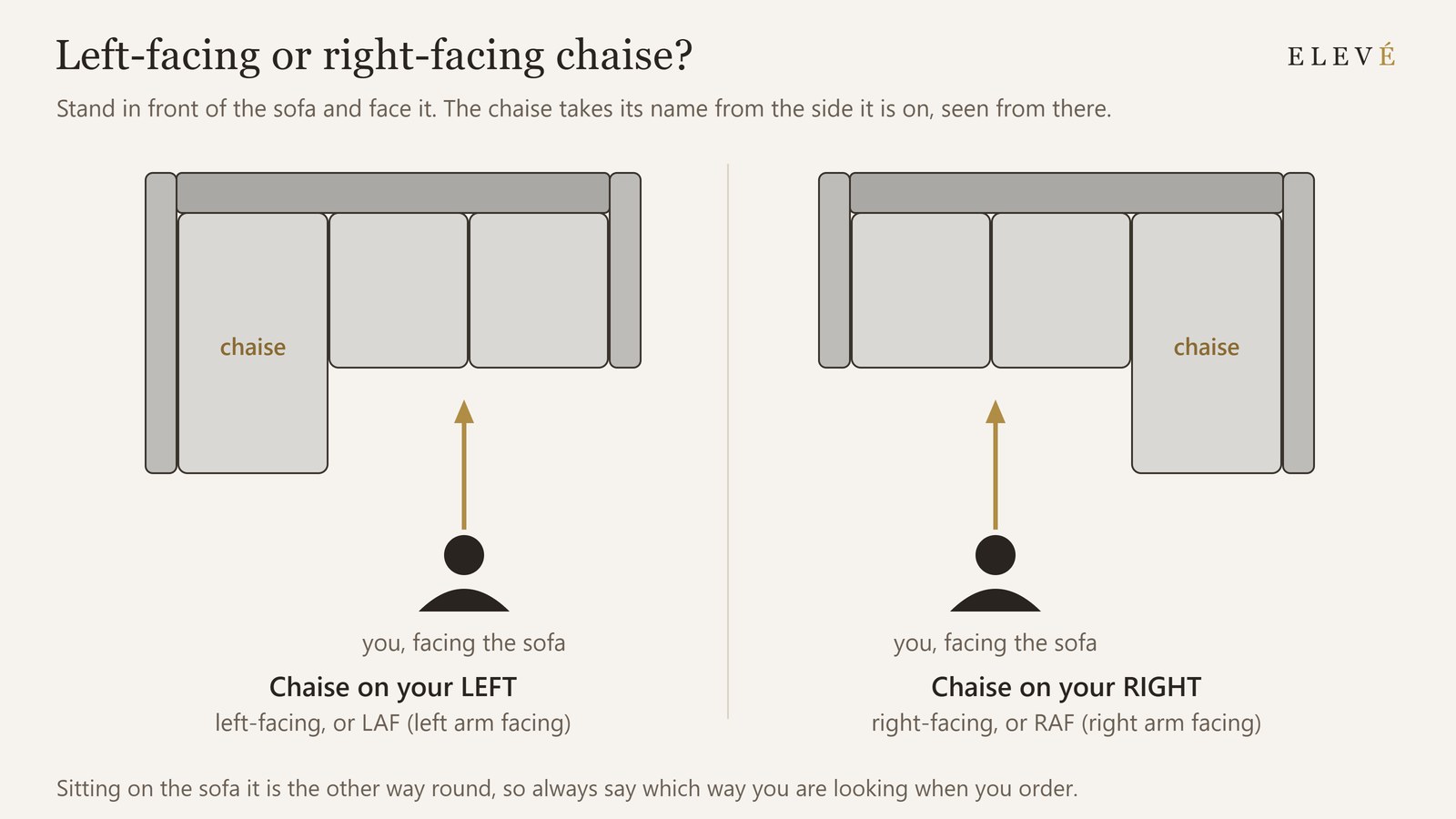
This is the single most common ordering mistake, and the reason is simple: left and right swap depending on where you stand. The industry convention is to describe the sofa as you face it. If the chaise is on your left when you stand in front of the sofa, it is a left-facing chaise, often written LAF (left arm facing). Sit down on that same sofa and the chaise is on your right.
Before you confirm the side:
- Tape it on the floor. Mark the full outline with masking tape, including the chaise, and live with it for a day.
- Check the view. Whoever lies on the chaise should face the TV or the window, not have it over their shoulder.
- Keep the walkway clear. The chaise should not narrow the route to the balcony, the kitchen or a door.
- Think about the sun. Lying with strong afternoon light on your face is less restful than it sounds.
- Think about moving. If you are renting and may move, ask whether the chaise can be made to swap sides, or choose a sofa with a separate ottoman.
The sizes that work
An L-shaped sofa is a big object, and a few centimetres decide whether it feels generous or oversized. These are the ranges we design within for most Dubai homes.
| Typical range | Notes | |
|---|---|---|
| Overall length | 2.2–3.2 m | Set by the wall; leave 20–30 cm clear at each end where you can |
| Chaise projection | 1.5–1.7 m | From the back of the sofa to the front of the chaise; about 1.55 m suits most adults |
| Overall depth | 90–100 cm | Deeper sofas need a room more than about 4.5 m across |
| Seat depth | 55–60 cm upright, 65–75 cm lounging | Measured from the front edge of the seat to the back cushion |
| Seat height | 42–45 cm | 46–47 cm is noticeably easier for taller people |
| Back height | 75–85 cm | Check it against any window sill behind the sofa |
| Walkway beside the chaise | 75–90 cm | Less than 75 cm and people start to squeeze past |
| Seat edge to coffee table | 40–45 cm | Close enough to reach a cup, far enough for knees |
Two numbers are worth deciding together. The overall depth decides how the room feels to walk through, while the seat depth decides how the sofa feels to sit in. A family that sits upright for conversation needs a shallower seat than one that lies back to watch films, even on the same footprint. Our sofa sizing guide takes you through measuring the room step by step.
Arms, backs and details: where the character comes from
Once the size and the layout are fixed, a handful of details give the sofa its character.
- Arms. Slim track arms keep the look crisp and give the most seat for the length. Rolled arms are softer and more classic. Remember that both arms count: a 20 cm arm adds 40 cm to the overall length.
- The back. A tight back is upholstered in place, so it always looks neat and holds you upright. Loose back cushions are softer and can be adjusted or plumped, but they need plumping.
- Channel stitching. Parallel channels sewn through the upholstery, usually upright on the back. They add rhythm and structure, and they suit velvet and smooth weaves.
- Button tufting. Fabric-covered buttons pulled through the padding to form diamond pleats, the detail behind the Chesterfield. It adds depth and a tailored, traditional note.
- Piping and topstitching. A corded edge (piping, or a welt) outlines each cushion, in the same fabric or a contrast colour. Visible stitched seams, often doubled, draw the line of an arm or a base.
- Legs. Brushed brass reads light and glamorous, timber warm and natural, matt black modern. Legs of about 10 cm leave room to clean underneath.
Details also change how a sofa ages. Channels and tufts collect dust in their seams, so a soft brush on the vacuum keeps them clean. Piping takes wear first along the front edge of the seat cushions, so it should be cut from a hard-wearing fabric.
Three original designs from our workshop
To show how much the details change a sofa, here is one L-shaped sofa with a left-facing chaise, designed three ways. The layout and the proportions stay the same; the arms, the back, the stitching and the legs change. Each one is an original ELEVÉ design, made to order in our Dubai workshop in your size, your fabric and on your chaise side.
The Channel
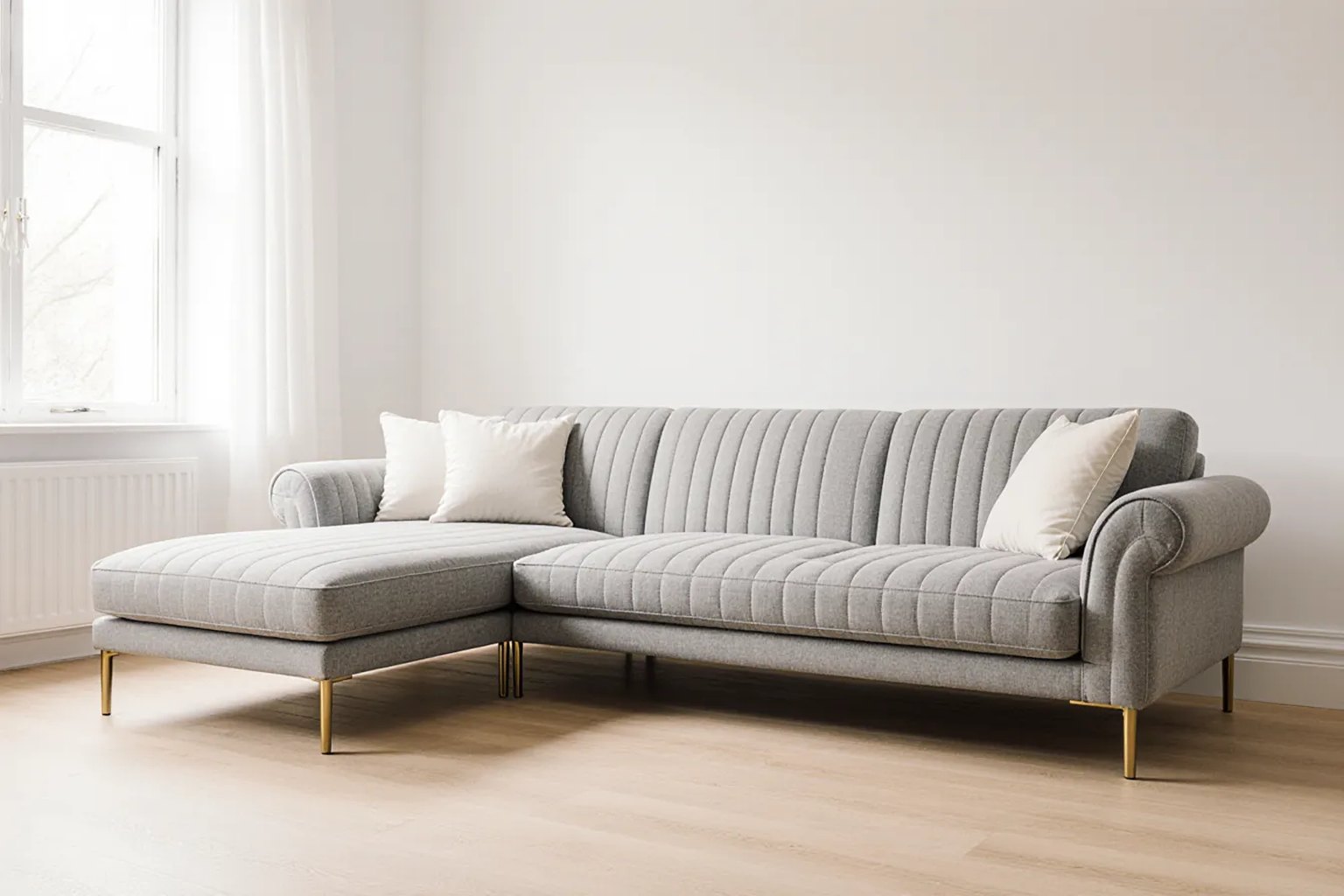
The most decorative of the three. The upright channels on the back give it structure and a touch of Art Deco, the rolled arms soften the outline, and slim brass legs lift it off the floor. The tight back holds you upright for conversation, with scatter cushions for lounging. It looks best in a fabric with a soft sheen, where the light catches the channels.
The Tufted
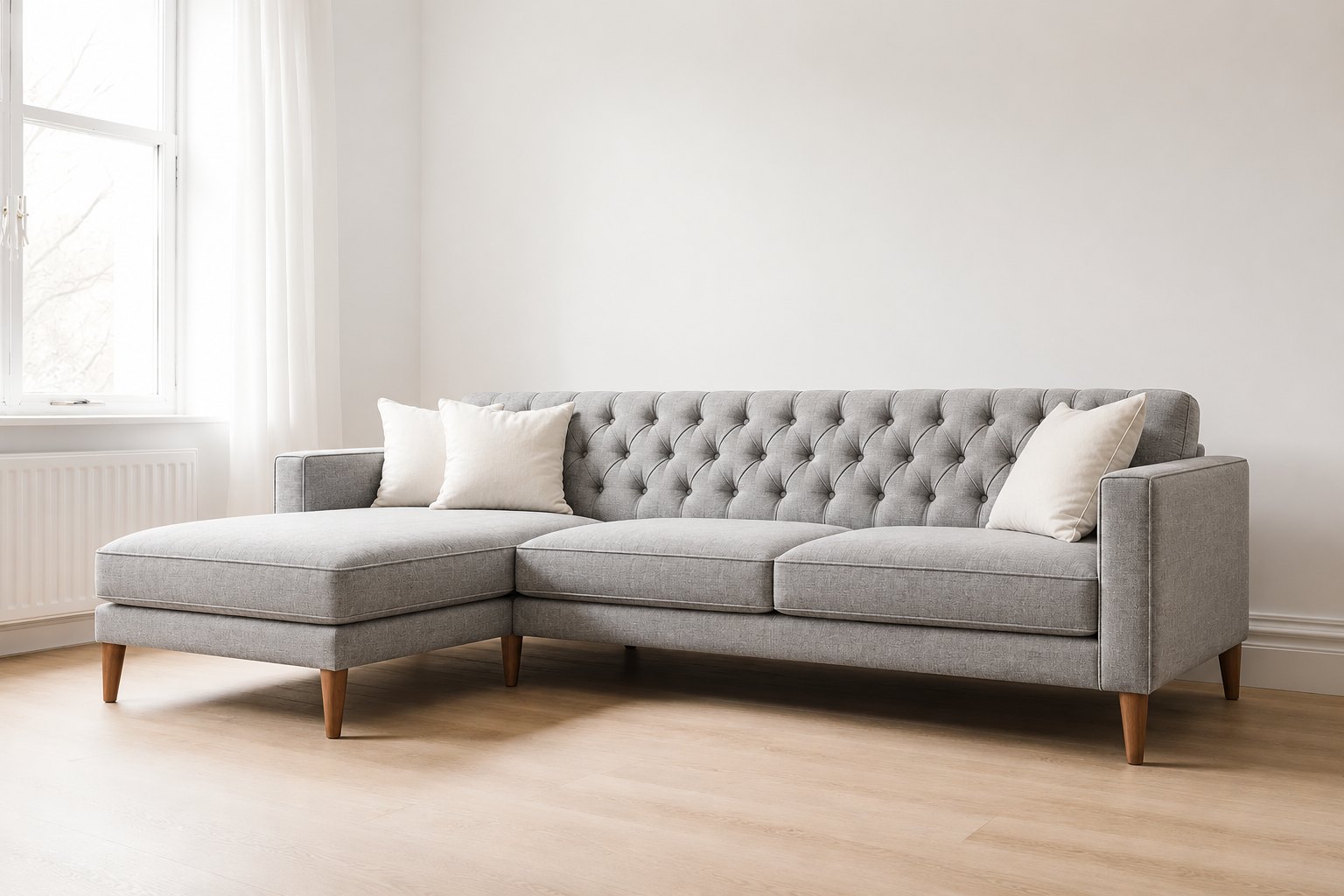
A classic detail on a clean, modern body. The button tufting gives the back depth and a tailored, traditional feel, while straight track arms and piped box cushions keep the lines crisp. Solid teak legs add warmth. If you love deep buttoning, our guide to Chesterfield sofas explains how it is done by hand.
The Tailored
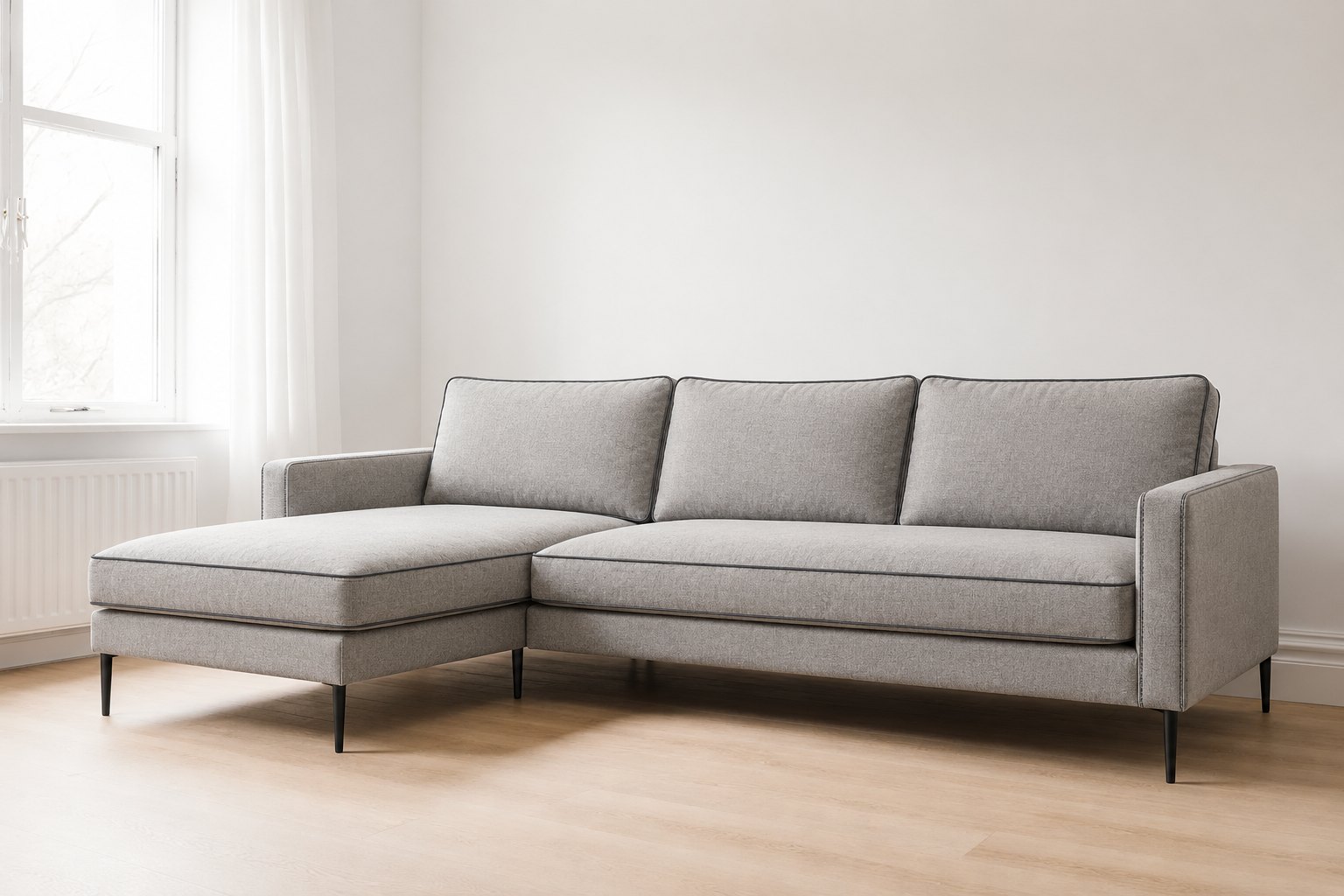
The most relaxed sit of the three. Plump loose back cushions make it soft and adjustable, and charcoal piping outlines every cushion, so it reads as sharp and graphic even in a pale fabric. Double topstitching on the arm fronts repeats the line, and slim matt black legs keep it light.
What goes inside
The parts you cannot see decide how long the sofa lasts, and an L-shape asks more of them than a straight sofa: the chaise carries a person lying along a long rail, and the two sections meet at a joint.
- Frame. Kiln-dried solid hardwood, such as teak or sheesham, with joints that are glued, dowelled and corner-blocked. Avoid MDF, chipboard and softwoods such as pine.
- Springs. Eight-way hand-tied coil springs are the traditional benchmark; heavy-gauge sinuous springs are the common, more economical alternative. Ask which you are getting.
- Cushions. High-resilience foam of at least 35 kg/m³, wrapped in fibre or feather, with zipped covers that come off for cleaning.
- Fabric. For a family sofa, a performance fabric of 30,000 Martindale rubs or more. Beside a window, choose one rated for UV and fade resistance, especially in light colours.
We go into each in detail in our bespoke sofa guide, our article on how long a sofa should last and our guide to choosing upholstery fabric.
Getting it into the apartment
A 2.5 m L-shaped sofa will not go up in most lifts in one piece, and it should not need to. We build L-shaped sofas in two or three sections that join on site with steel connectors. The legs unscrew and the cushions come off, so each section can be carried on its back at under 70 cm high, through a standard door and into a passenger lift standing on end. Before the design is final, measure the narrowest door on the route, the turn in the corridor and the inside of the lift.
Before you order: a short checklist
- The chaise side, confirmed from the front of the sofa.
- Overall length, chaise projection and depth, checked with tape on the floor.
- Seat depth and height chosen for the people who will use it most.
- The route in measured: doors, corridors and lift.
- The frame wood and joinery written into the quotation.
- The spring system named: eight-way hand-tied or sinuous.
- Foam density and zipped, removable covers confirmed.
- Fabric rub count and UV rating checked, with physical samples seen in your room.
- A written warranty on the frame, and what it excludes.
The bottom line
Get the chaise side, the depth and the route in right, and the rest is the enjoyable part: the arms, the stitching, the fabric and the legs. See the sofas we make, or send us your room and we will draw an L-shaped sofa to fit it.
Planning an L-shaped sofa?
Send us the wall length, the side you want the chaise on and a photo of the room. We will suggest the size, the design and the fabric, and check the route in before anything is made.
Book a Consultation