Much of the work in our studio now comes as a tender: a package of drawings and schedules from a designer, fit-out contractor or operator, asking for prices on anything from twenty restaurant armchairs to a full rooftop of seating, joinery and planters. The best packages get accurate, comparable quotes in days. The weakest get quotes that differ by half and a month of questions. Here is what makes the difference, from the maker’s side of the table.
The short answer
Send a schedule with codes and quantities, a drawing or dimensioned image for every item, a specification of materials, finishes and fire rating, the site and installation scope, and the programme. Ask every bidder to list their assumptions and exclusions. Compare those before you compare prices.
What a good RFQ package contains
- A furniture schedule. One line per item, with a code (FF-01 for a dining chair, JN-03 for a bar counter, and so on), a description, the quantity, the location and a reference to its drawing. Keep codes stable across revisions so everyone can see what changed.
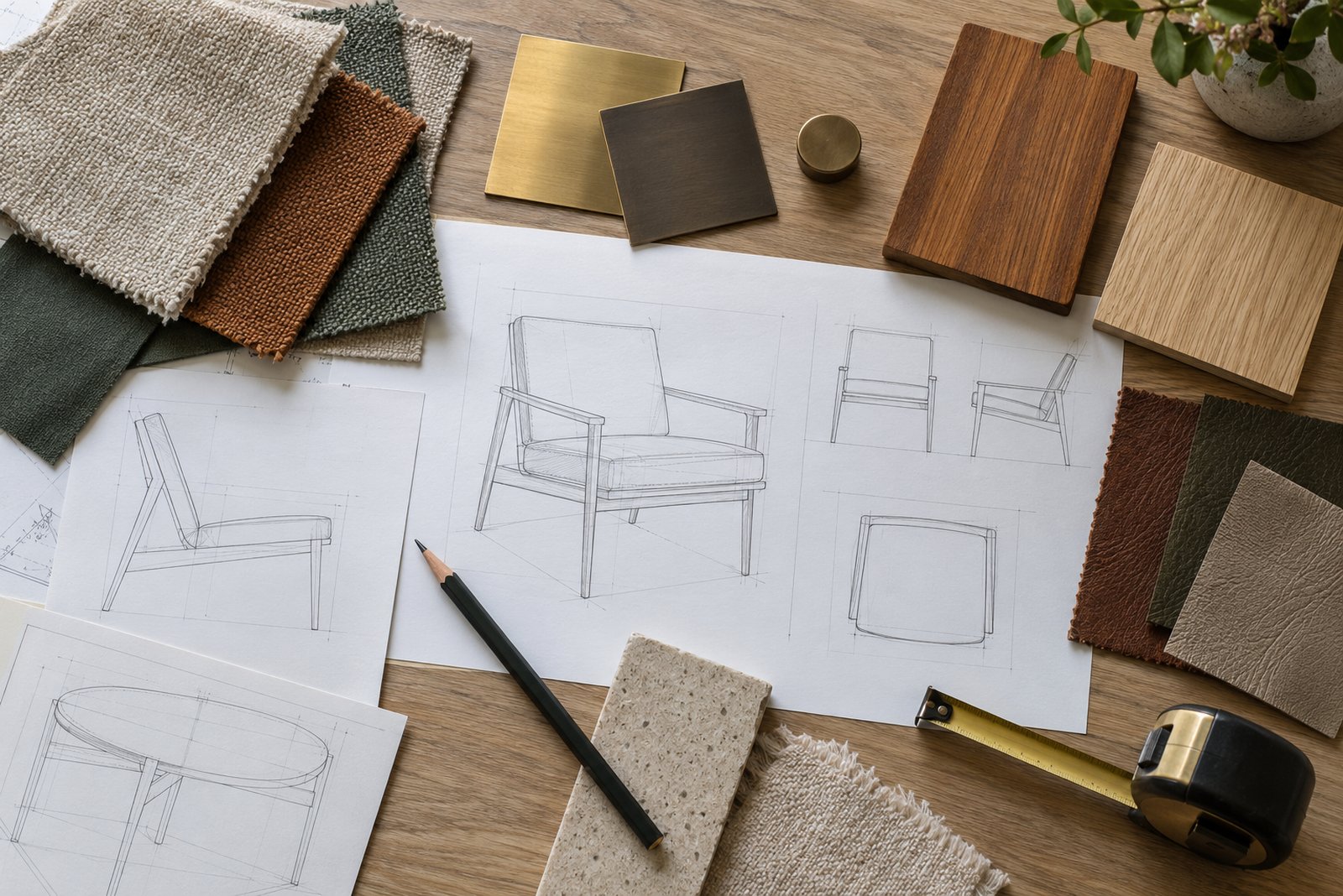
- Drawings for every item. Plan, elevation and section with overall sizes, seat height and depth, and the key details: leg sections, edge profiles, joints between materials. A mood image alone gives you a guess, not a price.
- A specification. Timber species and whether solid or veneer, metal grade and finish, stone type and thickness, fabric or leather by name and code with the meterage per piece, foam density, and the finish and sheen. Name the colour of every metal finish, for example a dark bronze PVD on stainless steel, rather than “bronze finish”.
- The fire rating. For seating, the standard and level, for example BS 5852 to ignition source 5 (crib 5); for boards and panels, the reaction-to-fire class. It changes the foam, the interliner and the fabric treatment, so it changes the price. Our guide to fire-rated upholstery explains the levels.
- The site and the scope. The address, the floor, lift and door sizes, delivery hours and whether you need installation, fixing to walls or floors, or only supply.
- The programme. When drawings will be final, when you need samples, and the date furniture must be on site.
- Submittals and terms. What you need before production: samples, shop drawings, a prototype, test certificates. And the commercial basis: currency, VAT, payment terms, retention and the warranty you expect.
Why quotes for the same chair differ
In our experience, the price gap between bidders comes mostly from what the brief left open:
- Extras on the drawing, not in the schedule. Castors, LED strips, brass skirting, loose cushions or a glass top drawn on the elevation but not listed. One bidder includes them, another does not.
- “Or equivalent”. An open material specification invites the cheapest equivalent. Name the product, or the performance you need.
- Missing sizes. Without a drawing, every bidder sizes the piece differently.
- Fire rating left unsaid. Crib 5 seating costs more than domestic seating, and adds time.
- Access and installation. Delivery to a rooftop or a mall with night-only access is a real cost.
- Revisions. A quote priced on revision R01 drawings cannot be compared with one priced on R02. Make sure every offer states the drawing revision it is based on.
A good maker will list their assumptions and give provisional rates where drawings are missing, rather than leave items out. Read those lists side by side before you read the totals.
From award to handover
- Shop drawings. The maker redraws each item with construction details, fixings and final dimensions. This is where the design intent becomes a buildable piece; check seat heights against your table heights and banquette depths against your layout.
- Samples. Physical samples of timber stain, metal finish, fabric, leather and stone, ideally viewed together under the venue’s lighting.
- Prototype. For repeated items such as dining chairs, one finished chair to sit in and approve. It is the cheapest insurance in the whole project.
- Production. Roughly six to ten weeks for most custom contract seating and tables after approvals, longer for imported fabrics, large stone or complex metalwork.
- Inspection. A visit to the workshop before dispatch, checking finish, dimensions and labels against the schedule.
- Delivery, installation and snagging. Pieces delivered by area, installed, protected, and a snag list closed out before handover, with care instructions and the warranty in writing.
Local manufacture or import?
Imported contract furniture can work well for standard catalogue pieces. For custom sizes, mixed materials and tight programmes, a Dubai workshop has clear advantages: you can inspect the prototype in person, adjust it in days rather than weeks, and order a few extra pieces later from the same timber and finish. We make our seating and tables in solid teak and sheesham in our Al Qusais workshop, with metalwork, stone and upholstery finished alongside.
A quick checklist for your next tender
- Schedule with stable codes, quantities and locations
- A dimensioned drawing for every item
- Materials and finishes named, not “or equivalent”
- Fire rating for seating and boards stated
- Site access, floor and installation scope
- Programme, submittals and commercial terms
- Every bidder to state the drawing revision and list their assumptions
The bottom line
A clear brief is the cheapest thing in a fit-out. It gets you comparable prices, fewer surprises in production and furniture that arrives as drawn. When details are still open, ask your maker to price on stated assumptions and confirm them as soon as the drawings land. For a wider view of specifying for hotels and restaurants, read our guide to contract furniture in Dubai.
Have a furniture package to price?
Send us your schedule and drawings. We will return a priced offer with our assumptions listed, and suggest a prototype for any repeated item.
Send Your Tender