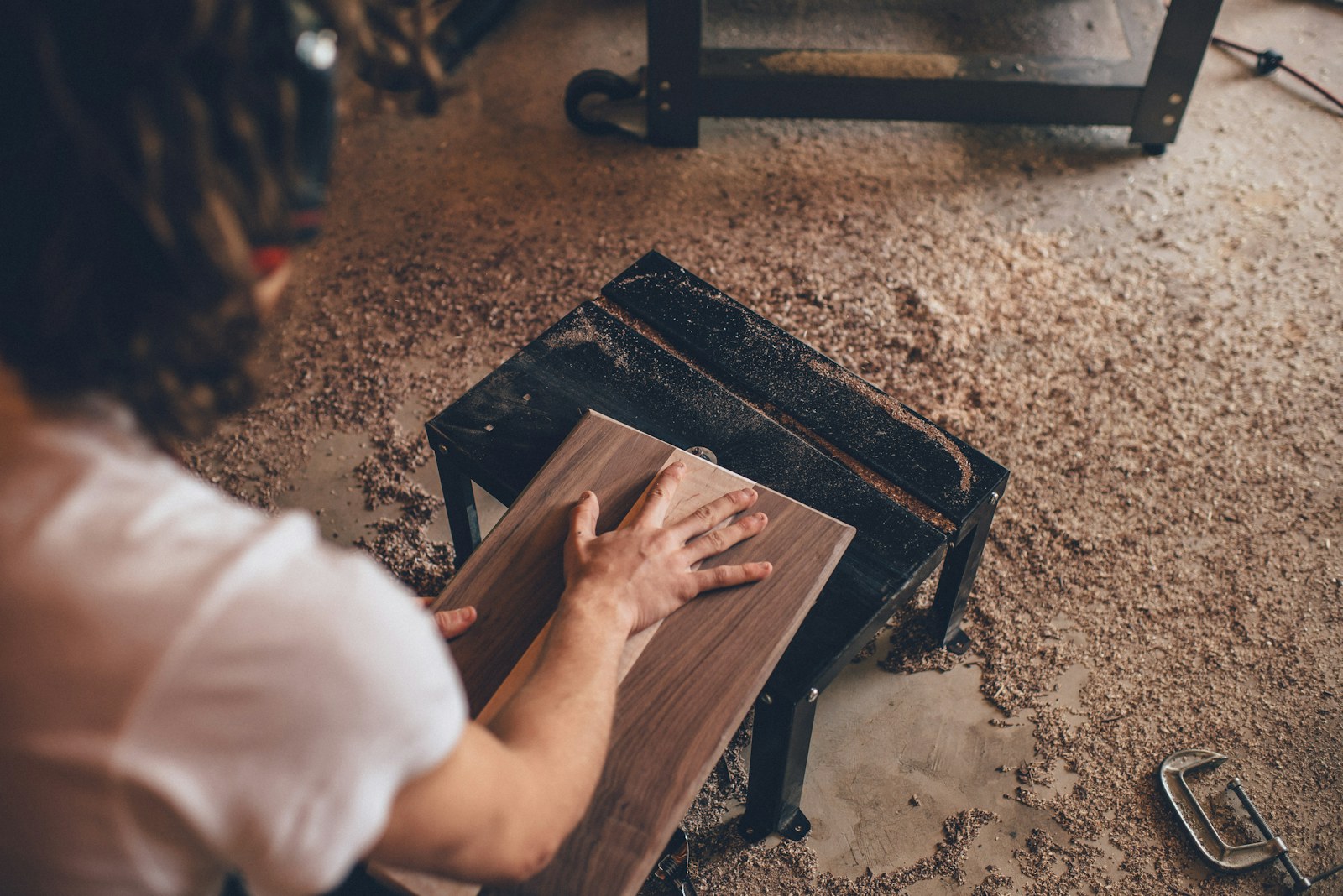
“Solid wood, not veneer” is one of the first things many of our clients say, and they are right to ask. Showroom labels such as “real wood”, “wood finish” or “made with natural wood” can mean a solid hardwood table, a thin slice of wood glued to fibreboard, or a printed paper that only looks like wood. Here is what each term really means, how to check a piece yourself, and where veneer is honestly the better choice.
The short answer
Choose solid wood for anything that is handled, knocked, carved or that you may want to refinish one day: dining table tops, chairs, legs, bed and sofa frames. Choose a good real-wood veneer on a stable core for large flat panels: wardrobe doors, wall panelling and cabinet sides, and for figured woods that would be unstable in solid form. And if you are paying for wood, avoid foil, paper and laminate “wood effects” altogether.
What the words actually mean
Solid wood means every visible part is sawn timber, the same wood all the way through. A wide table top is made of several boards glued edge to edge; that is normal and correct, because a single board a metre wide is rare and would cup and split.
Veneer is a thin slice of real wood, usually around 0.5 to 0.6 mm thick, pressed onto a core of MDF, plywood or particleboard. Thicker, sawn veneers of 1.5 to 3 mm exist and can be sanded more often, but they are less common in ready-made furniture.
Wood effect covers melamine, foil, printed paper and laminate. These are photographs of wood on a plastic or paper layer. They have their place in kitchens and offices, but they are not wood, and they cannot be sanded or refinished at all.
Five checks you can do in a showroom
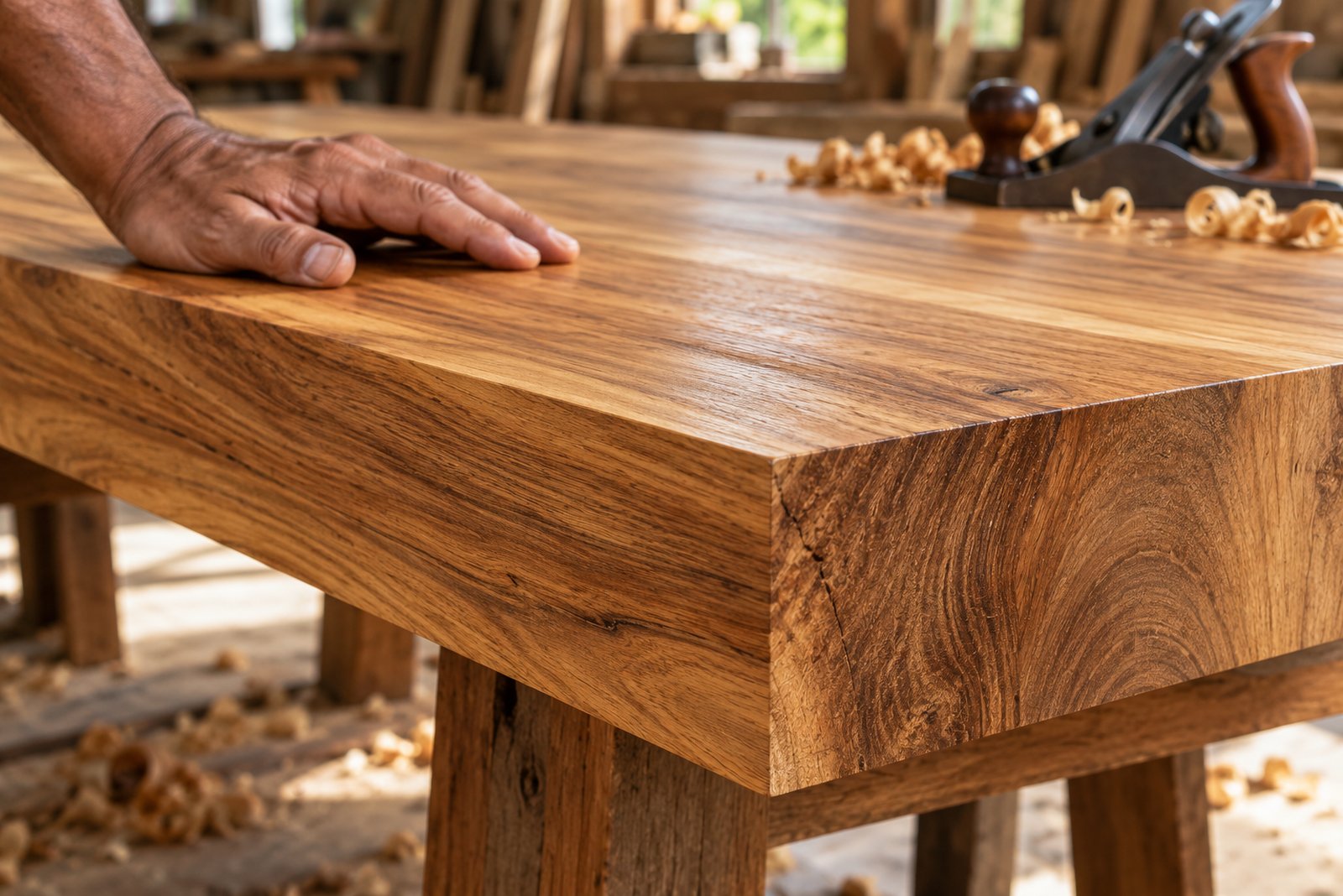
- Follow the grain over the edge. On solid wood, the figure on the top carries on down the edge and the end of the top shows end grain, the ring pattern of the tree. On a veneered top the edge is a separate strip, so the grain stops at the corner or changes direction.
- Look underneath. Turn a chair over or look under the table. Solid pieces show the same wood below as on top. Veneered panels often have a plainer balancing veneer or bare board on the underside.
- Look for repeats. If the same knot or swirl appears twice on one panel, or on every door of a wardrobe, you are looking at printed or sliced-and-matched surface, not separate boards.
- Look inside a hole. Screw holes, hinge recesses and the back of a drawer show the core. MDF looks like compressed brown felt; plywood shows layers; solid wood shows grain.
- Get it in writing. Ask for the species and the construction of each part: top, edges, legs, frame, carcass. A good maker will write “solid teak top 40 mm, solid teak legs” without hesitation. Weight is not a reliable test, because MDF is as heavy as many hardwoods.
Where solid wood is the right choice
Table tops in daily use. A solid top can be sanded and refinished many times over its life, small dents can often be steamed out, and a scratch is only a scratch. A 0.6 mm veneer can be lightly cut back once or twice before the core shows through.
Frames, legs and chairs. Strength comes from joinery: mortise and tenon, dowels and bridle joints need solid timber to grip. That is why we build every sofa, bed and chair frame in solid, kiln-dried hardwood.
Carving, shaped edges and turned legs. Any profile cut into the wood exposes what is underneath. Classic carved pieces must be solid.
Outdoors. Veneer and MDF fail quickly in the heat and humidity of a Dubai summer. Outdoor furniture should be solid teak, metal or stone.
Where veneer is honestly better
Large flat panels. Solid wood moves with humidity, mostly across the grain: a wide panel shrinks and swells through the year. A veneer on a stable plywood or MDF core hardly moves, so wardrobe doors stay flat and wall panelling keeps its joints tight. Our wardrobes, wall panels and cabinet carcasses are veneered for exactly this reason.
Book-matched and figured woods. Mirrored grain across a pair of doors, burr walnut or a dramatic crown figure are only possible, or affordable, as veneer.
Very large tops and weight limits. A boardroom table over three metres, or a top that must be lifted into an apartment, can be lighter and flatter as a veneered torsion box with solid lippings.
A good veneered piece will always have solid wood lippings on the edges that take knocks, and a balancing veneer on the back so the panel stays flat.
Solid wood in Dubai’s climate
The real risk with solid wood here is not the wood but how it was dried and built. Ask for timber kiln-dried to a low moisture content, typically around 6 to 10%, close to the dry air of an air-conditioned home. A solid top must be fixed to its frame with slotted brackets or buttons that let it move across its width; screwed down rigidly, it will crack. And keep any solid piece out of the direct blast of an AC vent and out of strong afternoon sun.
Teak and sheesham, through and through
Most of our solid furniture is made in teak and sheesham. Teak is naturally oily, very stable and resistant to moisture, and it sits at the higher end of the price range. Sheesham is dense and strong with a rich, varied figure, and costs less. Oak and walnut are available on request. Our guide to teak, sheesham and oak compares them in detail.
A quick checklist
- Grain that carries over the edge, and end grain at the ends
- The same wood underneath as on top
- No repeating knots or figure
- Species and construction of every part confirmed in writing
- Timber kiln-dried to around 6 to 10%
- A top fixed so it can move
- Veneer only where it makes the piece better: big flat panels and figured woods
The bottom line
Solid wood and veneer are both honest materials when they are used in the right place and described accurately. What you should not accept is a vague label. For a table, chairs or a bed frame you will keep for decades, insist on solid wood and ask to see the edge, the end and the underside. For a wall of wardrobes, a good veneer is the better engineering. If you are planning a table, our guide to dining tables made to measure covers size, wood and finish.
Want a table that is solid all the way through?
Visit our Al Qusais workshop to see solid teak and sheesham being made, or send us your size and we will quote with the construction of every part in writing.
Book a Consultation