Of all the rooms in an Emirati villa, the majlis carries the most meaning and the least room for error. It is where a family's standing, its manners and its memory are put on display every time the door opens to a guest. Get it right and it feels rooted, generous and quietly confident. Get it wrong — too themed, too literal, too much borrowed ornament — and it reads as a hotel lobby doing an impression of heritage. This guide is about designing a genuinely Khaleeji majlis for the modern Dubai villa: the hosting culture behind it, the seating protocol that governs it, the crafts that give it texture, and the discipline that keeps it from tipping into cliche. It completes the majlis series we have built across ELEVÉ's writing.
Why the majlis is a social institution, not a living room
A Khaleeji majlis is not the family's living room. In an Emirati home private life happens elsewhere; the majlis is the public face the household presents to the world. Historically it sat at the front of the house, often with its own external door, so guests — traditionally male, with a separate ladies' majlis — could be received without passing through private quarters. That separation still shapes villa planning today.
It is where marriages are discussed, disputes mediated, condolences received, business begun and Eid greetings exchanged. Hospitality here is close to obligation: a guest is received, seated according to rank, offered qahwa and dates within minutes, and never rushed. The design has to serve that — let the host watch the door, receive people in order, seat elders with honour, keep the coffee moving. Ornament is secondary. Design for the ritual first and the room reads as authentic before you add a single motif.
Seating protocol: the architecture of respect
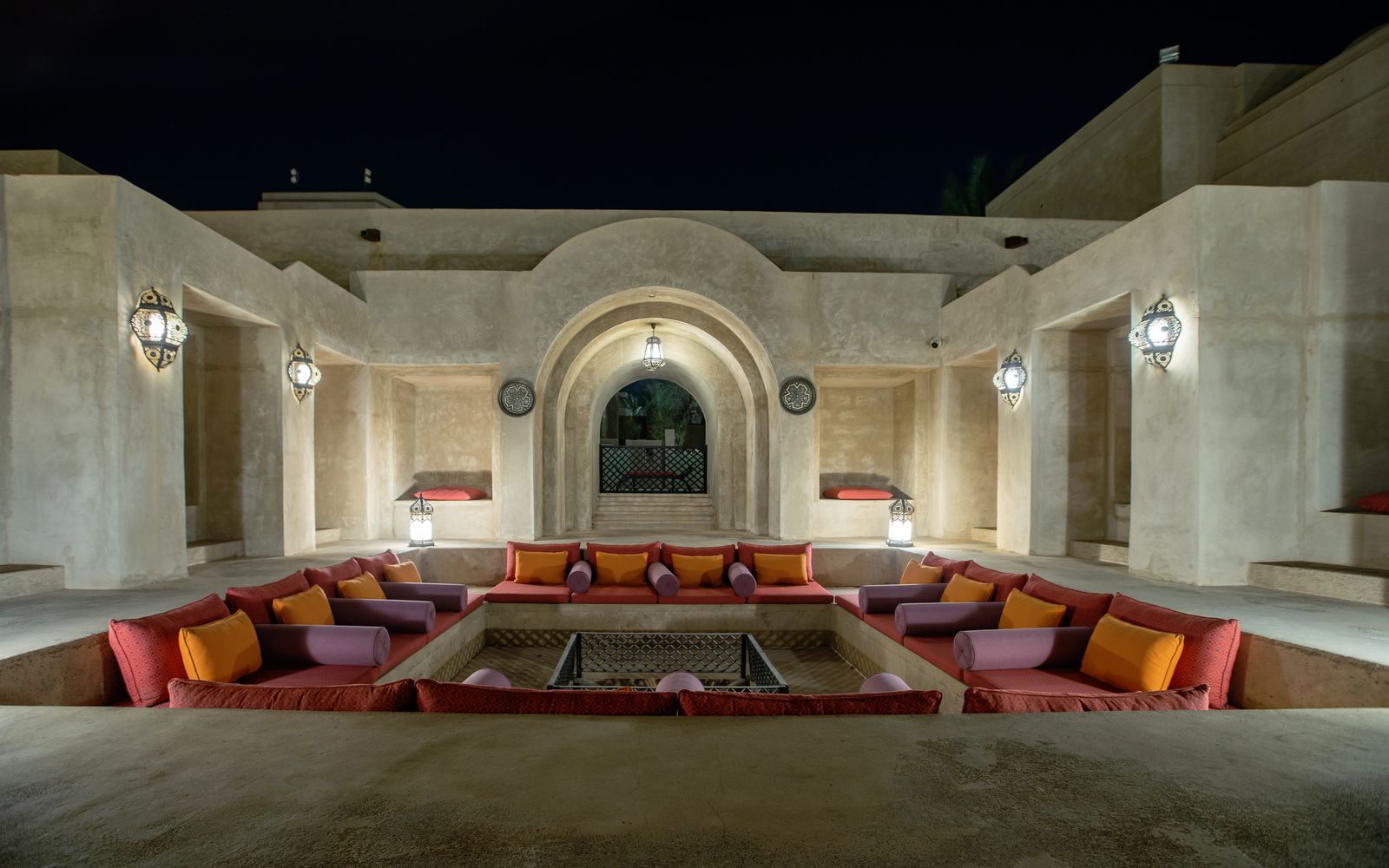
What most separates a real majlis from a decorated one is the seating logic. Seating runs around the perimeter so everyone faces inward, toward one another and the centre — nobody sits with their back to the room or facing a wall. This is the same perimeter thinking we covered in the majlis layouts guide, but here it carries social weight, not just capacity.
The head of the majlis
Every majlis has a sadr — the head, or seat of honour: the position deepest from the entrance, usually at the far corner or the centre of the far wall, reserved for the most senior or honoured person present, whether an elder, a sheikh, a visiting dignitary or the eldest of a visiting family. It is often subtly emphasised — a slightly deeper or wider seat, a distinct bolster, better sightlines down the room — but should read as the natural focal point, without throne-like theatricality.
Where the host sits
The host does not take the best seat. Traditionally he sits near the entrance, to rise and greet each arriving guest, watch the door, and signal the coffee server — the humblest position, nearest the door and first to stand, falls to the person whose house it is. So the seat closest to the entry needs clear sightlines to the door and down the seating, and easy access for standing and sitting repeatedly through an evening.
How guests are received
Guests are greeted individually in order of seniority, from the eldest down, and those already seated typically rise for elders. Newcomers are directed to seats matching their rank — the more honoured the guest, the closer to the sadr and further from the door. Qahwa is served starting from the right of the most senior guest. None of this is improvised; it is a shared code. Your layout has to make it effortless: an unobstructed path for the coffee server around the full perimeter, with a clear aisle of at least 90 cm in front of the seating so the server can move with a dallah and cups without leaning across anyone.
Sadu weaving and the textile language
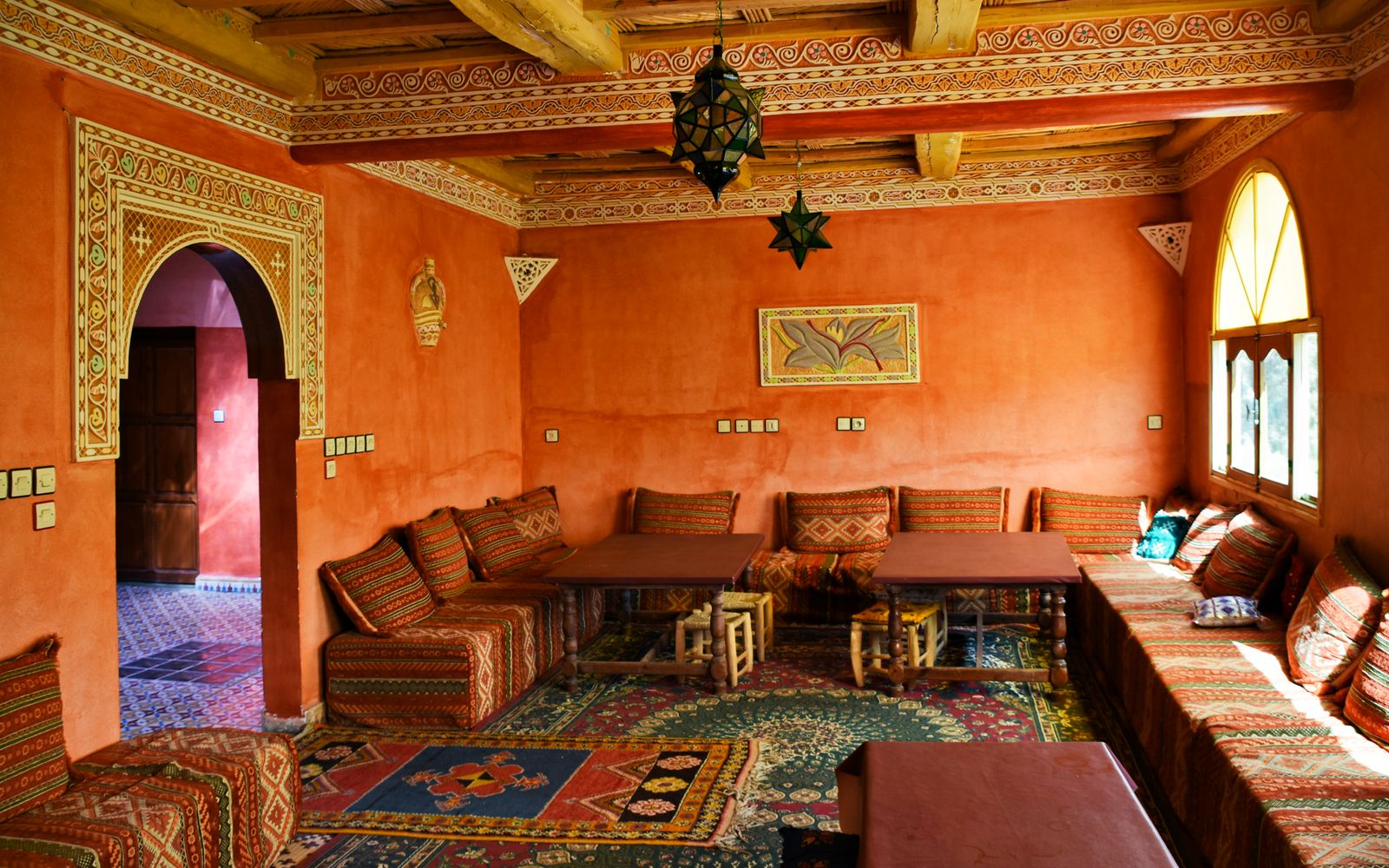
If one craft says “Gulf” instantly, it is sadu — the Bedouin flat-weave traditionally made by women on horizontal ground looms in sheep's wool, camel and goat hair. Recognised by UNESCO as intangible cultural heritage, sadu is built from tight geometric bands and tribal motifs in a disciplined palette: deep red, black, white and camel-brown, occasionally with an ochre accent. Each pattern carries meaning, referencing the desert, the family, protection.
The temptation is to upholster whole sofas in sadu or a sadu-print fabric. Resist it: at that scale the pattern flattens, the colours fight the room, and the effect reads as costume. Sadu works best in concentration:
- Bolster faces: the large side and back bolsters that define Khaleeji seating are the ideal home for sadu — a band of weave on the front face, plain linen behind
- A single runner or floor band across the centre of the room, framed by plain flooring
- One framed panel of genuine hand-woven sadu treated as art, ideally from an Emirati weaving cooperative rather than machine-printed
- Trim and edging: a narrow sadu border on an otherwise plain cushion or mattress edge
Pair it with quiet companions — undyed linen, natural wool, camel and sand tones — so the weave reads as a deliberate accent, not wallpaper. For how the same restraint plays out against a contemporary backdrop, the traditional versus modern majlis comparison is a useful companion piece.
Mashrabiya, carved gypsum and the architecture of craft
Beyond textiles, two architectural crafts carry the character: mashrabiya and gypsum (juss).
Mashrabiya
Mashrabiya — turned or latticed wooden screens — historically filtered harsh Gulf light, gave privacy, and let air move while women looked out unseen. In a modern majlis it earns its place symbolically and practically: a screen across a west-facing window cuts the low afternoon sun that otherwise turns a majlis into a furnace at 45–50°C outside, while casting a shifting geometric shadow across the floor. Use it as:
- A partition between majlis and entry lobby, or between men's and ladies' majlis — presence without a solid wall
- A window screen on hot elevations, backed by glass, dense enough to cut glare but open enough to keep the view
- A single backlit feature panel — one wall, not every surface
Commission it in a warm hardwood — walnut, teak-toned oak — with a geometry drawn from Gulf and wider Islamic patterning, and avoid the thin machine-cut MDF lattice that has become mass-market shorthand and warps in humidity swings.
Carved gypsum
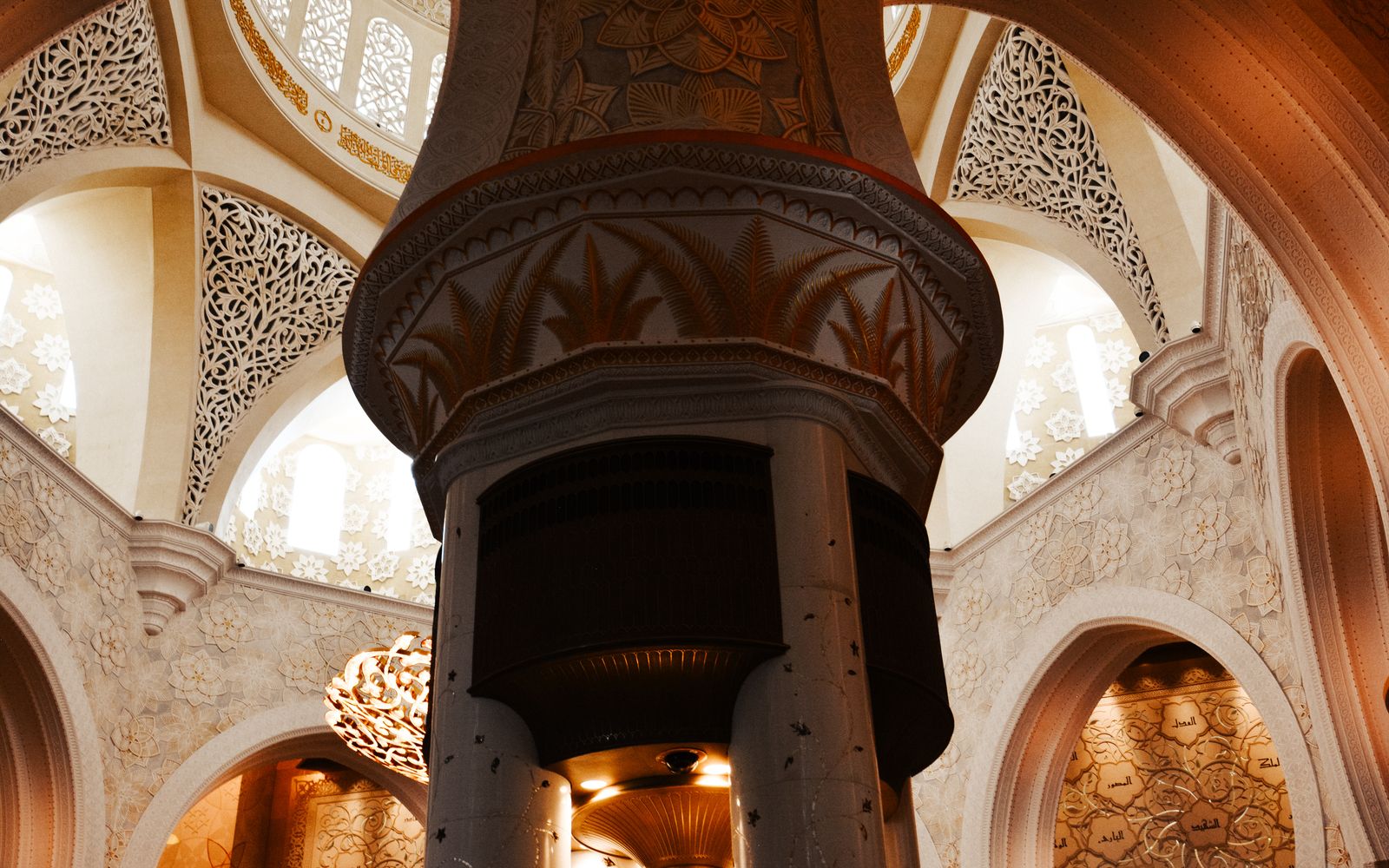
Hand-carved gypsum is the other signature — the crisp white relief of niches, borders, cornices and pierced screens that defined the old Gulf reception rooms. A single feature wall, or a run of gypsum roshan niches for displaying an incense burner and a coffee set, gives the room genuine depth of craft. Keep it white or a barely-warmed off-white, and to one or two surfaces: wall-to-wall carving overwhelms the seating and dates the room the day it is finished.
The qahwa ritual and its service objects
Nothing is more central to Emirati hosting than qahwa — the pale, cardamom-scented Arabic coffee served from a long-spouted dallah into tiny handleless cups (finjan), alongside dates. The ritual is itself the welcome, and the room should stage it properly rather than leaving it to a tray carried in from a distant kitchen.
- The dallah: the brass or steel coffee pot is both tool and emblem — it appears on the UAE's own coinage — and deserves a dedicated, beautiful place: a gypsum niche, a low console, or a built-in qahwa station
- Dates service: fresh dates on a brass or silver platter, offered before or with the coffee — surface for the platter within easy reach of the seating is essential
- Bukhour and the mabkhara: oud wood or bukhour burned in a mabkhara (incense burner) is passed around so guests can perfume their clothes — near the end of a visit, a signal the gathering is closing. Localised extraction or good cross-ventilation keeps the scent an event rather than something that permeates the whole villa
- Rosewater: some households still offer it — and it, too, needs somewhere to live and be served from
Practically, this means a service path and a service point. Coffee should reach the room from a discreet secondary door or pantry, not through the seated guests, and a built-in or freestanding station — a low buffet, a niche run, a qahwa corner — should be where the dallah, cups, dates and mabkhara belong. When the ritual has a home in the architecture the hosting flows; when it does not, every round of coffee becomes a small scramble. The same service-flow discipline anchors our guide to the Ramadan iftar majlis, where the coffee ritual runs every night for a month.
A restrained material and colour palette
The instinct with a “traditional” majlis is to reach for gold, jewel tones and heavy pattern everywhere. The more convincing heritage majlis does the opposite: it lets the crafts — sadu, gypsum, mashrabiya, brass — be the events, and keeps everything around them calm.
- Base palette: sand, bone, undyed linen, warm off-white gypsum, camel — the colours of the desert and the old houses, which also handle Dubai's daylight without glare
- Accents in concentration: the deep sadu reds and blacks, the brass of the dallah and mabkhara, one or two saturated bolster fabrics — not on every cushion
- Materials with provenance: solid warm hardwoods, hand-woven wool, natural stone or gypsum, aged brass — surfaces that read as made, not moulded
- Flooring: one large plain or subtly bordered rug over stone or timber, generous enough that all the seating sits on it — the majlis is grounded on a continuous covering, not islands of small rugs
- Ceilings: Dubai villa majlis rooms commonly run 3.0–3.6 m; a coffered timber ceiling or a simple gypsum cornice suits the proportion far better than an over-worked dome
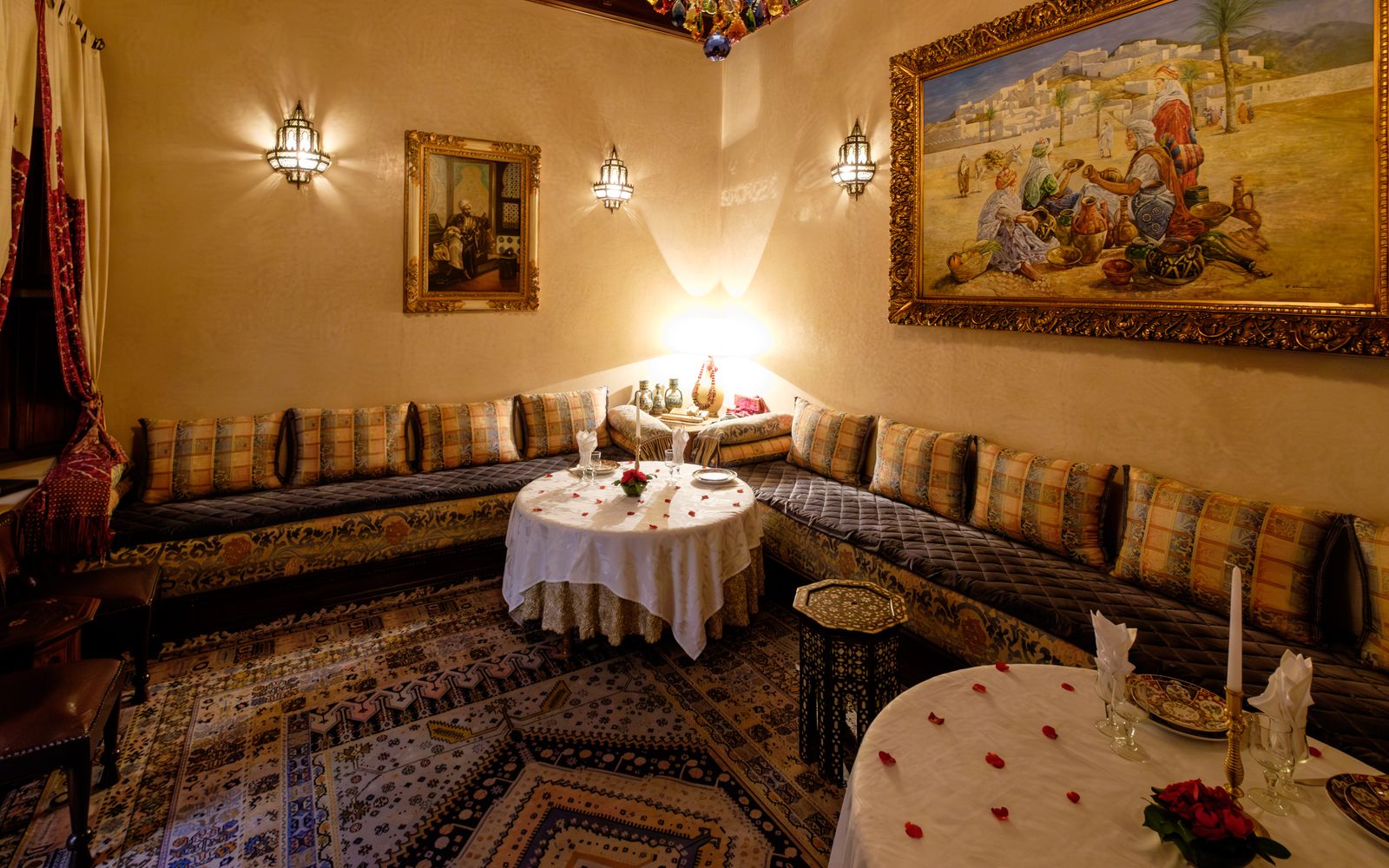
The seating follows the Khaleeji format: low, deep and firm, in fixed perimeter runs with substantial back and side bolsters. Seat height around 42–46 cm, seat depth 85–95 cm for relaxed long sitting, foam at 45+ kg/m³ so it holds shape through hours of hosting, and back bolsters up to 70–80 cm to support the shoulders during long evenings.
Honouring heritage without pastiche
Here is the discipline that separates the two outcomes. The failed heritage majlis distributes tradition — a little sadu here, a lantern there, arches on every opening, gold on every edge, fretwork on each wall — and looks borrowed, like a set. The successful one concentrates tradition and lets contemporary calm carry it.
A working test: identify your heritage moments and count them. Three or four is usually right — one gypsum or mashrabiya feature wall, one framed sadu or piece of named regional art, the qahwa station, and the bolstered perimeter seating. Everything else — walls, floor, ceiling, the bulk of the upholstery — stays quiet. Specific things to avoid:
- Sadu-print fabric across whole sofas — or worse, onto wallpaper and curtains too
- Pointed arches applied to every doorway and niche as pure decoration
- Machine-cut MDF “mashrabiya” on every wall, especially the flimsy kind that warps in humidity
- Gold everything — gilded furniture, gold ceiling, gold trim — which reads as banquet hall, not home
- Faux camel saddles, oversized decorative dallahs and desert props as ornament; the real service objects, used, always beat the stand-ins
- Theme-park literalism: a majlis should feel like a rooted, lived-in Emirati room, not a heritage-village re-creation
Authenticity here comes from restraint and real craft with provenance — a genuine hand-woven panel from an Emirati cooperative outperforms a wall of printed motif every time, precisely because it is allowed to stand alone.
The Khaleeji heritage majlis checklist
- Majlis at the front of the villa with its own or a semi-private entrance and a discreet qahwa service route
- Perimeter seating so every guest faces inward; nobody faces a wall
- A clear sadr — seat of honour deepest from the door for elders and honoured guests
- Host's seat near the entrance for greeting and watching the door
- A clear service aisle (90 cm+) around the perimeter for the coffee server
- Sadu used in concentration — bolster faces, one runner, one framed panel — not on whole sofas
- One mashrabiya feature or window screen in real hardwood, working with the climate — not on every wall
- One carved-gypsum feature wall or niche run, kept white and to one or two surfaces
- A dedicated qahwa station housing the dallah, dates platter and mabkhara, plus bukhour ventilation
- A restrained sand-and-bone palette with brass and deep-red accents concentrated, not distributed
- Three or four heritage moments, counted — everything else calm
The bottom line
A Khaleeji heritage majlis is not a style you apply; it is a set of relationships — between host and guest, elder and youth, ritual and room — that the design either serves or fights. Get the protocol right and the crafts restrained, and the room feels unmistakably Emirati without a single cliche: guests received in order, elders honoured at the sadr, qahwa from a station built to hold it, sadu and gypsum and mashrabiya as concentrated moments against a calm ground. That is the majlis that ages well and reads as rooted rather than performed — and it completes the majlis series we set out to build.
If you are designing or renovating a heritage majlis, our team handles full majlis design, bespoke Khaleeji seating and joinery, sourced sadu and commissioned mashrabiya from our Al Qusais workshop — at the showroom or on site at your villa.
Designing a heritage majlis?
Book a complimentary majlis design consultation. We'll review your hosting culture and protocol, propose a layout with a proper seat of honour and qahwa station, and return a complete heritage design with budget within two weeks.
Book a Consultation