A majlis is fundamentally a room for hosting. Get the layout wrong and no amount of fabric, joinery or chandeliers will rescue it — guests sit too far apart, conversation fragments, and the room never settles. Get the layout right and even a modestly furnished majlis hosts effortlessly. This guide breaks down the six layouts we actually use in current Dubai villa projects, with seating counts, room sizes and the architectural decisions that decide which one fits.
Start with two numbers
Before drawing any layout we ask the family two questions, and the answers decide everything:
- Maximum guest count at one sitting: the highest number of people the family realistically hosts in this room at once. Not the theoretical maximum — the actual count from the last three large gatherings.
- Frequency: daily intimate hosting, weekly mid-size, or occasional large gatherings only? The dominant use case decides the seating ratio between fixed and flexible.
A villa that hosts twelve weekly and twenty-eight at Ramadan needs a different layout than a villa that hosts thirty every Friday. Always plan for the dominant rhythm, then add 25–30 per cent buffer for peak.
The six layouts that work
1. The classical perimeter U
Three runs of sofa or banquette seating along three walls, with the fourth wall as the entry and feature wall. The classical Khaleeji layout, still the most common in formal Emirati majlis.
- Best for: formal hosting, very large guest counts, traditional families
- Room size: 40–70 m²
- Seating: 22–36 guests
- Ceiling height: 3.4 m minimum; 4 m+ for the most generous version
- Common mistake: running the U too long — if any sofa run exceeds 8 metres the centre of the room becomes a void and conversation breaks into clusters. Limit each run to 6–7 m maximum.
2. The dual U (large room split)
Two facing U-shaped seating groups arranged along the long axis of the room, each a self-contained conversation zone. Used in very large majlis where a single perimeter U would create dead space at the centre.
- Best for: rooms over 70 m² or with awkward long-rectangular footprints
- Room size: 70–120 m²
- Seating: 30–52 guests in two zones of 15–26 each
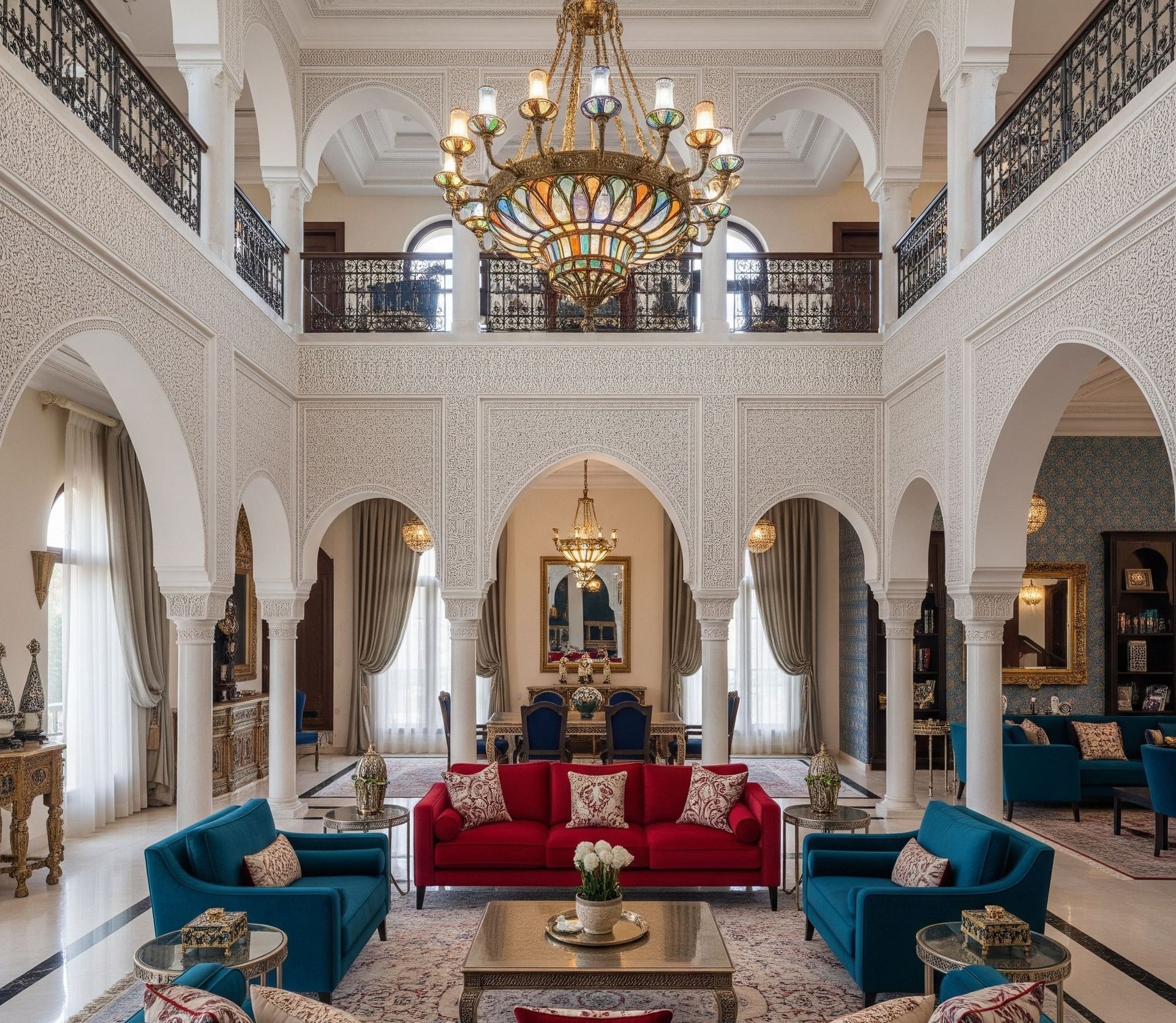
- Ceiling height: 3.6 m+; double-height (5–6 m) becomes spectacular
- Common move: a statement chandelier centred between the two zones unifies the room; a feature stone wall behind one zone anchors the formal end
3. The L-shape
Two perpendicular sofa runs forming an L, with armchairs completing the third side. The most relaxed and intimate majlis layout, increasingly popular in family majlis and contemporary villas.
- Best for: family majlis, daily-use spaces, smaller formal majlis
- Room size: 22–42 m²
- Seating: 10–18 guests
- Ceiling height: 3.0–3.5 m feels right; works in standard villa rooms
- Why it works: the open side faces the architectural feature (window with garden view, fireplace, art wall), making the room feel generous without requiring scale
4. The H-shape (twin facing sofas)
Two long sofas facing each other across a central table, with armchairs at each end forming the cross-bars of the H. The most conversational layout because every seat directly faces another.
- Best for: formal hosting where conversation matters more than maximum seating; clients who entertain a regular small-to-mid group
- Room size: 28–50 m²
- Seating: 12–22 guests
- Ceiling height: 3.2 m+; sofa scale matters — specify deep modular pieces with 90–100 cm depth
- Central feature: a long majlis table (180–240 cm) or a low Moroccan-style brass tray on legs. Allow 1.4–1.6 m between facing sofa edges.
5. The dual-orientation (two-zone formal)
A long room divided into two distinct seating zones by a console table, screen, or change in ceiling treatment. One zone is the entry/welcome group with two armchairs and a small sofa; the inner zone is the main conversation space.
- Best for: long narrow rooms, projects with strict hosting hierarchy (greet at entry, escort to main zone)
- Room size: 38–60 m² in a long format (typically 5×10 m or larger)
- Seating: 16–26 guests total across both zones
- Architectural detail: the transition between zones should be marked by a console, runner rug change, or a ceiling cove break — never let the room read as one long undifferentiated space
6. The modern open majlis
An open-plan arrangement of modular seating, ottomans and floor cushions around a central low table or fire feature. Less rigid than the U or H, designed for contemporary lifestyles where the majlis hosts a wide range of occasions.
- Best for: contemporary villas, families who entertain casually and formally in the same room
- Room size: 28–55 m²
- Seating: 14–26 guests; flexible with movable ottomans and floor cushions
- Trade-off: reads less ceremonial; not the right choice if the client values the formal Khaleeji aesthetic of fixed perimeter seating
For a deeper read on the modern majlis brief — cultural cues, materials, lighting — see our modern majlis design ideas guide.
The architectural decisions that drive the layout
Entry placement
The single biggest layout constraint. Guests entering a majlis should immediately see the centre of the conversation zone — not the back of a sofa, not the open side of a U, not the WC corridor. Entry on the long wall typically forces a dual-zone or H-shape layout. Entry on the short wall opens the room to U-shape, L-shape, or modern open arrangements.
Window orientation
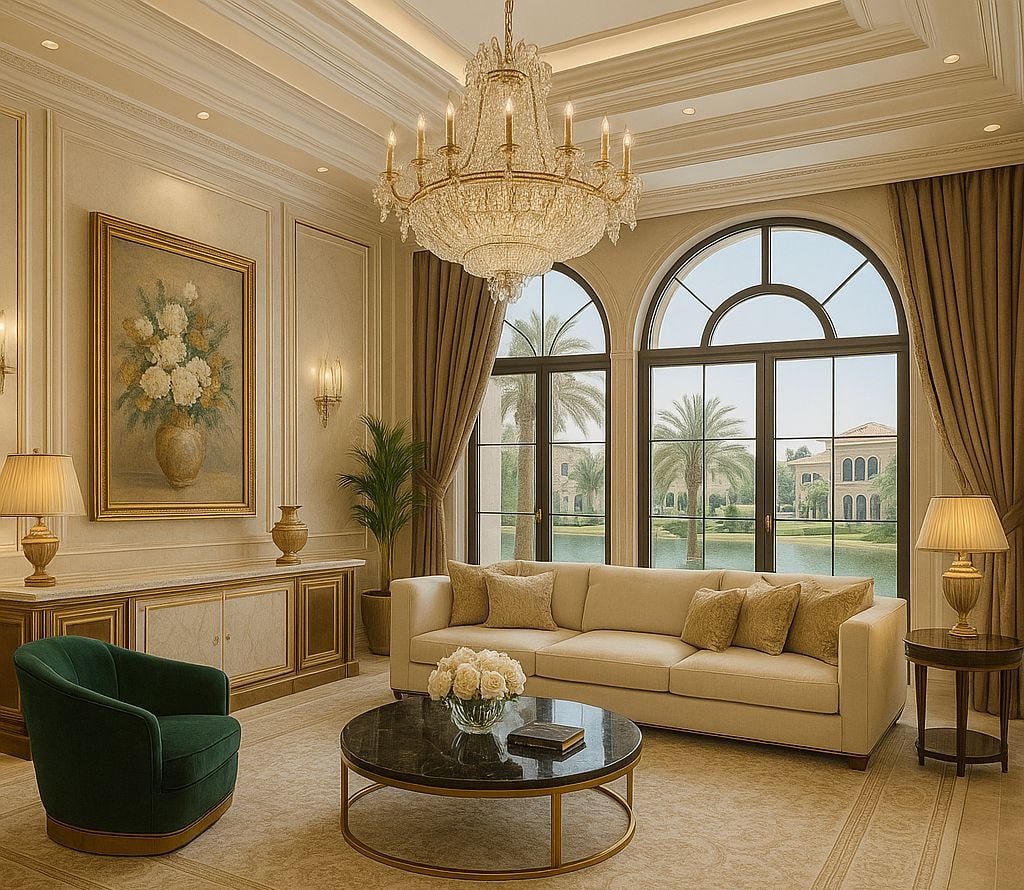
Wherever the room has its primary view (garden, golf course, sea), the seating arrangement should respect it. The honorific seat (where the host of honour sits) typically faces the view; the entry corner faces the room. Avoid blocking large windows with high-backed sofas — the room loses its best architectural moment.
Ceiling height
- 3.0–3.2 m — standard villa ceiling, L-shape or modern open layouts work; perimeter U starts to feel cramped
- 3.4–3.6 m — the comfortable luxury default; supports all six layouts
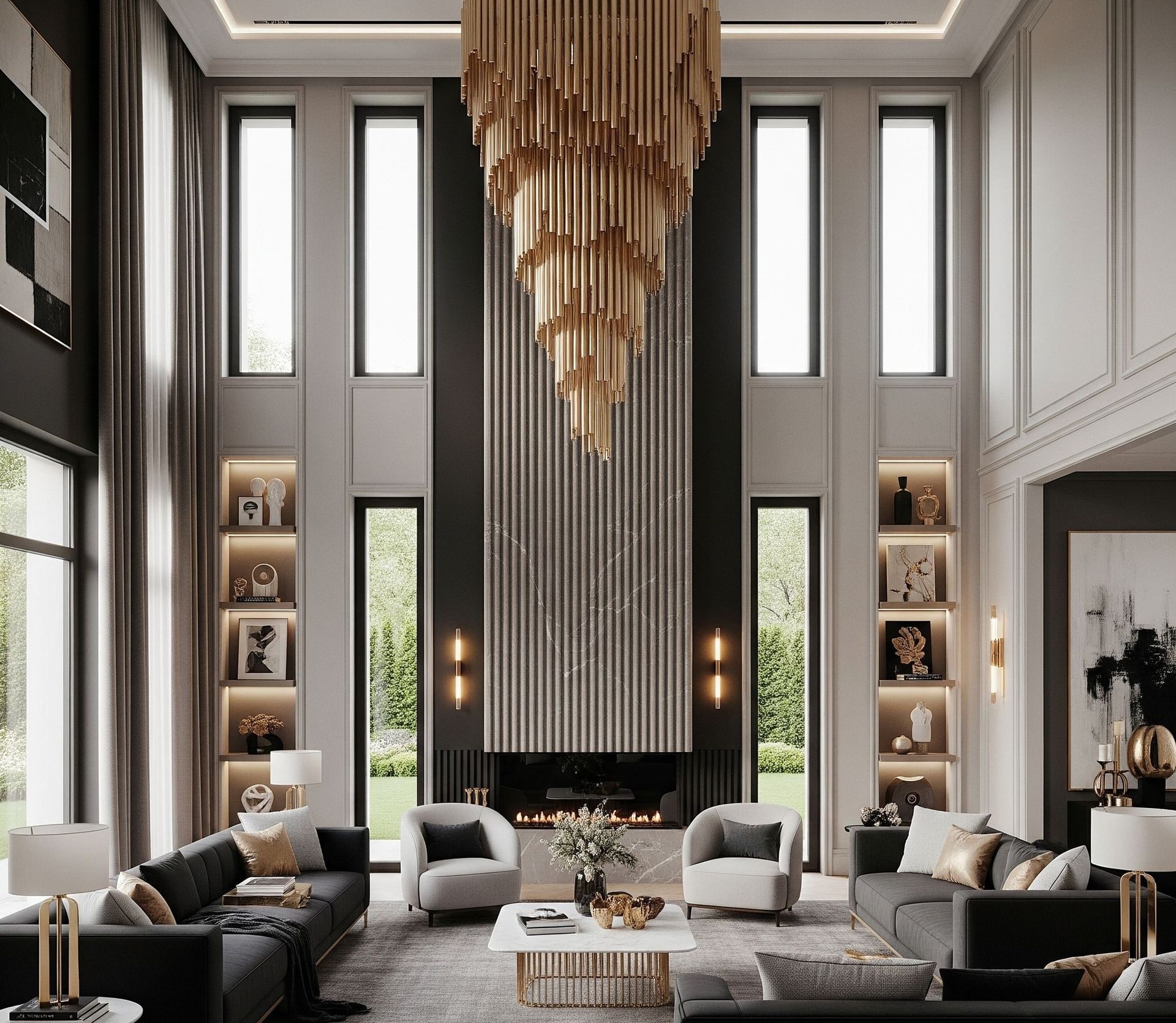
- 4 m+ or double-height — majlis becomes architectural showpiece; perimeter U, dual U, and dual-orientation come into their own with statement chandelier scale
Climate and acoustic considerations
A 30+ guest majlis is a hot room. Specify high-capacity AC distribution with diffusers placed away from where guests sit (cold air directly on the head ruins hospitality), heavy floor-length curtains for acoustic absorption (a stone-floor majlis without textile damping sounds like a tiled hall), and an integrated extraction or ventilation strategy if shisha or coffee preparation happens in the same room.
Men's vs women's majlis
In Emirati and Khaleeji villas, the brief still typically specifies two separate majlis spaces. The men's majlis is usually placed close to the entry — often with its own external door — for guests who don't enter the family quarters. The women's majlis sits deeper in the villa, often adjacent to the kitchen for service flow and connected to a private outdoor terrace.
- Men's majlis: typically larger, more formal, designed for occasional but large gatherings (Ramadan, weddings, condolences). Perimeter U or dual U are the most common.
- Women's majlis: typically warmer and more intimate, designed for regular smaller gatherings (tea, kitty parties, family visits). L-shape and H-shape are common; soft tones, more textile, lower lighting.
Younger Emirati families increasingly request one larger flexible majlis plus a smaller family majlis, treating gender separation as cultural-occasional rather than architectural-permanent. Expatriate clients commissioning villas often specify a single formal majlis for hospitality and use the family living room for everyday entertaining. Both briefs are valid; the architecture follows the family's actual hosting culture, not a template.
Seating and table dimensions that actually work
- Sofa seat depth: 75–95 cm. Deeper (90 cm+) for relaxed long-evening hosting; shallower (75–80) for upright formal seating.
- Sofa seat height: 42–48 cm. Standard for all but the most formal traditional rooms.
- Spacing between facing sofas: 1.4–1.7 m. Tighter and conversation becomes intimate; wider and it dilutes.
- Majlis table height: 35–45 cm. Low Moroccan-style tray tables sit at 25–30 cm.
- Armchair offset: if sofas have 90–100 cm depth, position armchairs 25–30 cm offset inward so their backs align visually with the sofa edge.
Most of our majlis sofa builds happen in our Al Qusais workshop — see our bespoke sofa guide for full construction and material detail, or browse custom sofas for current configurations.
Lighting layers for the majlis
Bright overhead light kills a majlis. Specify three lighting layers minimum, each on a dimmer:
- Statement central fixture: chandelier or pendant cluster scaled to the room. In a 4-metre ceiling the fixture often runs 1.5–2.5 m in vertical drop.
- Ambient recessed downlights: 2700–3000K, distributed to wash walls and seating zones, dimmable.
- Accent lighting: sconces flanking key wall features (carved gypsum, mashrabiya panels, art), table lamps on console tables, picture lights on framed Quranic calligraphy or art.
- Optional cove lighting: indirect LED in a perimeter cove or behind a ceiling reveal — the single most evening-transforming addition. We specify this in nearly every majlis we design.
For a complete room-by-room lighting strategy, see our lighting design guide.
The majlis-layout checklist
Before signing off any majlis floor plan, confirm:
- Hosting maximum is on paper; layout supports that count plus 30 per cent buffer
- Entry sight line falls on the room's strongest architectural moment
- No sofa run exceeds 7 m without a break or zone change
- Facing sofa spacing is 1.4–1.7 m
- Honorific seat faces the view, not the entry
- AC diffusers are not directly above any guest seat
- Three lighting layers, all dimmable, three scenes minimum
- Heavy floor-length curtains specified for acoustic absorption
- Side tables or low tables within easy reach of every seated guest
- Path from entry to seating is clear of obstacles for guests in long thobes
The bottom line
A majlis layout is a hosting choreography written in furniture. Decide the dominant hosting rhythm, pick the layout that supports it without strain, respect the entry sight line, get the spacings right, and add architectural lighting layers. The room then hosts effortlessly whether it's eight guests for Friday lunch or thirty-two for Ramadan.
If you're planning or renovating a majlis for a Dubai villa, our team handles full majlis design, custom sofa and table manufacturing, and the joinery and lighting integration that finishes the room. Book a complimentary consultation at our Al Qusais showroom or on site.
Designing a new majlis?
Book a complimentary majlis design consultation. We'll review the brief and floor plan, propose the right layout for your hosting rhythm, and return a complete design with budget within two weeks.
Book a Consultation