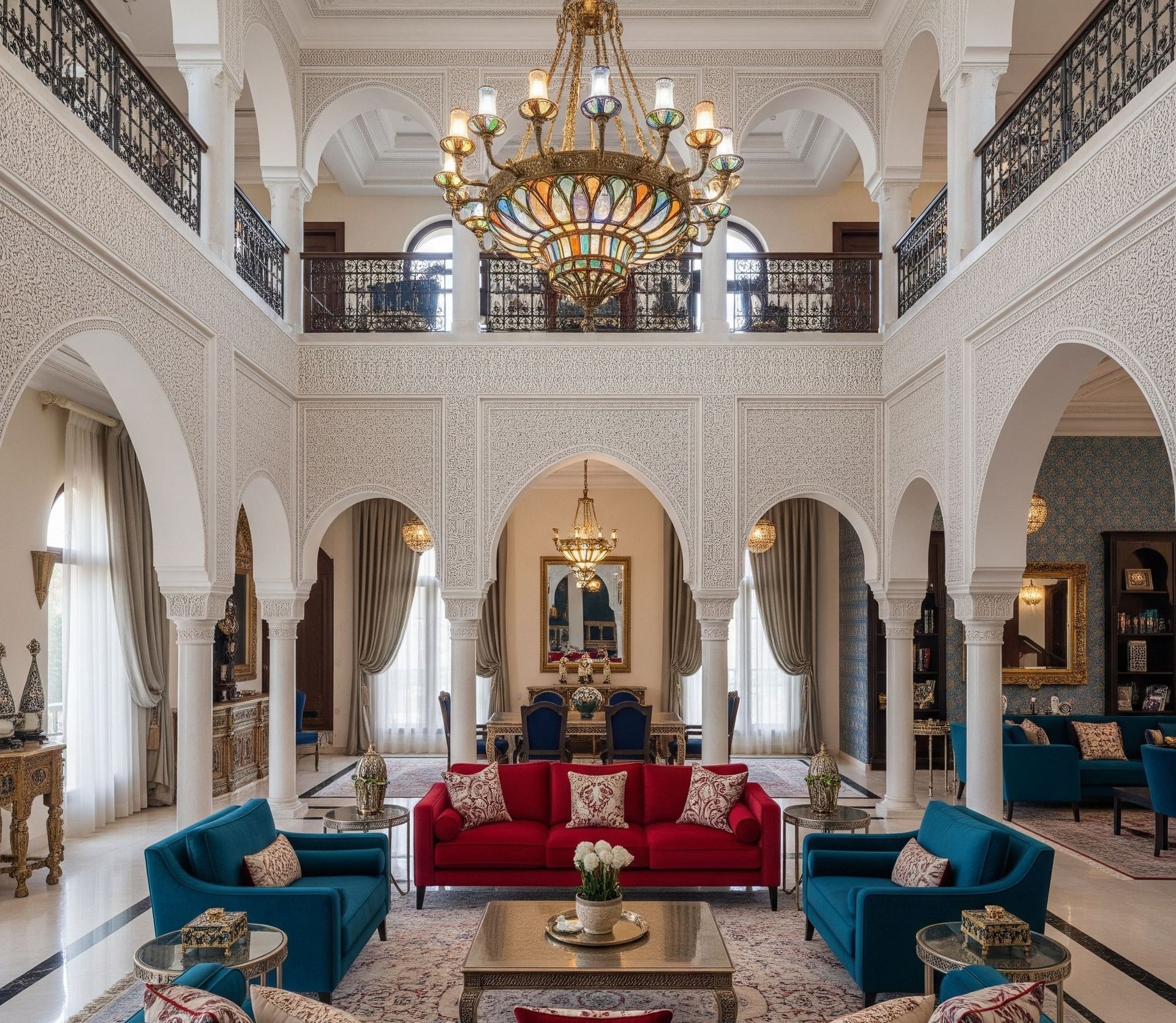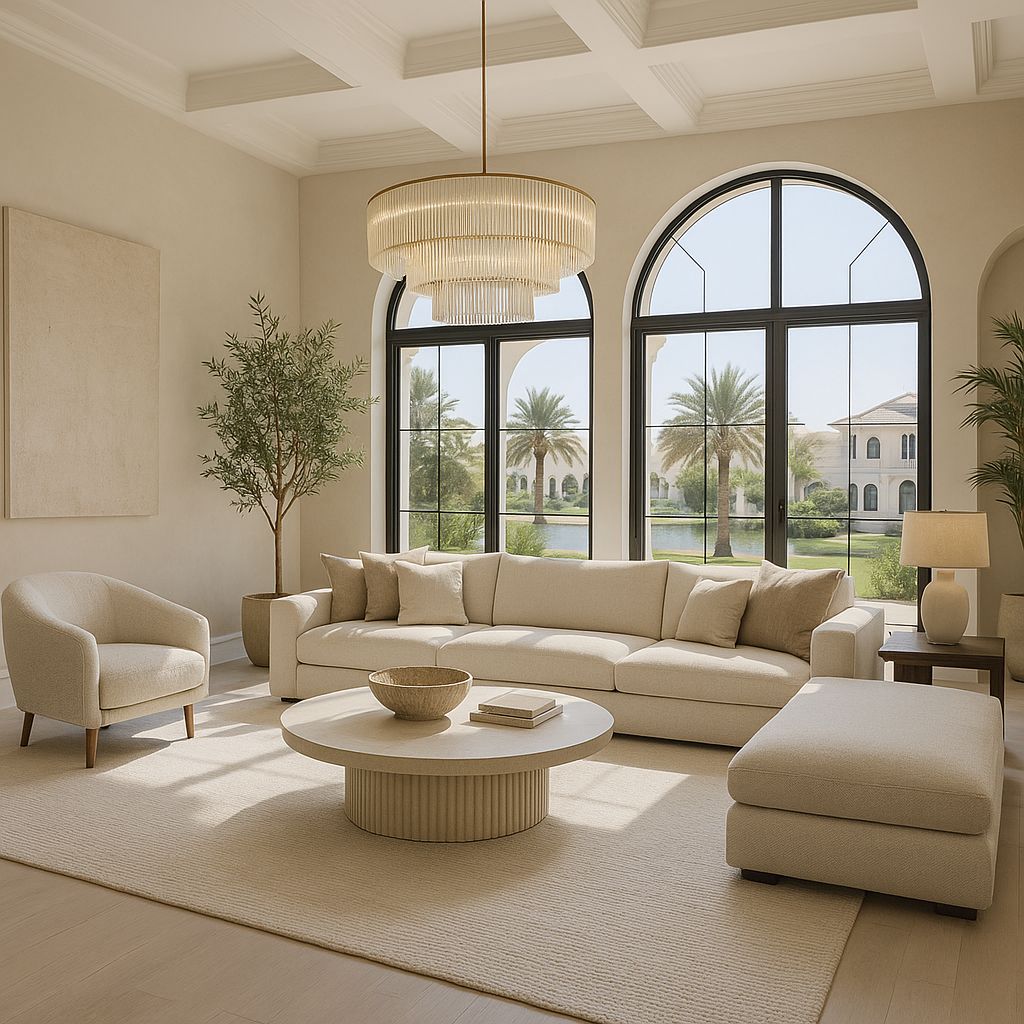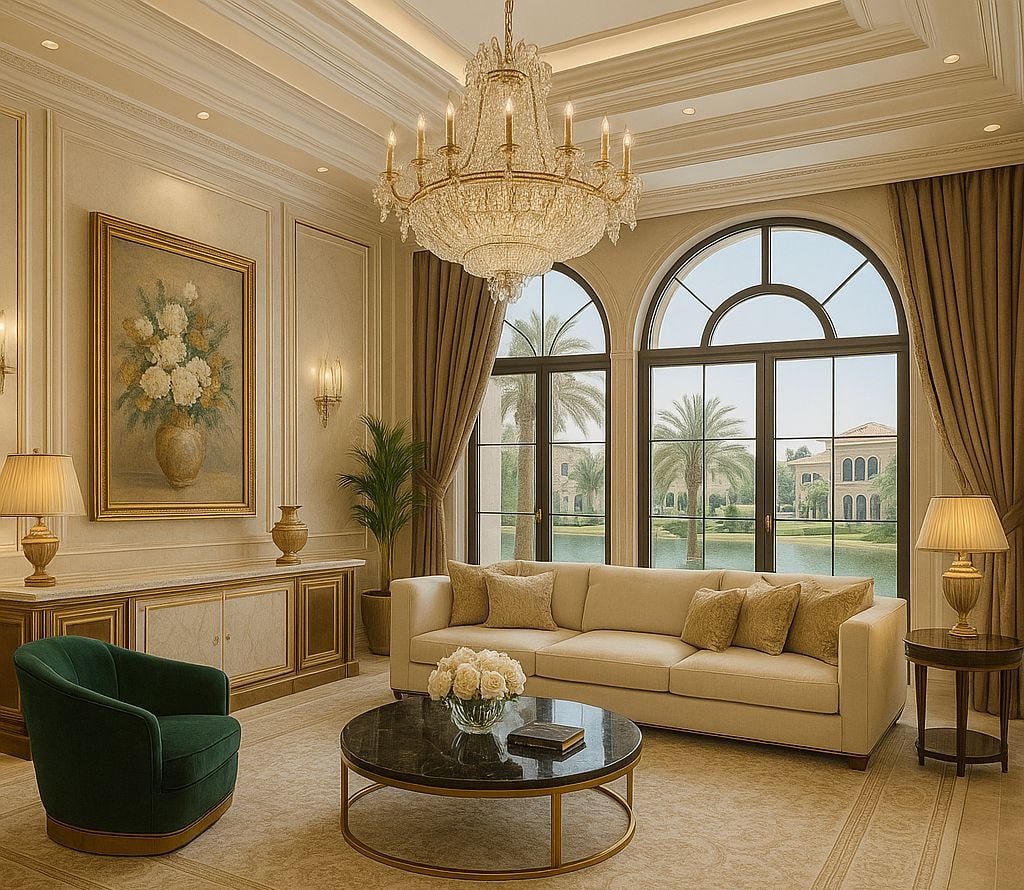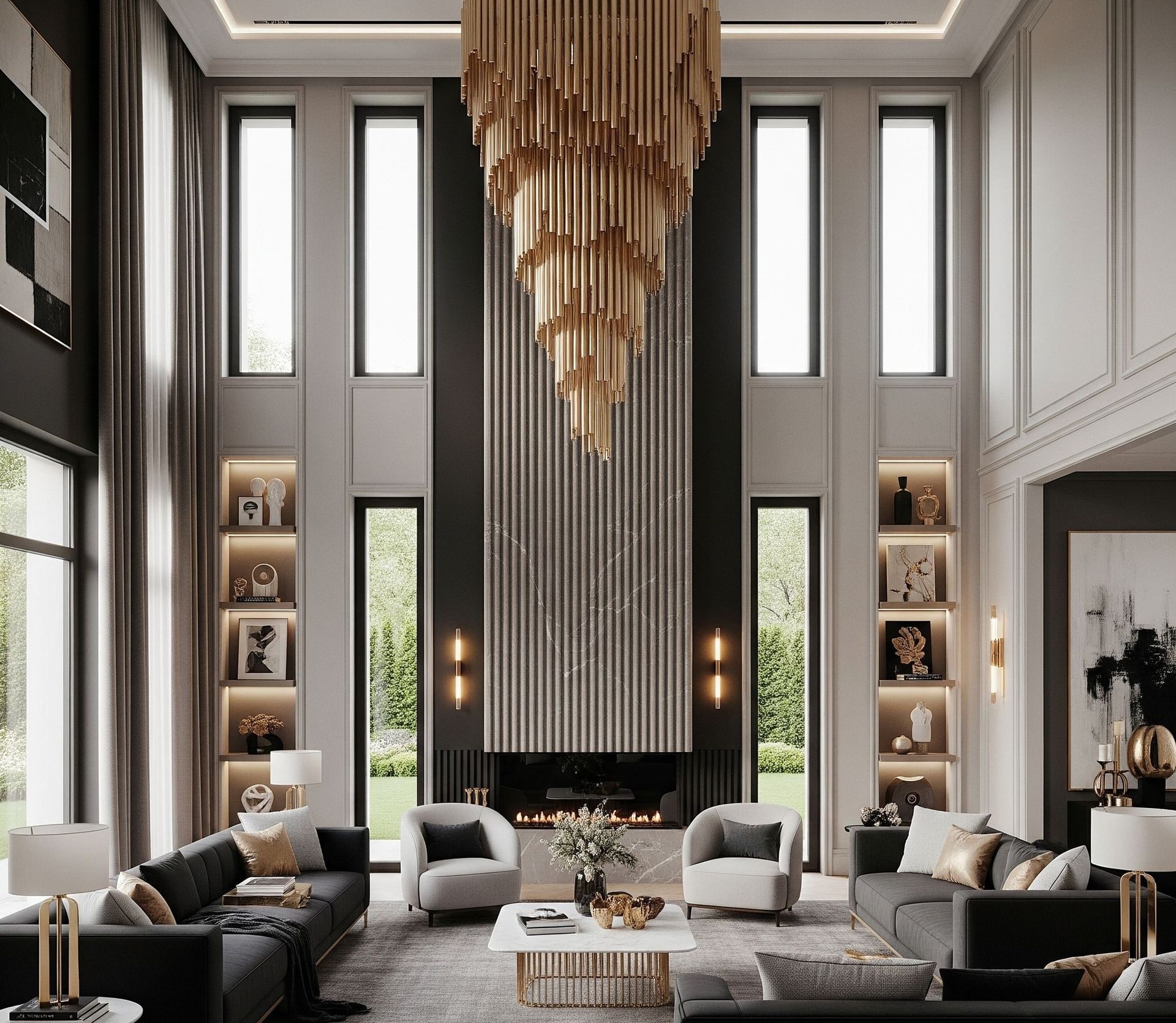
Lighting is the most under-budgeted line item on most luxury Dubai projects — and the most consequential. A villa with brilliant materials and weak lighting reads as ordinary. A villa with average materials and brilliant lighting reads as memorable. After completing fit-outs across Emirates Hills, Palm Jumeirah, Downtown and Dubai Hills, our team has settled on a few rules we apply on every project. This is the room-by-room guide.
The four layers of lighting
Every well-lit room in a luxury home has four light layers working together. Take any one away and the room loses dimension.
- Ambient. The base layer. Recessed downlights, cove lighting, ceiling fixtures. Provides general visibility.
- Task. Focused light for specific activities — reading, food prep, dressing, makeup. Lamps, under-cabinet, vanity lighting.
- Accent. Light that draws the eye to art, architecture, joinery or feature surfaces. Wall washers, picture lights, niche LEDs.
- Decorative. Fixtures that are themselves part of the design — pendants, chandeliers, sculptural floor lamps. They can produce light, but their primary role is visual.
Specifying only ambient is the single most common lighting mistake. The result: a flat room with no focal point and no atmosphere.
Colour temperature: the 2700K–3000K rule
Colour temperature is measured in Kelvin (K). Lower numbers are warmer, higher are cooler. For luxury residential in Dubai, the rule is simple:
- 2700K — living rooms, bedrooms, majlis, dining rooms. Soft, candle-warm, flattering to skin tones, complimentary to wood and brass.
- 3000K — kitchens, bathrooms, dressing rooms, study. Slightly crisper for task work without becoming clinical.
- 4000K — service areas only (laundry, garage, MEP rooms). Never in occupied living spaces.
- 2200K dim-to-warm — the luxury upgrade. Fixtures that warm as they dim, mimicking incandescent behaviour. Worth the premium in living and dining areas.
Developers default to 4000K. Always re-spec to 2700K–3000K before snagging.
CRI: the underrated specification
Colour Rendering Index (CRI) measures how accurately a light source renders colours compared to natural daylight. A CRI of 100 is perfect. For luxury interiors:
- CRI 90+ minimum for any residential fixture.
- CRI 95+ mandatory in art-display areas, dressing rooms, makeup areas and any space where colour fidelity matters.
- Below CRI 90, leather looks dead, art looks flat, food looks unappetising. Cheap LEDs often sit at CRI 70–80 — avoid.
Living Room
The living room takes the most layers, the most dimming scenes, and the most decorative fixtures. It also gets the most use.
- Ambient: 2700K recessed downlights spaced for even fill, all on dimmers. Avoid the over-lit grid — one downlight per 1.8–2.2 m² is plenty if you have other layers.
- Cove lighting: warm linear LED in ceiling perimeter coves transforms a flat ceiling into a feature. Use 2700K, hidden behind a 10–15 cm cove return.
- Task: a reading floor lamp beside the primary reading position, table lamps on side tables. These do most of the evening work.
- Accent: wall washers on the art wall and feature stone. Adjustable so you can re-aim when art changes.
- Decorative: a sculptural pendant or chandelier that anchors the seating arrangement — not centred on the room, but centred on where people sit.
- Scenes: "morning bright", "afternoon dim", "evening warm", "movie", "entertaining". Programme these into the smart control at commissioning.
Majlis
A majlis lives or dies by its lighting. Get this wrong and the room feels like a hotel lobby. Get it right and it feels like the heart of the home.
- Statement central pendant or chandelier — this is one of the few rooms where the decorative light is the design statement. Scale it generously.
- Layered ambient — recessed downlights provide fill without competing with the chandelier.
- Wall sconces on either side of any seating bay — warm, low, intimate. Critical for the late-evening atmosphere.
- Hidden floor cove at the base of feature walls or seating platforms — gives the room a "floating" quality favoured in modern majlis design.
- Dimming scenes for prayer, reception, late-night conversation. These are non-negotiable in a serious majlis.
For a deeper take on majlis design, see our Modern Majlis Design Ideas Dubai.
Dining Room
Dining lighting is a study in restraint. The table is the focus.
- Pendant or linear suspension over table at 75–85 cm above the tabletop. Lower for intimate, higher for grand.
- Wall washers on art — not too bright, not flat. Aim to gently outshine the pendant during conversation.
- Cove or perimeter lighting on the lowest setting for dining; pull up for buffet or service.
- Skip the downlight grid above the table. A single statement pendant plus reflected light from walls is the entire luxury dining lighting scheme. Multiple downlights wash out the pendant and kill the mood.
Kitchen
Kitchens need more light and more layers than any other room. Get the technical right; let the decorative do the talking.
- Ambient: 3000K recessed downlights on the ceiling. Allow generous coverage — this is task-heavy space.
- Under-cabinet LED: non-negotiable. Strip lights with diffusers, hardwired. Eliminates the shadow line on the worktop.
- Pendant lights over island: the kitchen's decorative moment. Three matching pendants for an island over 2.4 m, two for shorter. Hung at 75–85 cm above the worktop.
- Inside-cabinet LED on display cabinets and pantry — touch-on or motion-activated.
- Toe-kick LED for night use — a subtle line of light at the base of cabinets, on a separate switch or scene.
Master Bedroom
Bedrooms reward subtlety. The goal is layered warmth, not brightness.
- Ambient: minimal recessed downlights at 2700K, on heavy dimming. Often clients use these only at full brightness when getting dressed.
- Bedside reading lights: wall-mounted swing-arms or low pendants that free up the bedside table. Independent left/right switching.
- Cove behind headboard or behind a feature wall — transforms the bed wall into a backlit feature.
- Accent wash on art or one feature wall, dimmable.
- Floor-level "guide" LED behind bedside or under bed for night navigation, motion-activated, 1800–2200K so it doesn't disturb sleep.
Dressing Room & Walk-In Wardrobe
Dressing rooms are where bad lighting is most painful. Skin tone reads wrong, fabric colour reads wrong, you walk out the door looking different from what you saw in the mirror.
- 3000K, CRI 95+ minimum. Anything less makes outfit selection guesswork.
- Vertical illumination on the body — wall sconces flanking the full-length mirror at face height. Avoid only-overhead lighting which casts harsh shadows under eyes and chin.
- LED strips inside wardrobes — motion-activated. Worth the wiring effort.
- Display lighting for shoe shelves, watch displays, jewellery cabinets — museum-quality LED with UV filtering.
Bathroom
The bathroom is part luxury sanctuary, part task room. Different times of day, different lighting.
- Mirror lighting: vertical sconces flanking the mirror at face level. Backlit mirrors look beautiful but are useless for makeup — pair them with face-level fixtures.
- Ambient: 3000K recessed downlights. Avoid only above the mirror — harsh shadows.
- Shower lighting: IP-rated downlight over the shower zone. Add a chromotherapy strip if you want to elevate to spa-luxury.
- Mood light: a warm 2200K wall sconce or low pendant for evening baths. Linked to a "spa" scene with all other lights down to 10%.
- Toe-kick LED beneath vanity for night-time visits.
Outdoor & Landscape
Dubai outdoor lighting is its own discipline. Heat, dust, salt air and water exposure all demand specific specifications.
- IP65 minimum, IP67 for any near-water fixture. Marine-grade for Palm Jumeirah and coastal villas.
- 2200–2700K only. Outdoor white light at 4000K screams car park.
- Layer principles still apply. Path lighting, accent lighting on trees and water features, decorative pendants on terraces, ambient cove for outdoor dining areas.
- Avoid up-lighting that hits villa windows from below. Glare into the bedroom is the most common outdoor lighting complaint.
- Smart control: integrate landscape lighting into the same scene system as interior. "All off" should mean both.
Smart Control
Single biggest upgrade in luxury home lighting in the past decade. Without it, you have wall switches and lights. With it, you have an interior that adapts to time, occasion and mood.
- Lutron RA2 Select or HomeWorks QSX — the cleanest, most reliable system for most luxury Dubai homes. Best Dubai integrator support.
- Crestron — the choice for very large villas or homes with deep AV integration. Most customisation; highest cost; needs a serious integrator.
- KNX — the European open standard. Future-flexible, multi-vendor, popular for villa fit-outs in Emirates Hills and Al Barari.
- Avoid consumer-grade smart bulbs (Philips Hue, Lifx) on luxury projects. They drop offline, lag in scenes, and look unprofessional in the wall app.
Scenes worth programming
- Morning — full ambient at 80%, drapery open, kitchen full
- Day — ambient at 30%, accents off, drapery as needed
- Evening — ambient at 40%, all decorative on, accents on, drapery closed
- Entertaining — ambient at 30%, decorative bright, accents bright, dining at full
- Movie — ambient off in viewing zone, cove at 20%, path lighting only
- Late night — floor-level guide lights only, 1800–2200K
- All off — everything down, except security path lighting outside
Common mistakes to avoid
- Specifying only ambient downlights and calling it "lighting design"
- Defaulting to 4000K because that's what the developer installed
- Buying decorative pendants without integrating their light output into the room's overall scheme
- Skipping cove lighting because "it adds cost" — cove lighting is the single best return-per-dirham in luxury lighting
- Hard-wired wall switches everywhere instead of scene control — means lights will be used wrong forever
- Ignoring CRI on art-display areas
- Outdoor and indoor lighting on separate, uncoordinated control systems
- Unprotected up-lighting that glares into windows
The bottom line
Lighting is what makes a luxury interior feel inhabited rather than installed. Spend the money on layers, dim everything, hold the line on 2700K–3000K, programme proper scenes, and use a smart control system that will still be serviceable in ten years. Done well, lighting is invisible — you notice the room, not the fixtures.
Every villa and penthouse we deliver includes a full lighting design as part of the interior brief. Speak to our team if you'd like a lighting walkthrough of a project you're planning.
Planning a luxury fit-out in Dubai?
Our interior design service includes complete lighting design, smart control specification and integrator coordination. Book a private consultation with our team.
Book a Consultation