No design question in a Dubai villa brief recurs more often than this one: traditional or modern majlis? It is rarely a binary choice in our experience, but the conversation matters because the two approaches arrive at very different rooms even when they perform the same hosting role. This is an honest, side-by-side designer's view from a workshop that has built both in equal measure.
What we mean by each
Traditional majlis
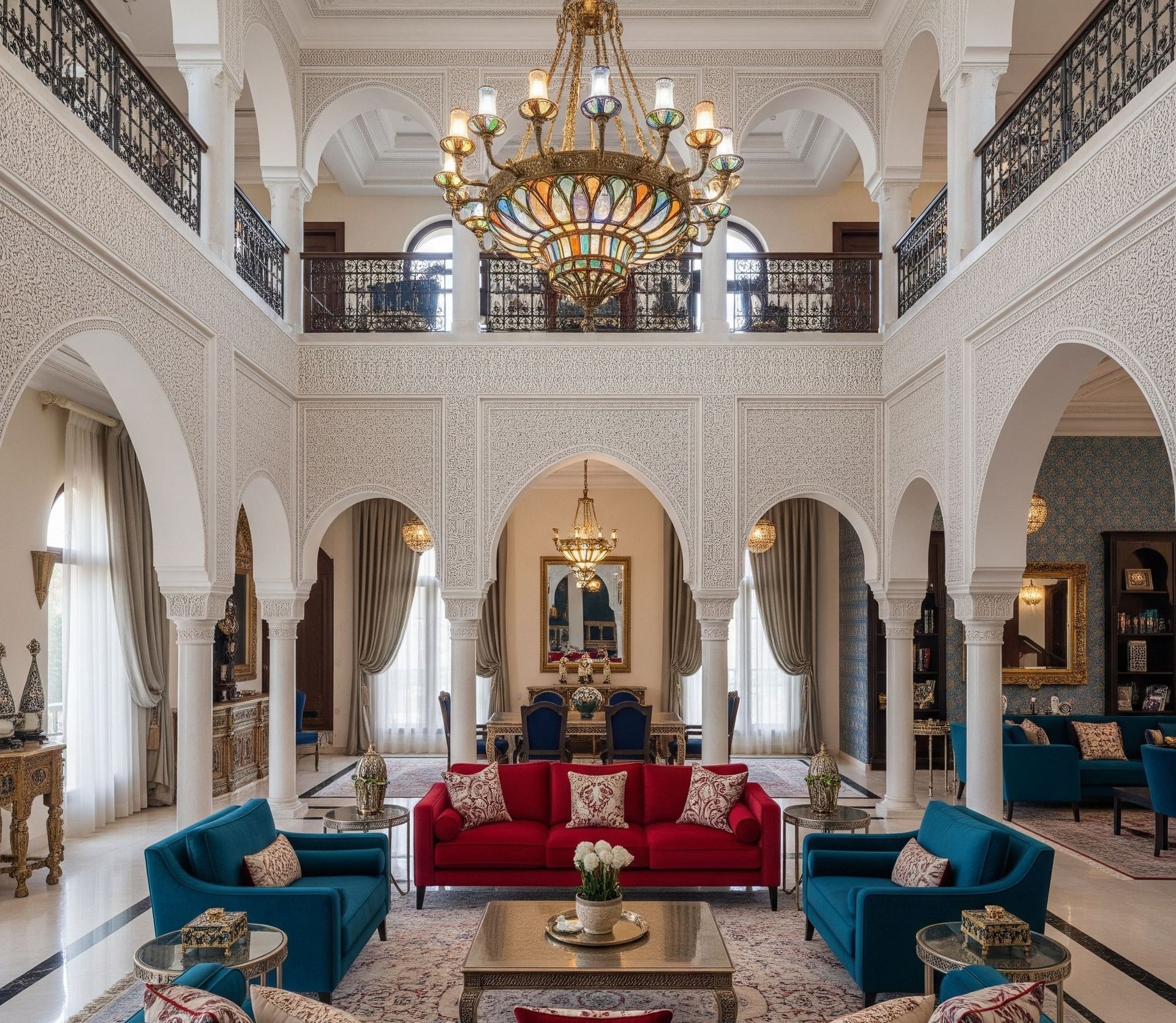
The Khaleeji formal majlis: fixed perimeter seating along three walls (typically a U-shape), heavy Arabic ornament (carved gypsum cornices, mashrabiya panels, gilt detail), warm jewel-tone palettes (deep reds, emeralds, royal blues, gold), elaborate ceiling treatments (often a central rose with a chandelier suspended from a dome or coffered surround), Quranic calligraphy on a feature wall, and the immediate visual signalling of Arab hospitality. The hosting choreography is also traditional — honorific seating, formal greeting, oud incense, qahwa service from a dallah.
Modern majlis
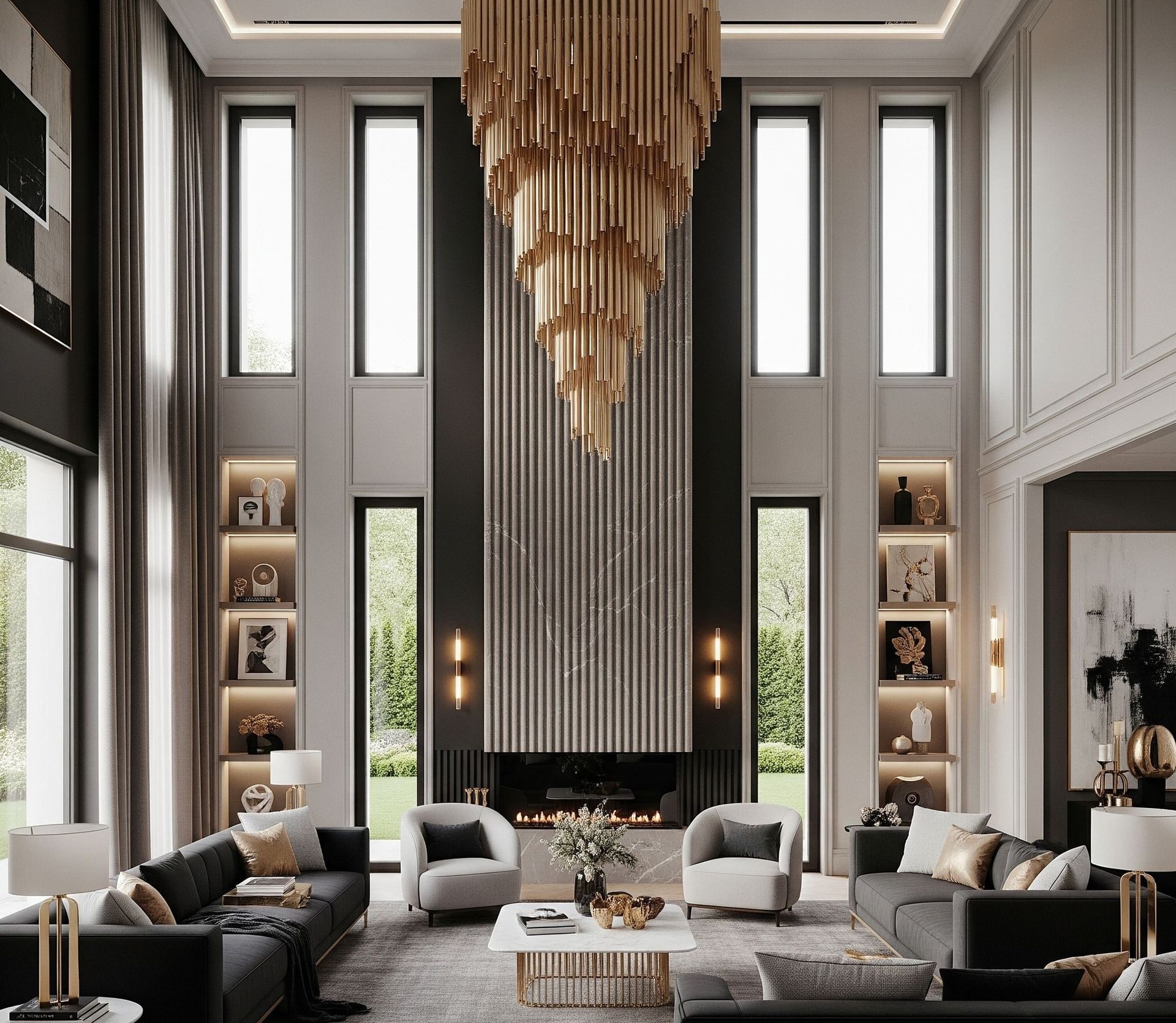
A contemporary take: more flexible modular seating (L-shape, H-shape, or open arrangement), a restrained palette (linen, wool, stone, smoked oak, brushed brass), considered architectural detail rather than literal motif (a fluted wood feature wall instead of mashrabiya carving; a bookmatched stone wall instead of carved gypsum), softer cove lighting layered with sculptural pendants instead of a single ornate chandelier, and a hosting culture that is more conversational and less ceremonial. The majlis still hosts at scale; it just signals contemporary design vocabulary instead of historical reference.
Where they actually differ
Layout and seating
Traditional majlis nearly always uses fixed perimeter U-shape seating, scaled for maximum hosting capacity. Modern majlis more often uses L-shape, H-shape, or modular open layouts, scaled for the dominant hosting rhythm rather than the theoretical peak. For deeper layout detail see our majlis layouts guide.
Materials
- Traditional palette: heavy upholstery (velvet, silk, brocade), carved hardwood frames, hand-glazed tiles, decorative metalwork (brass, copper), oriental rugs (Persian, Caucasian), gilt finishes
- Modern palette: linen, wool, performance velvets, smoked oak, walnut, travertine, bookmatched marble, brushed brass or gunmetal, contemporary rugs (Kvadrat, Designers Guild)
Joinery and architectural detail
- Traditional: carved gypsum cornices and ceiling roses, mashrabiya wooden screens, hand-carved arches, Mughal-influenced inlay, mother-of-pearl detail
- Modern: fluted oak or walnut wall panels, plain plaster ceilings with reveals and coves, statement bookmatched stone walls, framed art or sculpture in place of literal cultural motif
Lighting
- Traditional: a single statement chandelier centred on the room, often crystal or ornate brass; warm pools of light from wall sconces; minimal indirect lighting
- Modern: three-to-five layered lighting (chandelier or pendant cluster, recessed downlights, cove indirect, sconces, table lamps); all dimmable with three scenes minimum
Colour
- Traditional: jewel tones — deep reds, emerald, sapphire, royal blue, with gold and ivory accents
- Modern: earth tones — warm whites, stone, taupe, sand, muted greens and blues, with one accent jewel tone used sparingly
Budget
Both can be executed at any budget. At the luxury level, traditional majlis tend to cost more because they accumulate bespoke ornament — carved gypsum runs per linear metre, mashrabiya panels priced by the square metre, gilt finishes, hand-glazed tiles, decorative metal hardware. Modern majlis cost less per square metre at parity because they substitute considered architecture (a fluted wood wall) for accumulated ornament (a carved-gypsum ceiling). Rough order-of-magnitude:
- Traditional formal majlis: AED 450,000 to AED 2,500,000 turnkey, including custom seating, joinery, lighting, stone and decorative finishes
- Modern formal majlis: AED 280,000 to AED 1,400,000 turnkey, comparable scope and quality of build
Where they overlap
The functional and cultural fundamentals remain identical across both approaches:
- Hosting capacity is the design driver in both cases
- Heavy floor-length curtains are essential for acoustic absorption regardless of style
- AC distribution must avoid blowing on seated guests (the most common comfort failure across both styles)
- Qahwa, dates, oud and chai service expectations are universal — storage and serving paths need to be designed in
- Both styles benefit from a separate prep kitchen or scullery for service, never from the main show kitchen
- Floor-to-ceiling proportion matters in both; 3.4 metre+ ceilings serve either approach well
How to blend them well
Many of our current commissions land in the middle — what we call the “considered modern majlis” or “refined traditional majlis” depending on which side it leans. Successful blending follows three principles:
1. Decide which axis dominates and which contributes
Pick one approach as the architectural anchor and let the other contribute notes rather than competing. A modern majlis with a single ornate Moroccan brass tray table or one antique heritage piece reads as considered. A traditional majlis with one contemporary sculpture or art piece reads as confident. What you cannot do is split the room evenly between the two and expect coherence.
2. Modernise the architecture, traditionalise the textiles (or vice versa)
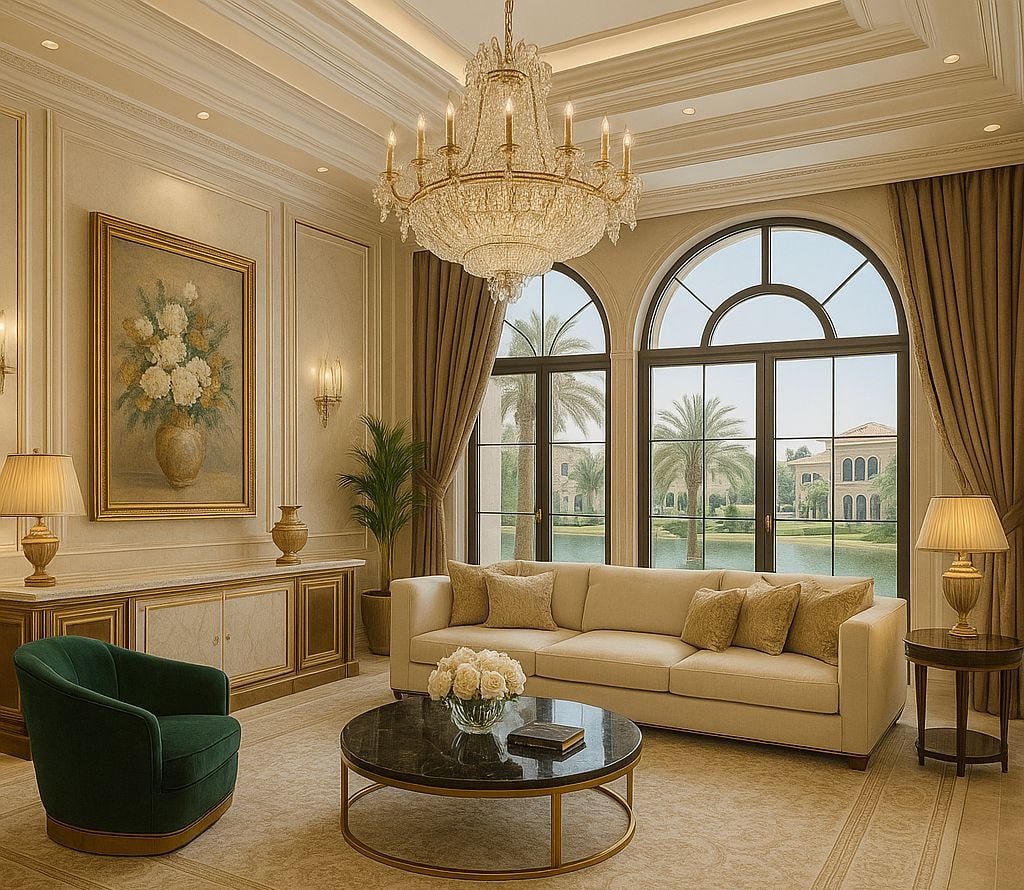
The most successful hybrid rooms we have built use modern architectural detail (plain ceilings with cove lighting, fluted wood walls, bookmatched stone) paired with traditional Khaleeji upholstery (deep velvet sofas, heavy curtains in jewel tones, oriental rug under the central table). The architecture reads contemporary; the textiles read culturally rooted. The inverse also works: traditional architecture (carved gypsum, mashrabiya) paired with contemporary modular sofas in muted linen and a single pendant cluster.
3. Edit the ornament
The biggest failure mode in hybrid majlis is accumulating both vocabularies. Carved gypsum and fluted wood and bookmatched marble and Quranic calligraphy and a contemporary art piece — in one room the result reads cluttered, not blended. Pick three statement gestures maximum. Strong rooms have edits, not totals.
Which fits your villa
The brief usually answers itself once two factors are clarified:
Architecture style of the villa
Traditional villas (Mediterranean, classical, formal Arabic facades) carry traditional majlis effortlessly. Contemporary villas (white-stucco minimalist, modernist glass, parametric exteriors) carry modern majlis effortlessly. Forcing the opposite style on either reads as architecturally fighting itself. Hybrids work when the villa already blends — for instance, a Palm Jumeirah villa with a classical stone facade and a contemporary interior fit-out throughout.
Hosting culture of the family
Families that host very large gatherings several times a year (Ramadan iftars, wedding receptions, condolences, Eid lunches with extended family) benefit from the maximum capacity of traditional perimeter U-shape seating. Families that host smaller mid-frequency gatherings (Friday lunches, business dinners, small celebrations) are usually better served by modern modular layouts.
For broader project-by-project context, see our Emirates Hills & Palm Jumeirah villa design notes.
What we've moved toward in 2026 briefs
The current cluster of Dubai villa briefs we are working on shows a clear pattern: even Emirati families historically associated with traditional majlis are commissioning what we call quiet luxury Khaleeji — the architectural rigour, hosting choreography and material weight of traditional majlis, but executed with restrained ornament, considered colour, and contemporary lighting. Carved gypsum is still present, but as a single feature wall rather than wrapping every cornice. Mashrabiya appears as one screen behind the dallah service zone rather than across full window walls. The result reads timeless rather than period.
Expatriate clients are simultaneously moving toward more confident cultural reference. Two years ago many wanted a generic luxury living room labelled “majlis;” today the same clients ask explicitly for cultural detail — oud burner integration, qahwa preparation station, heritage textile in one focused application. The middle ground is broadening.
The bottom line
Traditional and modern are not opposed approaches; they are two answers to the same hosting question, each shaped by its time and context. The right majlis for any villa is the one whose architecture, materials and choreography match how the family actually hosts and where the villa actually sits. Pick the dominant axis, edit the ornament ruthlessly, and let one approach lead while the other supports. The best majlis we have ever delivered have all done exactly that.
If you are designing a new majlis or rethinking an existing one, our team handles the full design, custom seating manufacturing, joinery and lighting integration from our Al Qusais workshop. Book a complimentary consultation at our showroom or on site at your villa.
Designing a new majlis?
Book a complimentary majlis design consultation. We'll discuss the brief, propose the right approach for your villa and hosting rhythm, and return a complete design with budget within two weeks.
Book a Consultation