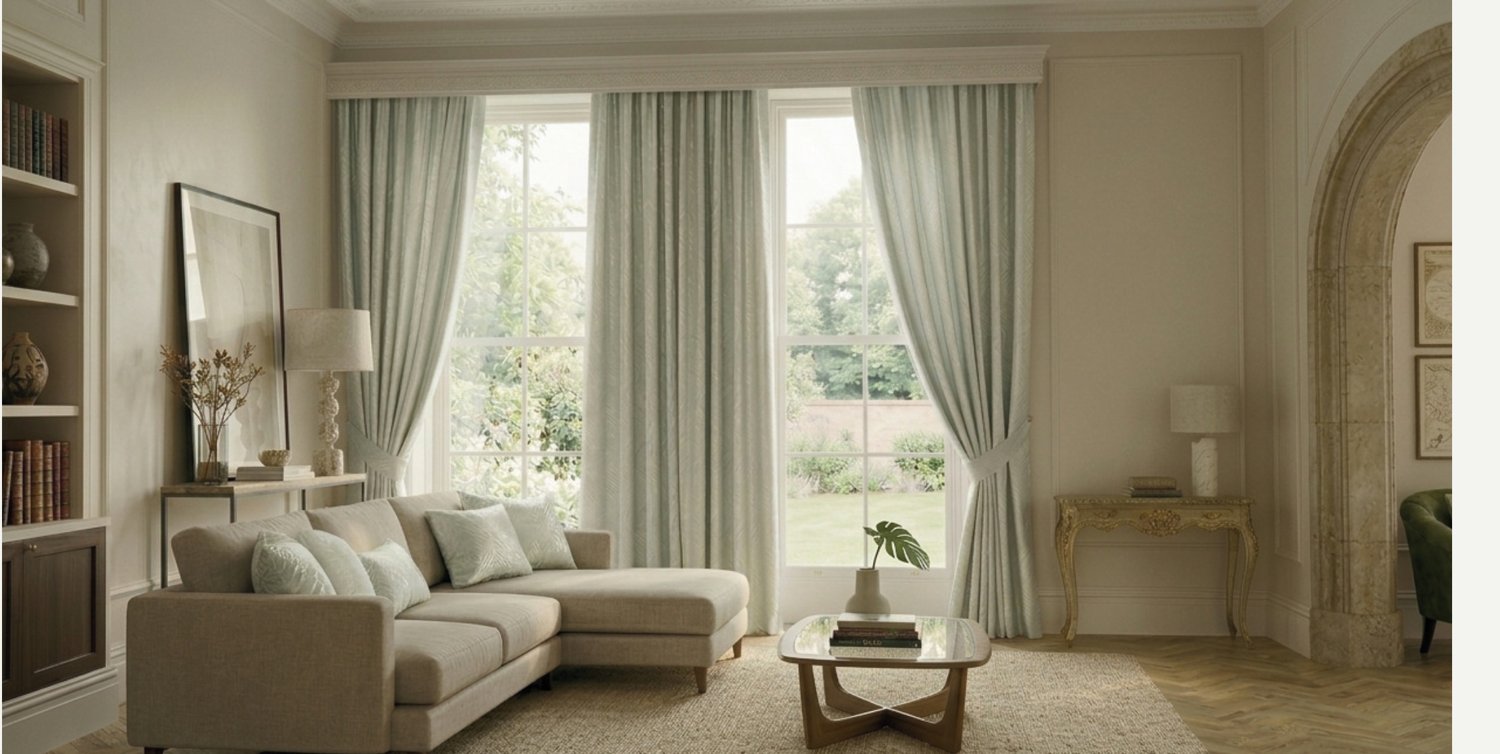
Almost every disappointing curtain we are asked to replace was not a bad fabric choice. It was a bad measurement. Curtains that stop short of the floor, that stack across the glass and steal the view, that hang thin because there is not enough cloth in them — these are arithmetic problems, not taste problems. The good news is that the arithmetic is simple, and getting it right is what separates window treatments that look tailored from ones that look bought off a shelf.
The golden rule: measure the track, not the window
This is the mistake behind most of the others. A curtain is made to fit its track, and the track should be considerably larger than the window. So the order is: decide where the track goes, fit or mark it, and only then measure.
As a starting point, mount the track about 15 cm above the window frame and extend it about 20 cm beyond each side. Taller and wider makes the window look bigger, lets the curtains park on solid wall rather than glass, and — in this climate — seals the opening properly against heat. If your ceiling allows, running the track to the ceiling or into a recessed curtain pocket is better still.
Measuring the width
Measure the full length of the track or pole, end to end, in metres. If the pole has finials, measure between them, not over them.
Then apply the fullness ratio. Fabric width is not track width — it is a multiple of it:
- 2.2–2.5× — pinch pleat, French pleat, wave. The tailored standard.
- 2× — acceptable minimum for most headings.
- 1.8–2× — flat panel or eyelet, where a flatter look is intended.
- Below 1.8× — avoid. This is what people mean when they say curtains look cheap.
So a 3 m track at 2.3× needs about 6.9 m of finished curtain width, split across a pair. Sheers often go higher, 2.5–3×, because the whole point of a sheer is the ripple.
Measuring the drop
Measure from the top of the track (or the underside of the curtain pocket, or the top of the pole ring's eye — whichever the curtain hangs from) down to the finished floor.
Then decide the finish at the bottom:
- Floating (1 cm clear): crisp, contemporary, easy to clean. Our default in Dubai villas.
- Breaking (1–2 cm long): softer, slightly traditional, forgiving of uneven floors.
- Puddled (5 cm+): dramatic, but it collects dust, complicates cleaning and can foul low-level AC returns. Use sparingly here.
Measure in three places — left, centre, right — for both width and drop. Villa floors and ceilings are rarely dead level, and a 2 cm variance across a wide window is common. Use the smallest drop so no panel drags.
Stack-back: the measurement nobody thinks about
When curtains are fully open, the gathered fabric occupies space. That is stack-back, and it runs roughly 15–25% of the track length depending on fabric weight, lining and heading.
On a 3 m track, that is 45–75 cm of bunched curtain sitting somewhere. If your track stops at the window edge, it sits over the glass — permanently blocking part of the view and the daylight you paid a premium for. If the track extends onto the wall, the curtain parks on plaster and the window opens fully. Interlined and blackout curtains stack fatter than sheers, so allow more.
Returns and overlap
Two small details that separate professional work:
- Returns: the curtain wraps back from the track end to meet the wall, typically 7–10 cm. Without a return you get a permanent light gap and, in summer, a heat gap.
- Overlap: a pair should cross in the centre by 5–8 cm rather than merely meeting. This is what makes blackout actually black.
Double tracks for sheer and blackout
Most Dubai rooms want two layers — a sheer against the glass, a blackout or dimout on the room side. That needs a double track, which needs depth: allow around 12–15 cm of projection from the wall, or a curtain pocket at least that deep. This has to be decided before ceilings are closed and painted, which is why window treatments belong in the first-fix conversation, not the last one. See our blackout and thermal curtain guide for the performance side.
The Dubai villa quirks that catch people out
- Floor-to-ceiling glazing. Beautiful, and unforgiving — there is no wall above to hide a track, so a ceiling-recessed pocket is usually the only elegant answer. Plan it early.
- AC grilles above the window. Extremely common, and they dictate track position. Never block a supply grille with a pelmet.
- Marble or stone sills that project. A projecting sill can push the curtain out at the bottom. Either clear it with a deeper track or run the curtain to the floor in front of it.
- Curved and angled walls. Common in Dubai architecture, and they need a bent track made to a template, not a standard straight one.
- Sliding doors to terraces. Track must extend well past the opening so the stack never obstructs the door in use.
- Handover villas with no pocket. If the developer left no provision, a well-detailed surface track with a slim pelmet is the honest fix — see our handover checklist.
A quick checklist
- Steel tape (never fabric), step ladder, someone to hold the other end.
- Track position decided and marked before measuring.
- Width = full track length. Drop = track top to finished floor.
- Three measurements each way; use the smallest drop.
- Fullness 2–2.5× the track width.
- Stack-back checked against the glass line.
- Returns and centre overlap allowed for.
- Double-track depth confirmed if layering.
- Floors finished? If tiling or timber is still to come, note it — it changes the drop.
When to hand it over
Measure yourself for a budget estimate, by all means. But for the final order, have it surveyed professionally — not because the maths is hard, but because responsibility should sit with whoever makes the curtains. When we measure, the fit is our problem; when a client measures, an error becomes an expensive conversation. Our measure is complimentary and takes under an hour for a typical villa, and we bring cuttings from all five collections so fabric and dimensions are settled in one visit.
Ready to measure up? Talk to our team — ELEVÉ measures, makes and installs curtains from our Al Qusais workshop.
Rather have it measured properly?
Book a complimentary measure. We survey every window, advise on tracks, linings and fullness, and return an itemised quotation.
Book a Consultation