In the last week of July, the villa is doing everything right — the AC is set sensibly, the doors stay shut, the filters were changed — and the bill still climbs. The reason is usually glass. In UAE homes, windows are responsible for something in the order of 20–40% of the total cooling load, and in a west-facing villa with generous glazing it sits at the top of that range. Curtains are usually treated as a decorating decision made at the end of a project. In this climate they are closer to building fabric, and specified properly they are one of the few soft furnishings that pay for themselves.
Why glass is the weak point
A wall in a Dubai villa is insulated. A window is not, or not nearly as well. Solar radiation passes straight through the glazing and is absorbed by floors, furniture and surfaces inside, which then re-radiate heat into the room — the greenhouse effect, happening in your living room at three in the afternoon. On top of that, the glass itself conducts heat inward, and the air immediately against it becomes a warm layer that drifts into the space.
Good glazing helps, but most villas here were not built with triple-glazed, low-E units, and replacing glass is expensive and disruptive. Window treatments are the practical intervention: a well-made, well-fitted curtain can reduce heat gain through a window by roughly a third, and the resulting drop in cooling demand over a Dubai summer is genuinely noticeable on a DEWA bill. It is also instant — measured one week, installed the next.
Blackout, dimout, thermal: what the words actually mean
Blackout
Blackout means total light exclusion. It is achieved either with a three-pass coated lining (a woven base with layers of acrylic foam, the middle one usually black) or with a separate blackout interlining sewn between face fabric and lining. Properly made, you cannot see your hand in front of your face at noon. Essential in bedrooms, media rooms and any room used by someone working shifts or sleeping through the morning.
Dimout
Dimout — sometimes sold as “room darkening” — cuts most light but allows a soft residual glow. Many clients prefer it in living rooms and majlis, where full blackout feels oppressive during the day. It still delivers most of the thermal benefit.
Thermal
Thermal describes insulation rather than light. A thermal curtain is dense, usually interlined with a soft bump or fleece layer, and its job is to slow the movement of heat. Here is the useful part: in practice, a properly built blackout curtain is a thermal curtain, because the very layers that stop photons also slow heat. You rarely have to choose between the two.
Solar-reflective and technical linings
For the harshest west and south-west elevations, reflective-backed linings bounce a portion of radiation back through the glass before it is ever absorbed. They are less about darkness and more about rejecting energy at the first opportunity, and they pair well with a decorative face fabric that carries the room.
The lining does the work — not the face fabric
This is the single most common misunderstanding. Clients often assume a heavy velvet blocks more heat than a linen. In reality the face fabric is largely aesthetic; the performance sits in what is behind it. A mid-weight linen with a three-pass blackout lining and an interlining will outperform an unlined velvet comfortably, and it will hang better, feel lighter and suit contemporary Dubai interiors far more naturally.
That is why we specify curtains as a stack rather than a single cloth: face fabric for the look, interlining for body, drape and insulation, and lining for light control and protection. Across our curtain and fabric collections — Aria, Luméra, Aurelia, Serein and Vespera — almost any face cloth can be built onto a blackout or thermal construction, so you are never forced to choose between the fabric you want and the performance you need.
Fitting: where most curtains fail
You can buy the best lining available and lose most of its benefit to a bad installation. Heat does not need much of a gap. The rules that matter:
- Go wider and higher than the window. Mount the track roughly 15 cm above the frame and extend it about 20 cm beyond each side. The curtain should seal against wall, not glass.
- Close the top. The gap above a curtain is a chimney — warm air rises out of it and pulls cool room air in at the bottom. A pelmet, a recessed curtain pocket in the ceiling, or a ceiling-fixed track kills that convection loop. In villas we specify a plastered curtain pocket wherever the ceiling allows; it looks cleaner and performs better.
- Use side returns. The curtain should wrap back to the wall at each end rather than stopping in mid-air. Returns are worth more than fabric weight.
- Leave a small air gap. Around 3 cm between fabric and glass. Still air is an insulator; fabric pressed against hot glass simply conducts.
- Run to the floor. Short curtains vent at the hem. Full-length, just brushing the floor, is both better looking and better performing.
- Overlap in the centre. A pair should cross by 5–8 cm at the middle, not merely meet.
Then use them: closing curtains on sun-facing elevations from late morning until the sun drops is where the savings actually accrue. This is exactly the behaviour that motorised tracks on a schedule automate away.
Layering: sheer by day, blackout by night
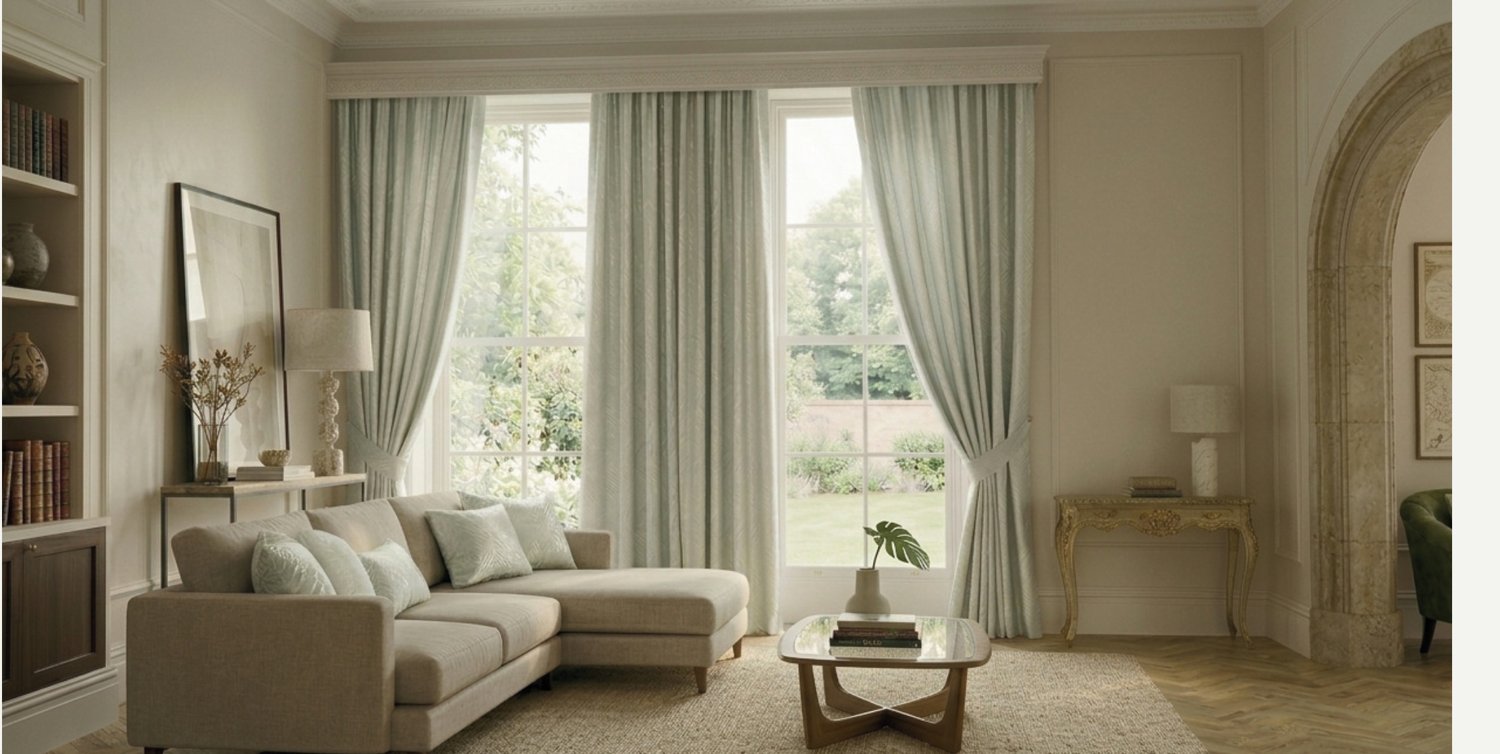
The arrangement that works best in Dubai homes is a double track: a sheer or textured voile on the window side, a blackout or dimout drape on the room side. By day the sheer diffuses hard light, cuts glare on screens, and gives daytime privacy without shutting the room down — and it takes the edge off direct radiation. By evening the heavy curtain closes for darkness, insulation and acoustic calm.
Aesthetically it is also the more generous look: two layers read as considered and hotel-like, where a single panel can look thin. Our guide to choosing curtains for Dubai homes goes deeper on headings, stack-back and proportion.
Room by room
- Master and guest bedrooms: true blackout, no compromise. Add the sheer layer for daytime use.
- Children's rooms: blackout, and cordless or motorised for safety. Worth it for daytime naps and early sunrises.
- Media and cinema rooms: blackout plus mass for acoustics — interlined, generously gathered. See home cinema design.
- Living rooms and majlis: dimout with a sheer. Preserve the daylight that makes the room feel good.
- West-facing anything: reflective-backed lining. This is the elevation that punishes you between 3pm and 7pm.
Fading, and why it matters here
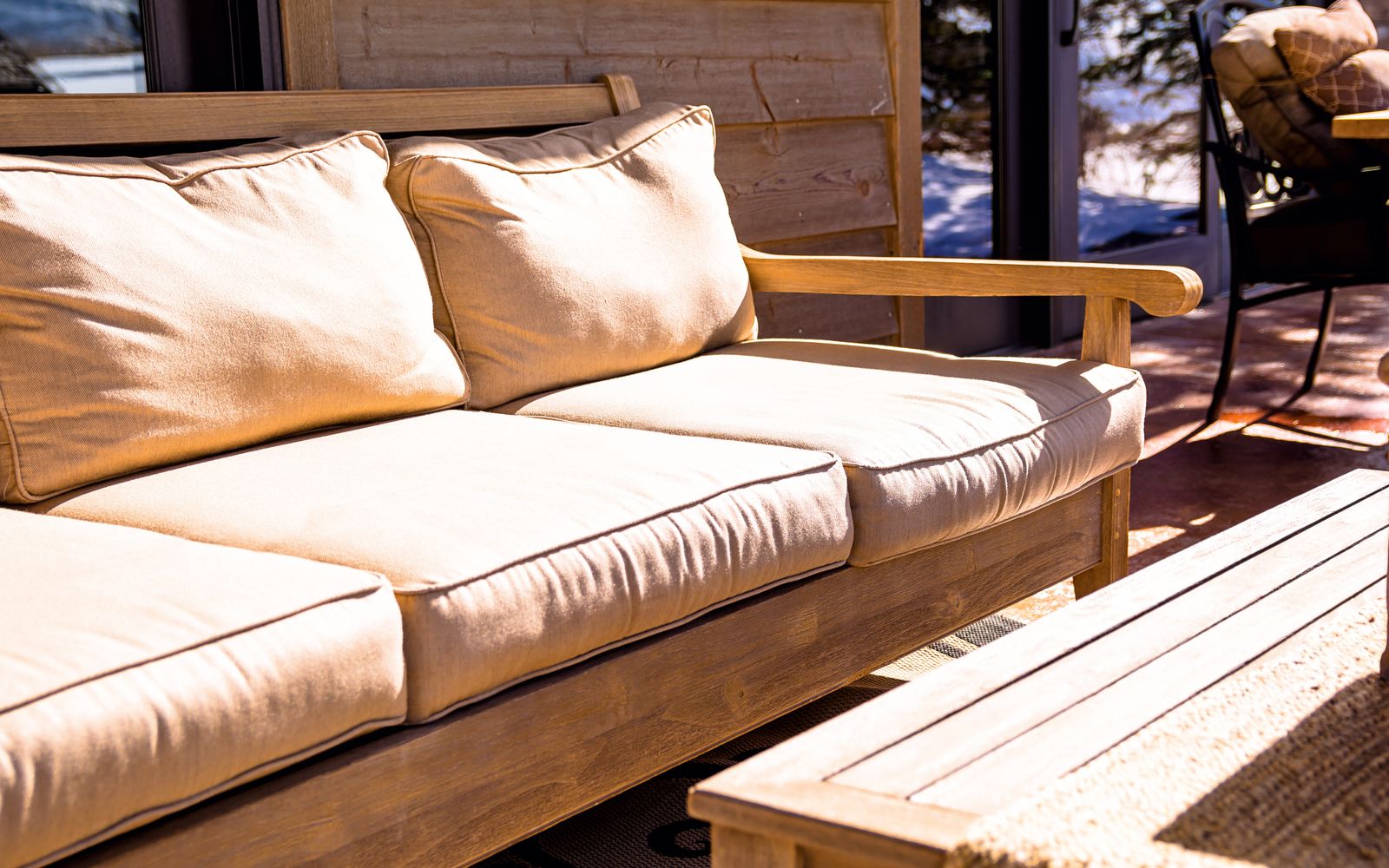
UV in the Gulf is unforgiving. It bleaches face fabrics, degrades stitching and, over years, embrittles the fibres of unlined curtains — and it does the same to sofas, rugs and timber behind the window. A quality lining is a sacrificial UV barrier: it protects the face fabric, and it protects everything in the room. If you have watched one arm of a sofa lighten while the other stayed true, you have seen the argument for lined curtains in physical form.
Choose solution-dyed or high-lightfastness cloths for the most exposed windows, and avoid deep saturated colours in direct sun unless you accept some drift over time.
What it costs
As a guide, made-to-measure blackout curtains including quality lining, track and installation run around AED 250–700 per square metre of finished curtain, depending on face fabric, heading style and whether interlining is used. In practice:
- Standard villa bedroom window: AED 1,800–4,500
- Large living-room glazing or sliding doors: AED 5,000–15,000
- Whole villa, 12–18 windows, sheers and blackouts on double tracks: AED 30,000–90,000
- Motorisation: add roughly AED 1,200–3,500 per track
Set against a cooling bill that runs from May to October, and against the furniture and joinery the linings protect, this is one of the more rational line items in a Dubai home.
The bottom line
Treat curtains as thermal equipment that happens to be beautiful. Specify the lining first and the face fabric second. Fit them wider and higher than feels necessary, close the gap at the top, wrap the returns to the wall, and run them to the floor. Layer a sheer for the day and a blackout for the night. Do that and the same villa, on the same thermostat setting, simply costs less to keep comfortable — and looks considerably better while doing it.
Planning window treatments before the worst of the summer returns? Talk to our team — ELEVÉ measures, makes and installs curtains from our Al Qusais workshop, with cuttings available from all five collections.
Considering blackout or thermal curtains?
Book a complimentary measure and consultation. We'll bring cuttings, advise on linings for each elevation, and return a full quotation.
Book a Consultation