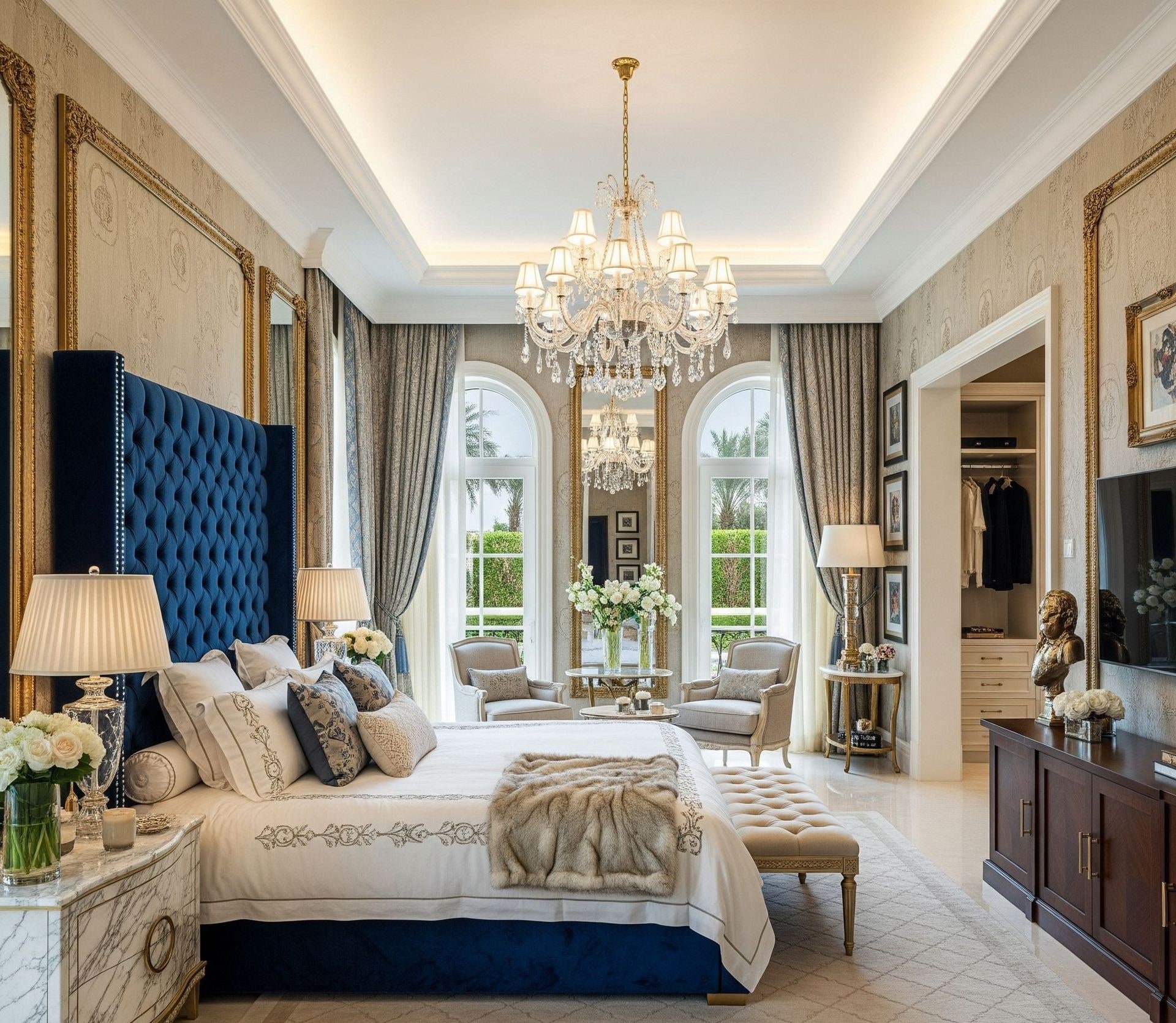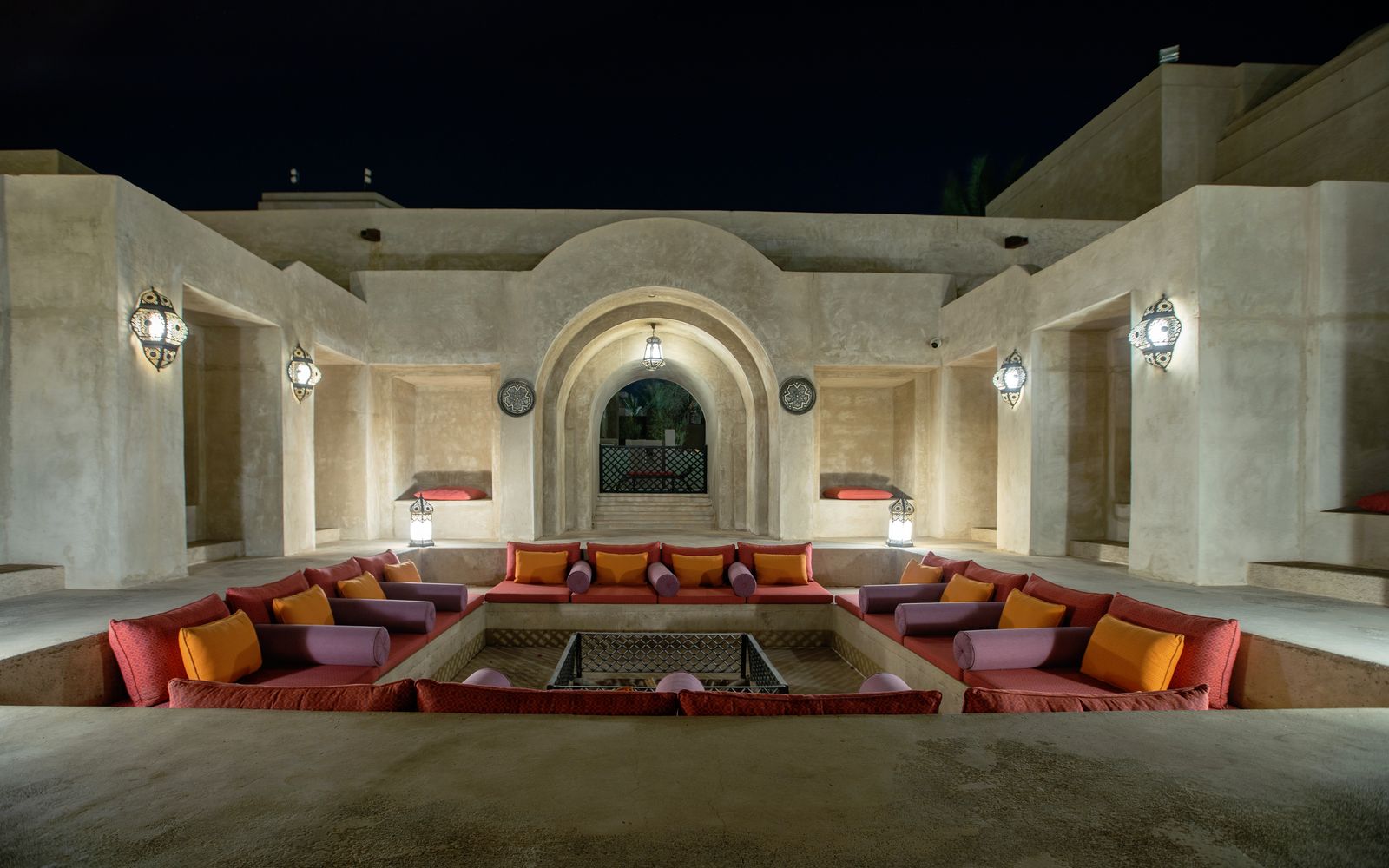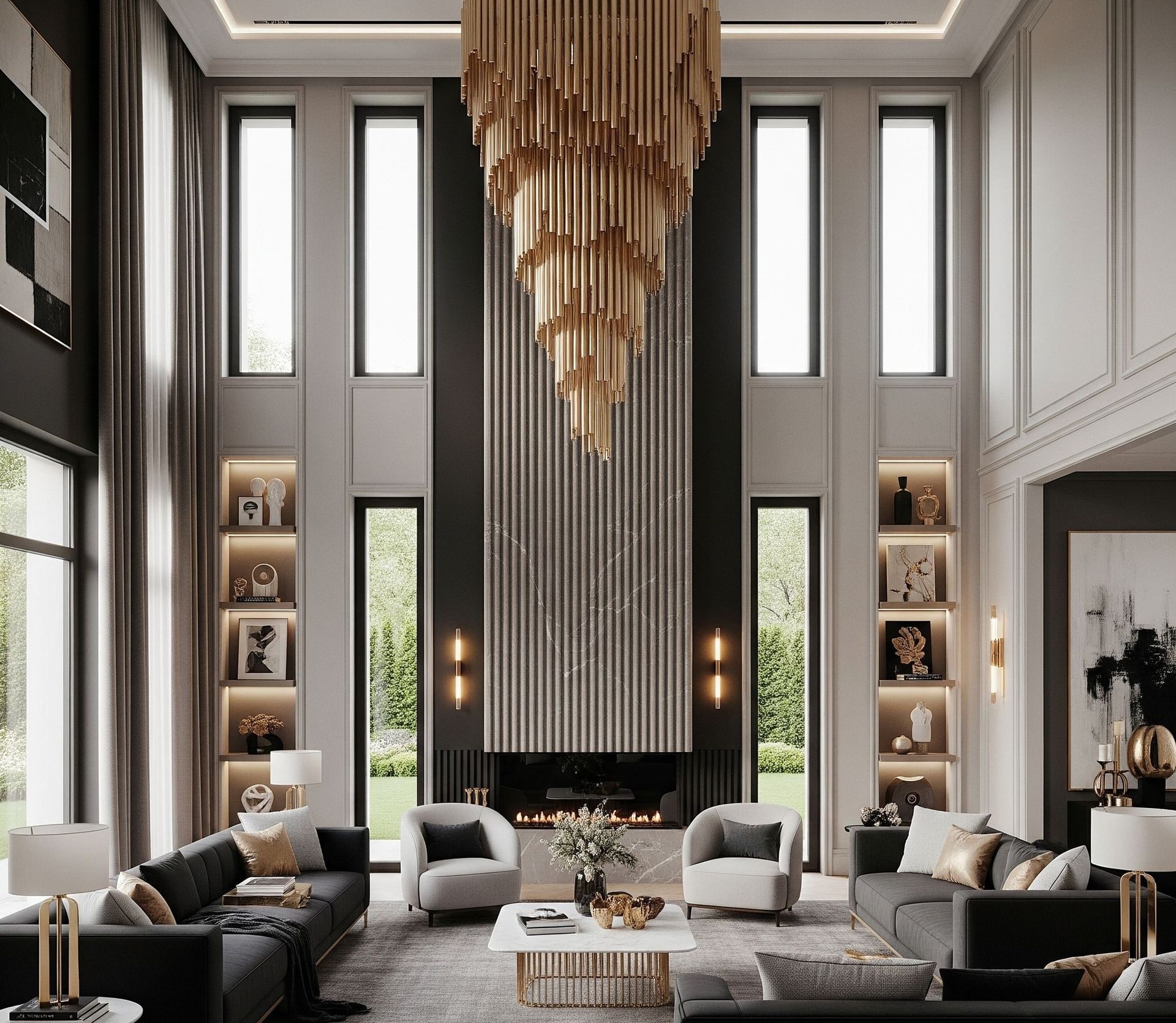
Almost every Dubai home is built on hard floors — porcelain, marble, engineered stone — for the entirely sensible reason that they stay cool and survive the dust. The side effect is a house that can feel acoustically hard and visually cold, particularly in the large-volume, high-ceilinged rooms that are standard here. A rug is the fastest, least disruptive correction available: it warms the room, absorbs the echo, defines a seating area in an open plan, and adds the texture that stone cannot. Provided it is the right size. Most are not.
Sizing: the rule almost everyone breaks
The commonest mistake in Dubai interiors is a rug that is too small — a modest rectangle floating in the middle of a large room with all the furniture standing off it on tile. It makes the rug look like a mat and the room look unresolved. Rugs should sit under furniture, not between it.
Living rooms and majlis
- Best: all legs of all seating on the rug, with 20–30 cm of rug visible beyond the furniture.
- Acceptable: front legs of every piece on the rug. This still ties the group together.
- Wrong: a rug that only the coffee table stands on.
- Practical sizes: a three-plus-two arrangement usually needs around 240 × 340 cm; larger villa living rooms want 300 × 400 cm or more. In a genuinely large majlis, custom sizing is often the only way to get it right — see our majlis layout guide.
Dining rooms
The rug must extend far enough that chairs stay on it when pulled out — allow 60–75 cm beyond the table edge on every side. A chair that catches its back legs on the rug edge every time someone sits down is a daily irritation, and it wears the binding. Flat-weave or low-pile only; chairs need to slide.
Bedrooms
- Rug under the bed extending 60–75 cm beyond each side and the foot — so feet land on wool, not cold stone.
- Or two runners, one each side of the bed, in a smaller room.
- Start the rug below the bedside tables rather than in line with the headboard.
Entrances and corridors
Runners should leave roughly 10–15 cm of floor visible on each side. Dubai corridors are often long; a single long runner reads better than several short ones.
Fibres, judged by this climate
Wool
The default, and deservedly. Resilient, naturally soil- and flame-resistant, comfortable underfoot, and it recovers from compression rather than flattening permanently. It also takes dye beautifully. New wool sheds for the first few months — normal, and it stops.
Silk and bamboo silk
Extraordinary lustre and the ability to shift colour with the light. Delicate, shows footprints, and vulnerable to strong sun. Best as an accent, in low-traffic rooms, away from direct light. Bamboo silk gives much of the sheen at lower cost but marks easily with water.
Cotton and flat-weaves
Light, washable, informal. Ideal for children's rooms and casual spaces; less luxurious underfoot and less acoustically useful.
Jute, sisal and natural fibres
Wonderful texture and very on-trend with 2026's natural-material direction. Two warnings for Dubai: they are unforgiving of moisture, so keep them away from bathrooms, terraces and anywhere damp; and coarse sisal is hard underfoot in a home where people are usually barefoot. A wool-jute blend is often the better compromise.
Solution-dyed synthetics
Much improved and genuinely useful here. Colour is locked into the fibre, so UV fading is minimal, and most can be cleaned aggressively or hosed down. The right answer for terraces, covered outdoor seating, pool areas, entrances and homes with young children or pets.
Construction: what you are paying for
- Hand-knotted — each knot tied individually to the warp. The most durable and most valuable construction; a good one lasts generations. Priced by knot density and materials.
- Hand-tufted — yarn punched into a backing with a tufting tool, then latexed and backed. Far quicker to make, so far more affordable, and available in any custom size, shape and colour. The practical choice for most contemporary schemes.
- Flat-weave / kilim / dhurrie — no pile, reversible, light. Excellent under dining tables and in layered arrangements.
- Machine-made — consistent and inexpensive. Quality varies enormously; the better solution-dyed versions are genuinely good value for high-traffic areas.
Custom, and why it matters here
Dubai villa rooms are frequently large and rarely standard — long open-plan living areas, circular or angled majlis, double-height spaces, awkward columns. Standard rug sizes stop at dimensions that suit European rooms, which is precisely why so many Dubai rugs look undersized. Commissioning custom lets you set the exact dimensions, shape a rug around a column or a curved wall, match a specific palette, choose pile height and specify the binding. For a room that has already been designed to the millimetre, it is the logical last step.
Care in a dusty, sunlit city
- Vacuum regularly and properly. Fine sand is abrasive and works to the base of the pile, where it cuts fibres from beneath. This is the main cause of premature wear in Dubai. Weekly, minimum.
- Rotate 180 degrees every six months — evens both traffic wear and sun exposure.
- Keep out of sustained direct sun, or fit sheers. UV fades rugs exactly as it fades upholstery; our window treatment guide covers the protection side.
- Use a felt or felt-and-rubber underlay. It prevents slipping on polished stone, extends rug life considerably, improves the feel underfoot and adds acoustic absorption. Never skip it on tile.
- Blot spills, never rub. Rubbing drives the stain into the pile and distorts the weave.
- Professional clean every 12–24 months, more often in a household with children or pets.
What it costs
- Hand-tufted wool, custom size: AED 900–2,200 per m².
- Hand-knotted: from about AED 2,500 per m², rising sharply with knot density and silk content.
- Machine-made / solution-dyed synthetic: AED 250–700 per m².
- A 3 × 4 m hand-tufted wool rug therefore typically lands between AED 11,000 and AED 26,000.
- Underlay: allow AED 60–150 per m². Do not omit it.
The bottom line
Buy the largest rug the room can take, not the one that fits the budget most comfortably — an oversized rug flatters a room and an undersized one shrinks it. Choose wool for principal rooms, solution-dyed synthetics where life happens, and keep silk for places it will be admired rather than walked on. Always use underlay, vacuum more often than feels necessary, and go custom when the room is not a standard shape — which, in a Dubai villa, it usually is not.
Looking for a rug sized to the room rather than to a catalogue? Talk to our team — ELEVÉ commissions custom rugs alongside our furniture and fabric collections.
Looking for a rug that actually fits?
Book a complimentary consultation. We source and commission custom rugs sized, coloured and shaped to your rooms.
Book a Consultation