A solid wood table is delivered in perfect condition. A few months later a fine crack appears along the top, a gap opens between two boards, or the dining chairs start to creak and wobble. The wood is not faulty. It is doing what wood always does: taking moisture from the air and giving it back. In Dubai, where homes swing between cool, dry air-conditioning and humid outside air, that movement is larger than most people expect. Here is what happens, and how to prevent it.
The short answer
Wood shrinks as it dries and swells as it takes up moisture, mostly across its width. Furniture cracks or loosens when that movement is blocked or happens too fast. Prevent it with timber kiln-dried to 8 to 12% moisture, construction that lets the wood move, a finish on every face, and sensible placement away from AC vents and direct sun.
How wood moves
Wood is made of long fibres that hold water. Even after drying, it keeps exchanging moisture with the air until it reaches a balance, the equilibrium moisture content. At around 22 to 24 °C, that balance is roughly as follows:
| Relative humidity | Wood settles at about | Where you might see it |
|---|---|---|
| 30% | 6% | A room right in front of a cold AC outlet, or a cooled room in winter |
| 45% | 8–9% | A typical well-run air-conditioned Dubai home |
| 65% | 12% | A home with the AC off for a few days in spring or autumn |
| 80% | 16% | A closed, un-cooled villa in a humid summer week, or a shipping container |
Furniture made at 8 to 12% sits comfortably in the middle of that range. Timber made up at 16% or more, which is common for air-dried or poorly stored stock, has a long way to shrink once it reaches a cool, dry living room.
As moisture content changes, wood changes size, but not equally in every direction. Along the grain it barely moves at all. Across the grain it moves a great deal, and more in the direction of the growth rings than across them. That is why tops split along their length and drawers stick across their width, never the other way round.
How much? Using published shrinkage figures for teak, a 90 cm wide flat-sawn teak top moves roughly 6 to 7 mm across its width for a 4% change in moisture content. Many common hardwoods move about twice as much. Teak’s stability is one of the main reasons it is so prized, and well-seasoned sheesham is also a stable wood for furniture, though it moves a little more than teak.
Why Dubai homes are hard on wood
Outside, coastal Dubai often sits at 50 to 90% humidity in summer. Inside, a well-run air-conditioning system can bring rooms down to 30 to 45%. Several things make it worse:
- AC vents blow cold, dry air straight onto whatever sits in front of them. One face of a table can dry much faster than the other, which causes cupping and splits.
- Strong sun through big windows heats one part of a piece while the rest stays cool.
- The summer away. When AC is switched off for weeks, indoor humidity can climb sharply; switched back on, the wood dries fast. Those swings are when joints loosen.
- New villas and fit-outs. Fresh plaster, screed and paint release moisture for months, so furniture delivered into a just-finished home sees a long drying period.
Our guide to furniture that lasts in Dubai’s climate covers the effect on fabrics, leather and metal too.
Why tops crack
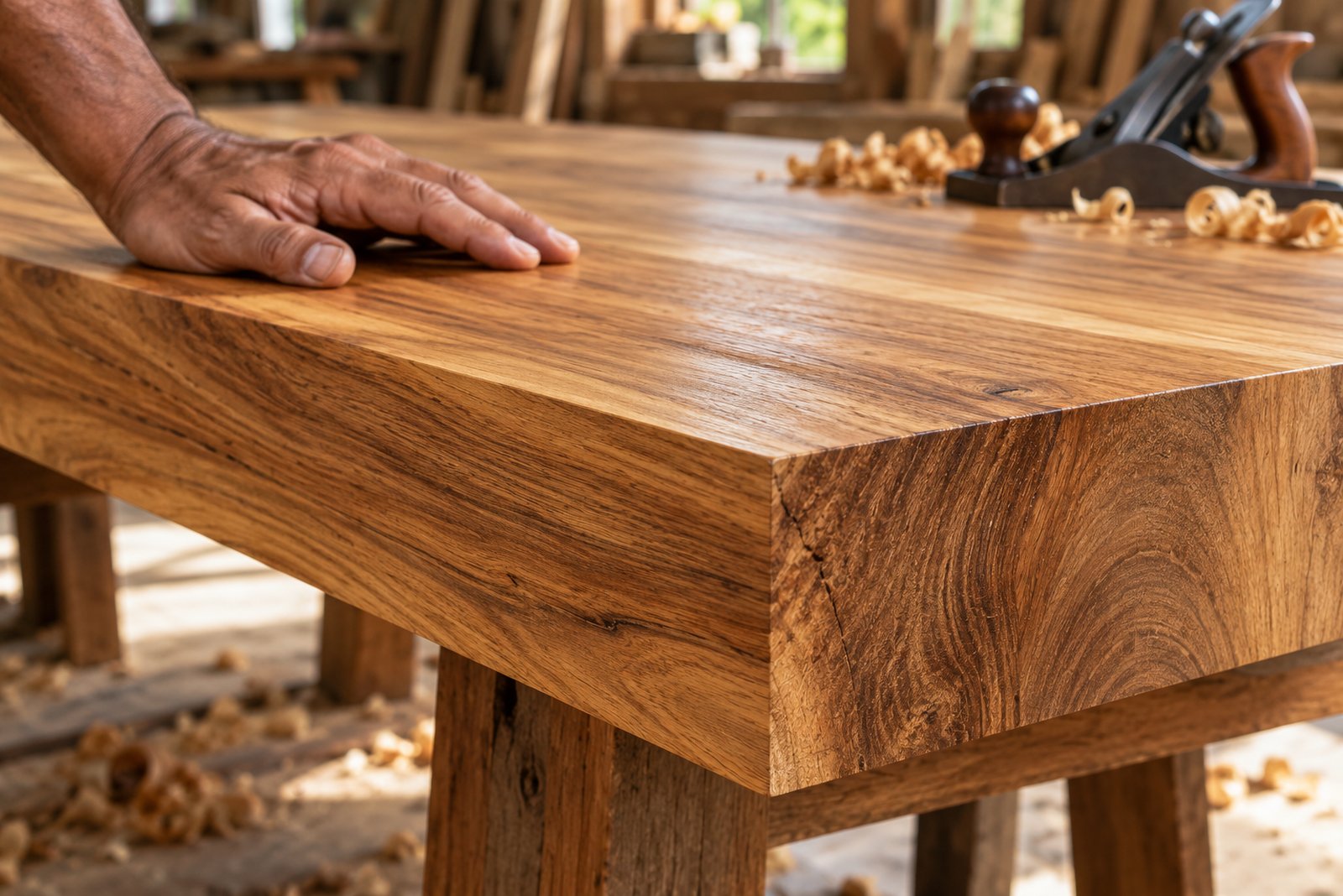
A solid top wants to shrink and swell across its width. If it is screwed rigidly to a frame along both edges, the frame holds it still while the wood tries to shrink. Something has to give, and the top splits, usually along a glue line or through a knot. Breadboard ends glued along their full length cause the same problem.
Timber that was not dried properly is the other common cause. Wood made up at 15 to 20% moisture keeps drying for months in an air-conditioned room, shrinking around 1.5 to 3% across its width as it goes, depending on the species. A board that leaves the workshop tight can open up a gap of several millimetres.
Why joints loosen
Chair and bed joints loosen through a quieter process. When a tenon swells inside its mortise, it presses against the surrounding wood and slightly crushes the fibres. When it shrinks back, it is now smaller than the hole, and the joint has play. A few cycles of humid and dry, combined with someone tipping back on two legs, and the chair begins to creak. Poorly dried timber, joints held only by screws, and glue that has failed on an oily wood surface all speed this up.
Reading the signs
Most movement problems announce themselves early. Catching them in the first few months makes the repair simple.
| What you see | Likely cause | What to do |
|---|---|---|
| Fine crack along the end of a top | End grain drying faster than the rest; unsealed ends | Seal the end grain; move away from vents and sun |
| Split along a glue line or through the middle | Top fixed rigidly to the frame while shrinking | Change to slotted fixings or buttons, then glue and refinish |
| Top curved like a shallow dish (cupping) | One face drying faster, often finish on one side only | Seal the underside; keep out of direct AC airflow |
| Gap opening between boards | Timber made up too wet, now shrinking | Leave a full season to settle, then fill or rejoin |
| Chair creaks or rocks | Joints compressed and loosened by humidity swings | Dismantle, clean and re-glue the joints |
| Drawers or doors stick in summer | Wood swelling when the AC is off | Run the AC; ease the drawer only once conditions are steady |
Prevention 1: properly dried timber
This matters more than anything else. All our solid teak and sheesham is kiln-dried to 8 to 12% moisture content and allowed to settle in the workshop before it is cut, close to the level it will reach in an air-conditioned home. A good maker will check moisture with a meter and will not hurry this step. Ask what moisture content the timber was dried to; if the answer is vague, be cautious.
Prevention 2: construction that allows movement
- Table tops fixed with wooden buttons, metal “figure-of-eight” fasteners or screws in slotted holes, so the top can slide across the frame as it moves.
- Narrower boards. A wide top made of several boards around 10 to 15 cm wide, with the growth rings alternated, stays flatter than a few very wide boards.
- Breadboard ends glued only at the centre and pinned through elongated holes elsewhere.
- Frame-and-panel construction for doors and bed panels, with solid panels left free to float in their grooves rather than glued in.
- Glued mortise and tenon or dowelled joints on chairs and beds, with corner blocks glued and screwed, rather than screws alone.
- Veneer on a stable core for very large flat panels such as wardrobe doors, where solid wood would move too much. Our guide to solid wood and veneer explains where each belongs.
You can see these details at each stage in our article on how bespoke furniture is made.
Prevention 3: finish every face
A finish does not stop wood exchanging moisture; it slows it down. What matters is that the slowing is even. A top lacquered on the upper face but bare underneath will dry faster from below and cup. Ask for the underside, the inside of rails and the end grain to be sealed as well as the visible faces. Lacquers slow moisture exchange more than oils, but an oiled piece that is re-oiled regularly copes well too.
Prevention 4: placement and habits at home
- Keep solid wood furniture at least 1 to 1.5 m from AC outlets, and angle louvres so the air does not blow directly onto it.
- Keep pieces out of strong direct afternoon sun, or use sheers and blinds.
- Aim for indoor humidity of about 40 to 55%. A cheap digital hygrometer shows you what your rooms are really like.
- When you travel in summer, leave the AC running at a higher setting rather than switching it off completely, so humidity does not climb and then crash.
- Re-tighten bed bolts and check chair joints a few months after delivery, then once a year. A slight settling in the first season is normal.
Moving into a new home or a newly fitted villa
New plaster, screed, tile adhesive and paint hold a surprising amount of water and release it for months. A new villa or a freshly renovated apartment can be noticeably more humid than it will be a year later, especially if the AC was not running during the works. Then, once the family moves in and the AC runs every day, the house dries out over the first summer.
- Run the AC for two to three weeks before solid wood furniture is delivered, so the house is closer to its long-term condition.
- Keep furniture covered and out of rooms where sanding, painting or grouting is still going on.
- Expect a little settling in the first season, and plan a check of bolts, drawers and doors after the first summer.
- Avoid storing furniture for weeks in an un-cooled warehouse or container before delivery; it can pick up moisture and then lose it again in your living room.
Teak and sheesham in air-conditioned rooms
Teak is our first choice where stability matters most: wide table tops, outdoor-to-indoor pieces and anything near large windows. Its natural oils slow moisture exchange and its shrinkage is low for a hardwood. Sheesham is dense, strong and the best value for strength, and once properly seasoned it is a reliable furniture wood in air-conditioned rooms. Its interlocked grain resists splitting, though it moves a little more than teak, so we pay particular attention to how wide sheesham tops are jointed and fixed. Oak and walnut are available on request where a client wants their grain, but they are not our everyday frame woods.
If a crack has already appeared
A fine surface check in the finish can often be polished out. A split through a top can usually be glued and clamped, or filled with a matching sliver of the same wood, then refinished. A loose chair joint should be taken apart, cleaned of old glue and re-glued; adding screws to a loose joint only hides the problem for a while. In every case, fix the cause too: change rigid fixings for slotted ones, or move the piece away from the vent.
The bottom line
Wood will always move. Good furniture is made from timber dried to the right moisture content and built so that the movement has somewhere to go, then finished evenly and placed with a little care. Do that, and a solid teak or sheesham table will stay flat and tight in an air-conditioned Dubai home for decades. Every piece of our bespoke furniture is made this way in our Al Qusais workshop.
Want solid wood furniture that stays tight and flat?
Visit our Al Qusais workshop to see how we dry, join and fix solid teak and sheesham, or send us your sizes for a quote with dimensioned drawings.
Book a Consultation