Trend previews written in January are guesses. This is the opposite — a mid-year review of what has genuinely defined the first half of 2026 across the villas, penthouses and majlis renovations we have designed and built from our Al Qusais workshop. Six months of client briefs, showroom conversations and completed handovers converge on seven clear directions. None of them are about a colour of the year or a single hero material. They are about how Dubai's most demanding homeowners now want to live — and about a decisive move away from the high-gloss, catalogue-imported look that defined the previous decade.
1. Bespoke and made-to-measure has overtaken imported furniture
The single loudest signal of 2026 is that made-to-measure is no longer the premium exception — it is the default request. The driver is geometric before it is aspirational. Dubai villas simply do not have the proportions that European catalogue furniture is designed for.
- Ceiling heights: 3.0–3.6 m in a typical villa reception, against the 2.4–2.7 m that off-the-shelf casegoods and wall units are scaled to. A 2.2 m imported wall unit leaves a metre of dead wall above it.
- Majlis wall runs: 7–11 m of continuous seating wall that no fixed sofa configuration fills without awkward gaps or a jarring join.
- Room widths: reception widths of 6–8 m that leave standard 2.4 m sofas marooned in the middle of the floor.
Clients have done the arithmetic on lead time and cost, and it favours local manufacture. A made-to-measure sofa or joinery run from a Dubai workshop lands in roughly six to ten weeks; the equivalent European import is commonly sixteen weeks or more once sea freight, customs and the summer shutdown of Italian ateliers are counted — and it still arrives sized for someone else's room. On landed cost, once shipping, duty and the strong-euro premium are included, bespoke is now at or below the imported alternative for comparable build quality. We covered the full comparison in our piece on Italian versus bespoke furniture in Dubai, and the mid-year reality has only sharpened the case.
What clients are actually commissioning: full-height media and display joinery, majlis seating built to the exact wall, dining tables sized to seat the family's real peak count rather than a nominal eight, and dressing rooms engineered around the specific wardrobe. The finish and hardware expectations have risen in step — see our detailed guide to high-end bespoke furniture materials and finishes in Dubai for how those specifications are being written this year.
2. Warm, earthy, quiet-luxury palettes and honed natural stone
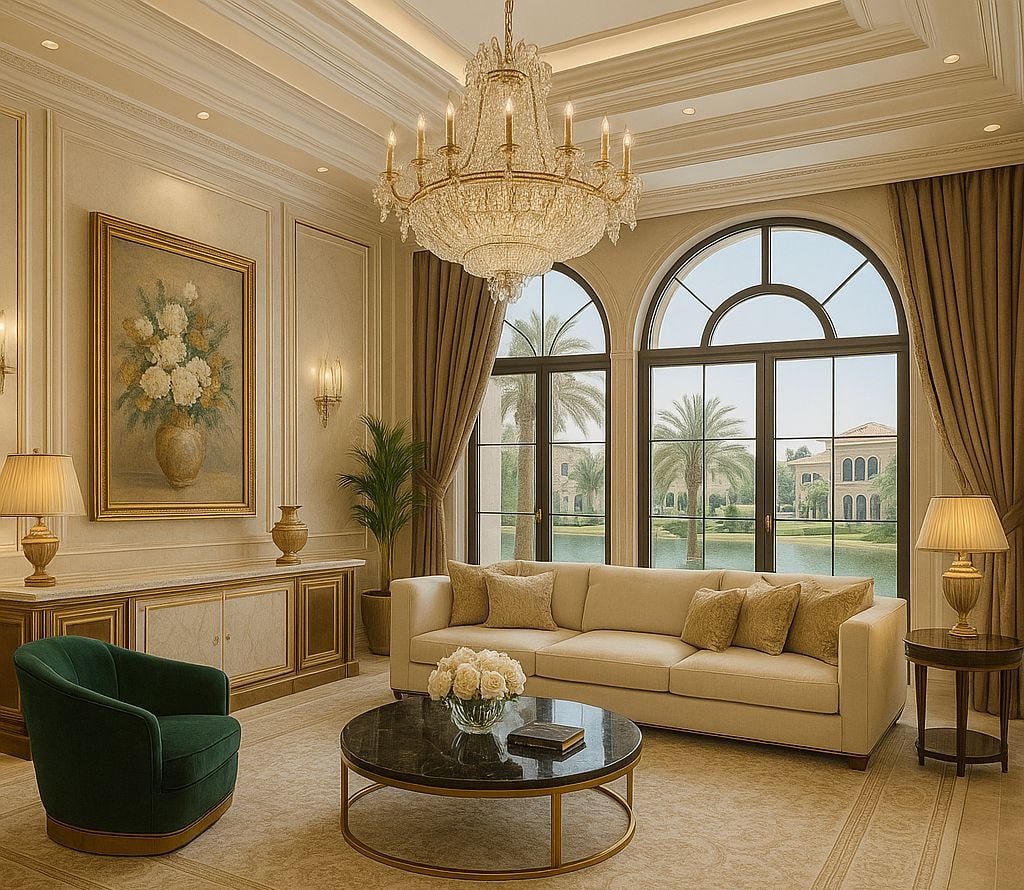
The cool grey-and-white, high-gloss palette that dominated Dubai interiors through the late 2010s is, at the mid-point of 2026, comprehensively out. What has replaced it is warm, tonal and tactile — a quiet-luxury sensibility where richness is read by the hand as much as the eye.
- Palette: putty, oat, clay, mushroom, warm taupe and soft terracotta, layered tone-on-tone rather than contrasted. Off-blacks and deep bronzes for grounding instead of pure black.
- Stone: honed and leathered finishes have overtaken mirror-polish. Warm travertine, cross-cut and vein-cut, is the material of the year; alongside it, honed Emperador, Breccia and warm-toned quartzites. Polished white marble as a whole-room statement now reads as dated.
- Metals: brushed and PVD-coated brass and bronze, satin nickel — matte, warm, fingerprint-forgiving — replacing the mirror chrome and rose-gold of the previous cycle.
- Textiles and walls: bouclé, heavy washed linen and wool in upholstery; lime plaster, micro-cement and fine Venetian polished plaster on walls in place of flat paint.
There is a climate logic underneath the aesthetics. Honed and leathered stone hides the etching and water-spotting that Dubai's hard water and 50°C-plus summer humidity swings inflict on polished surfaces; matte brass does not show every fingerprint in strong Gulf daylight; warm tone-on-tone schemes read as calm rather than clinical in rooms that receive intense, high-angle sun for most of the year. Quiet luxury here is not only a look — it is a set of materials that ages gracefully in this specific climate.
3. The majlis, reinterpreted with restraint
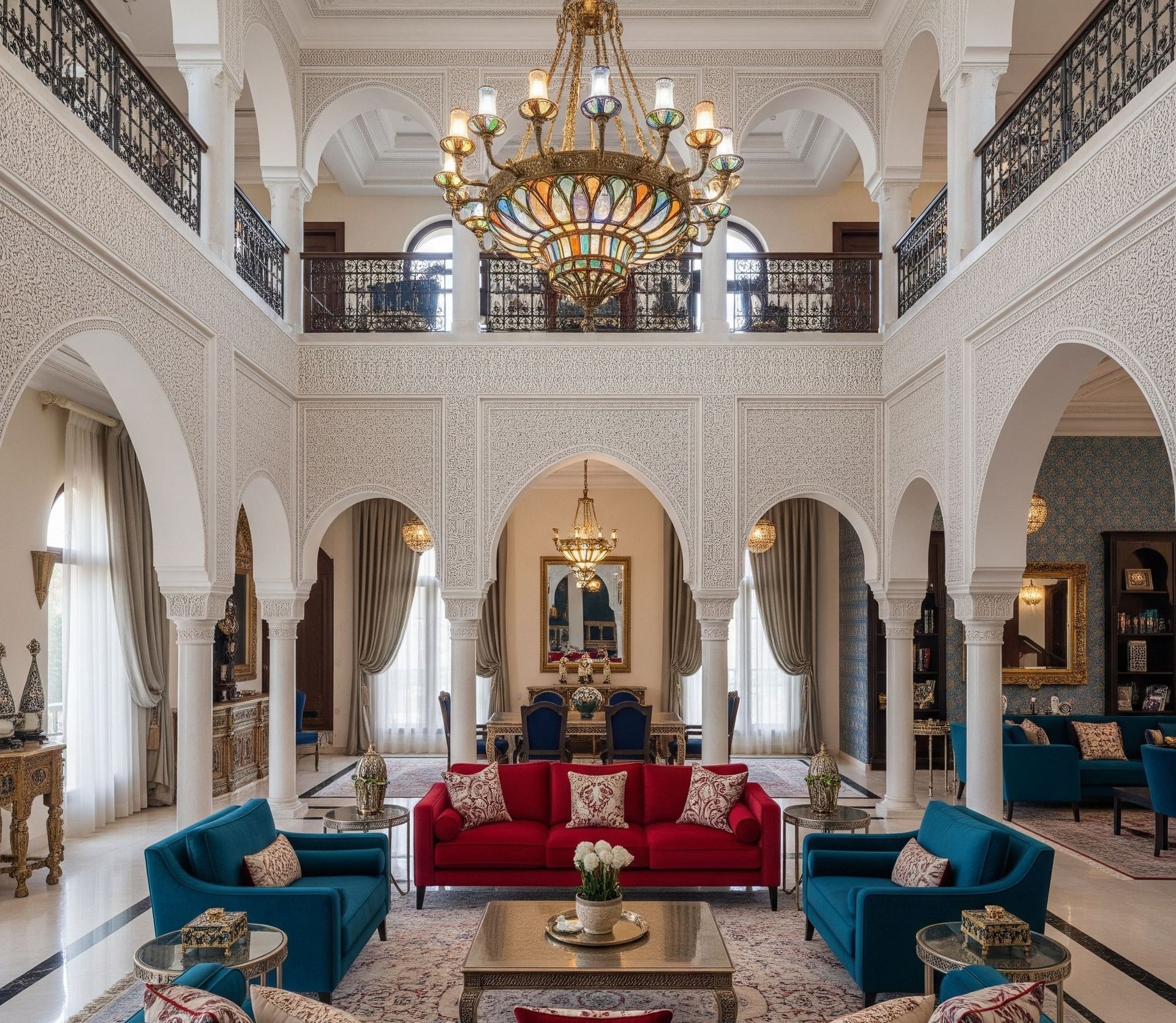
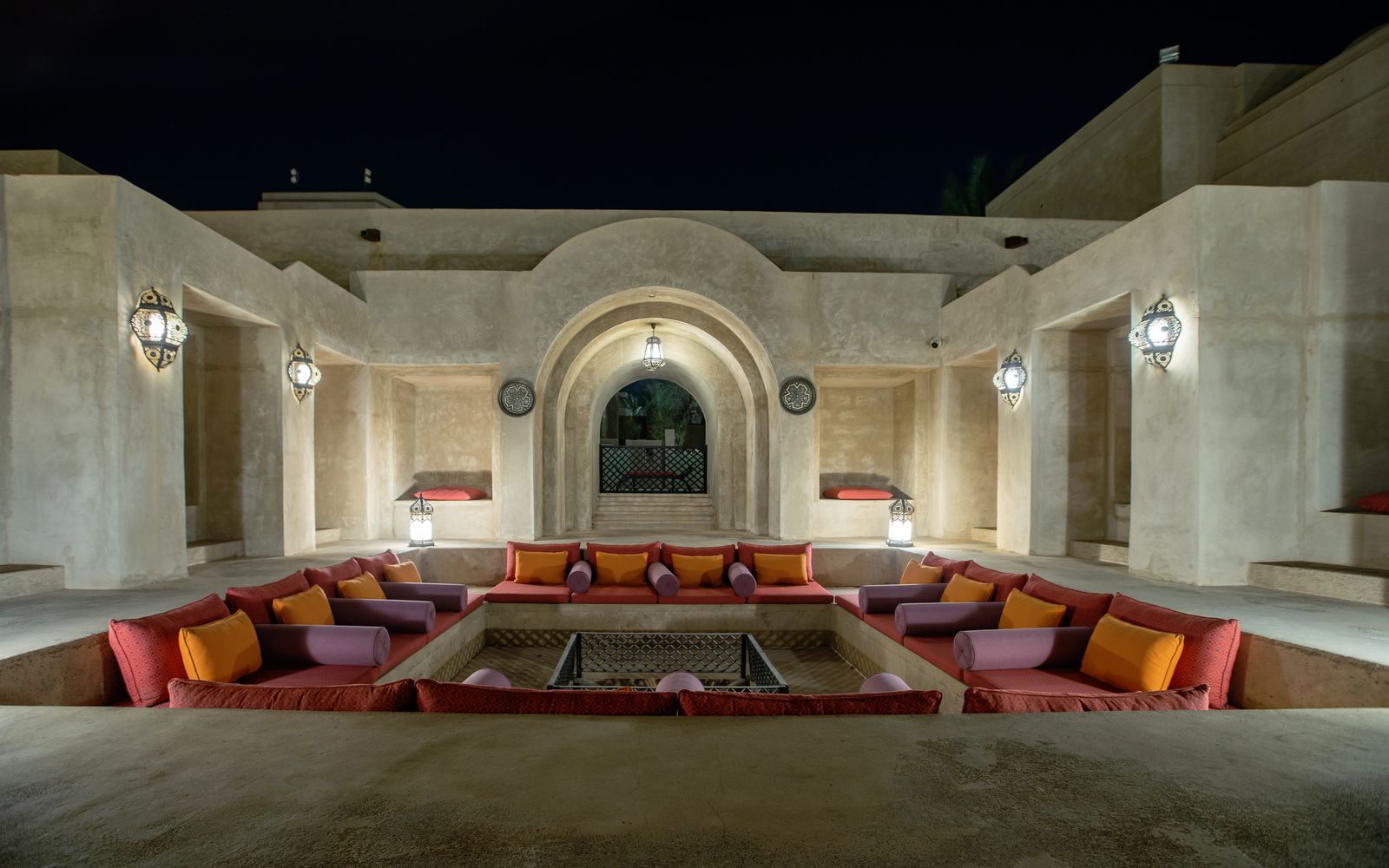
The majlis remains the non-negotiable heart of the Emirati and wider Gulf home, but the way it is being designed in 2026 has shifted decisively. The heavily gilded, fully-ornamented, wall-to-wall carved majlis is giving way to a restrained interpretation — heritage cues held in concentration against a calm contemporary backdrop.
- Layout: cleaner perimeter and dual-U arrangements sized to the family's genuine peak hosting count, with generous circulation rather than seating crammed to every wall.
- Heritage in concentration: one carved-gypsum or fluted-timber feature wall, one considered mashrabiya screen or calligraphy panel — not ornament distributed across every surface.
- Seating: deeper, lower, more comfortable modern majlis seating (seat depths of 90 cm and above) built to the wall, upholstered in the warm tonal palette rather than heavy jewel-tone brocade.
- Lighting: layered and scene-based in place of a single ornate central chandelier doing all the work.
We set out the plan-by-plan thinking behind this in our guide to majlis layouts for modern Dubai villas. The mid-year pattern is that clients want the room to read unmistakably as a majlis — culturally rooted, built for real hosting — while looking as considered and contemporary as the rest of the villa. Restraint, not more decoration, is now the marker of a serious majlis.
4. Dedicated wellness rooms — the home gym, spa and sauna
Through the first half of 2026, a dedicated wellness suite has moved from a nice-to-have to a standard line item in the villa brief. Where three years ago a treadmill in a spare bedroom sufficed, clients now commission a properly designed home gym, and increasingly a spa zone with sauna, steam and cold plunge alongside it.
- The home gym: engineered flooring (rubber or cushioned-timber systems rated for dropped Olympic loads), 2.7 m-plus clear ceiling height for overhead lifts, full-wall mirror, dedicated high-capacity cooling, and mechanical ventilation sized for exertion rather than domestic occupancy.
- The spa: Nordic-style saunas in Alpine spruce or Canadian hemlock, steam rooms in warm stone, and cold-plunge units — the contrast-therapy triad has become a genuine mid-2026 request rather than an outlier.
- Finishes: the same warm, tactile palette as the main house — honed stone, timber, soft indirect light — so the wellness suite reads as part of the home, not a clinical annexe.
The specification detail matters here more than in almost any other room, because heat, humidity and structural loads are all in play. Our dedicated guide to home gym and spa design in Dubai covers the ventilation, waterproofing and material choices that separate a wellness room that lasts from one that fails within a couple of Dubai summers.
5. Biophilic and indoor–outdoor living
Bringing nature in, and blurring the line between inside and out, has been one of the most consistent threads of the first half of the year — adapted intelligently to a climate that is hostile to greenery for a third of it.
- Structural planting: internal planted courtyards, double-height green walls and specimen trees in reception voids, all on managed irrigation and grow-lighting so they survive independent of the outdoor season.
- Natural material as biophilia: where live planting is impractical, the biophilic instinct is satisfied through material — solid and veneered timber, natural stone, rattan and natural fibre, water features, and daylight brought deep into plan.
- Indoor–outdoor thresholds: full-height sliding and pocket glazing onto shaded terraces, with the same flooring run inside and out and a level threshold so the reception reads as continuous with the garden. The shaded, mistered, ceiling-fanned terrace is now designed as a genuine second living room, used through the cooler two-thirds of the year.
The mid-year nuance is that Dubai biophilia is climate-realistic. It is less about maximising exposed glass — which drives cooling loads to punishing levels — and more about controlled daylight, mature internal planting on proper irrigation, and natural materials that carry the feeling of nature indoors even when 50°C outside makes the real thing unusable.
6. Circadian and app-free, scene-based smart lighting
Lighting is where the smart-home conversation has matured most visibly this year. The novelty phase — colour-changing strips controlled from a phone app — has passed. What the 2026 luxury client wants is circadian and scene-based: light that supports the body clock and is operated without ever reaching for a device.
- Circadian tuning: tunable-white fittings that shift automatically from a crisp, cooler 4000K in the morning to a warm, restful 2200–2700K by late evening, tracking the day to support sleep and alertness — particularly valued in a city where residents move between fierce daylight and deeply air-conditioned interiors.
- Scene-based, app-free control: elegant engraved keypads (Lutron, Basalte and equivalents) replacing banks of plate switches. One press for “Welcome”, “Dining”, “Majlis” or “Goodnight”. The phone app exists as a fallback, not the daily interface.
- Quality of light: CRI 90-plus throughout, glare-controlled recessed detailing, and layered cove, accent and decorative light so no single fitting is overworked.
The through-line is that technology should disappear into the architecture. The most sophisticated systems we have specified this year are the ones a guest never notices as technology at all — the light simply feels right at every hour, and a single keypad press resets the whole room.
7. Sustainability — durable, repairable pieces built to last
Sustainability in the Dubai luxury context has, in 2026, become refreshingly concrete rather than a marketing veneer. It is expressed as longevity: solid, repairable, made-to-last furniture instead of fashion-cycle pieces destined for landfill.
- Solid construction: kiln-dried hardwood frames, mortise-and-tenon and dowelled joinery, and high-resilience foam at 45 kg/m³ and above that holds its shape for years rather than sagging within eighteen months.
- Repairable by design: removable, replaceable upholstery covers; seat cushions that can be refilled; timber that can be sanded and re-finished rather than binned. A piece built this way is re-covered a decade on, not discarded.
- Responsible materials: FSC-certified timber, low-VOC finishes and water-based adhesives — the last of which also matters for indoor air quality in sealed, heavily air-conditioned Dubai homes.
- Local manufacture: building in Al Qusais rather than shipping from Europe cuts the freight-and-packaging footprint of every commission — a quieter sustainability gain that also underpins the shorter lead times driving trend one.
The mid-year mood is that the most sustainable and the most luxurious choice have converged on the same object: a well-made, solid, repairable piece that is still in the room in twenty years. Disposability has quietly become the opposite of luxury.
What ties the seven together
Read as a set, the H1 2026 trends are not seven unrelated fashions. They point in one direction: away from imported, glossy, disposable and generic, and toward bespoke, warm, tactile, healthy and enduring. The Dubai luxury home at the midpoint of 2026 is quieter, more comfortable, more rooted in both its culture and its climate, and built to last. It is furniture and architecture designed for how a family actually lives across a Dubai year — not for how a room photographs on the day it is handed over.
If you are planning a villa, penthouse or majlis project for the second half of 2026 and want these directions translated into a concrete design and specification, our team handles full interior design, bespoke manufacturing and joinery from our Al Qusais workshop. You can also explore the full range of what we do on our services page.
Bring 2026's best ideas home
Book a complimentary consultation and we'll translate this year's defining trends — bespoke joinery, warm stone palettes, a reinterpreted majlis and built-in wellness — into a considered design and budget for your villa, returned within two weeks.
Book a Consultation